Table of Contents
Tempered glass is usually the better home gym mirror when you want a crisp reflection that stays flat and resists everyday scratches. Acrylic makes more sense when low weight and shatter resistance matter more than perfect image quality. It is easier to handle, but a thin sheet on an uneven wall can turn a straight barbell into a wavy line.
That is the short answer. The room may change it.
A quiet workout area in a spare bedroom has different risks from a tight garage where plates, bars, and adjustable benches move within inches of the wall. Before ordering anything, look at the training setup, the condition of the wall, and who uses the space.
Tempered Glass vs. Acrylic Gym Mirrors at a Glance
| What matters | Tempered glass mirror | Acrylic mirror | Better choice |
|---|---|---|---|
| Reflection | Sharp and consistent across a large panel | Clear when mounted flat, but more prone to waviness | Tempered glass |
| Impact behavior | Stronger than regular glass but can still break | Resists shattering and does not produce sharp glass fragments | Acrylic |
| Surface scratches | Harder to scratch during normal cleaning | Scratches more easily and needs gentler care | Tempered glass |
| Panel weight | Heavy and usually a two-person lift | Much lighter and easier to move | Acrylic |
| DIY installation | Requires careful lifting and substantial support | Easier to lift and cut, but needs a very flat backing | Acrylic for handling |
| Wall preparation | Rigid panel, though the wall must still be sound and level | Irregularities can show as waves in the reflection | Tempered glass |
| Purchase price | Varies widely; standard panels may cost less than custom acrylic | Thin tiles are cheap, but quality large sheets may not be | Depends on size |
| Installed cost | Often higher because of weight, delivery, and labor | Often lower to handle, but a rigid backer can add expense | Depends on the wall |
| Cleaning | Tolerates routine mirror cleaning well | Needs plastic-safe cleaner and a soft cloth | Tempered glass |
| Long-term appearance | Usually holds its clarity well | May show scuffs, bowing, or distortion if poorly supported | Tempered glass |
| Best setting | Permanent indoor gym with a protected mirror wall | Family gym, rental, lightweight wall, or higher impact risk | Depends on the room |
For most finished home gyms, tempered glass gives the better workout reflection. Choose acrylic when the consequences of broken glass or a heavy installation outweigh the small loss in optical precision.
What Are You Actually Comparing?
A tempered glass mirror starts with glass that has been heat-treated to make it stronger and change the way it breaks. The reflective coating is applied as part of the manufacturing process. If the glass fails, it is designed to fracture into smaller pieces instead of the long, sharp shards associated with ordinary annealed glass.
Tempered does not mean unbreakable. It also does not mean the broken pieces remain attached to the wall. A safety-backed gym mirror has a film on the rear that helps retain fragments after breakage. Tempering and safety backing solve related problems, but they are not the same feature.
Ask the seller exactly what the product includes. “Safety mirror” is too vague by itself. The Safety Glazing Certification Council explains that certified safety glazing carries a permanent mark tied to the standard it meets. Local code may not treat a home gym wall like a door or shower enclosure, but a clear product specification still gives you more useful information than a marketing label.
An acrylic mirror uses a PMMA plastic sheet with a reflective coating. It is often called a plexiglass mirror, although Plexiglas is a brand name. Acrylic is light, easy to fabricate, and far less likely to create a pile of sharp fragments after an impact. Plaskolite’s acrylic mirror product information describes the material as not shattering into sharp-edged pieces like glass.
It can still crack, chip, gouge, or pull away from a bad mounting surface. “Shatter-resistant” is more honest than “indestructible.”
Hasipu also explains how glass selection, reflective coating, backing, and inspection fit together in its guide to how mirrors are made.
Tempered Glass Mirrors: Advantages and Drawbacks
The biggest advantage of tempered glass is the view. It stays rigid across a large area, so the reflection is more dependable from the front, side, or across the room. This matters when you are trying to judge the angle of a bar rather than checking your hair before a workout.
Glass also has a hard face that stands up well to regular cleaning. Chalk dust and fingerprints are less likely to leave permanent marks when they are removed with a clean cloth. A quality panel can remain clear for years without developing the surface haze sometimes seen on heavily cleaned plastic.
Its main advantages are:
- crisp full-body reflection at normal training distances
- strong scratch resistance
- better dimensional stability across large panels
- a polished, permanent appearance
- easier everyday cleaning
The drawbacks become obvious during delivery and installation. Glass is heavy, difficult to maneuver through stairs or narrow doors, and unforgiving when an exposed edge strikes a hard surface. It needs dependable support, and a large panel may require professional installation.
Tempered glass can still break. A tempered panel also costs more to ship safely than a light plastic sheet, and custom holes or cutouts must normally be planned before tempering. Once the glass has been tempered, it cannot be casually trimmed on-site to correct a measuring mistake.
Acrylic Mirrors: Advantages and Drawbacks
Reflection Quality: Glass Wins, but the Wall Has a Vote
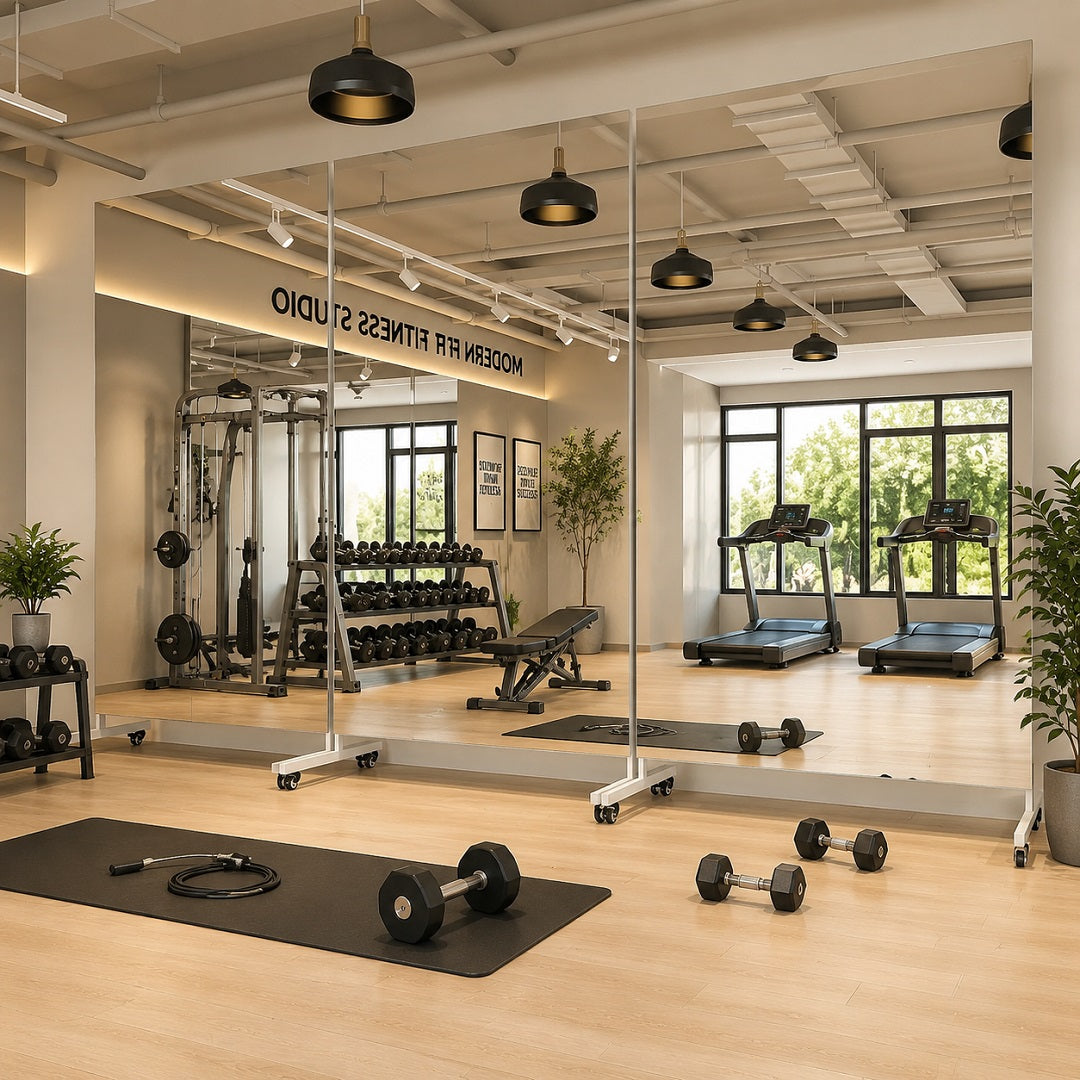
Form checks are the main reason to install a mirror wall in a home gym. A mirror should let you judge squat depth, shoulder position, balance, and alignment without making your body or equipment look stretched.
Glass performs well because it is rigid. A properly made glass panel stays flat across a broad area, so vertical rack posts remain vertical and a bar looks straight from end to end. It also keeps that crisp surface after years of normal cleaning.
Acrylic can give a clean reflection. The trouble starts when the sheet flexes.
Drywall often looks flat until a reflective plastic sheet is attached to it. Joint compound, bowed studs, textured paint, or a few uneven adhesive spots can pull the material into shallow curves. Those curves become visible from several feet away. A technical acrylic mirror installation manual warns that a non-flat support causes localized bending and distortion, and recommends a smooth, rigid backing for the best result.
Panel size and thickness matter too. A cluster of inexpensive peel-and-stick tiles may look acceptable from arm’s length, then show broken lines and mismatched angles from your lifting position. Larger, thicker acrylic panels supported across the full back generally look better than thin flexible squares.
Here is a useful test before you buy acrylic: stand six to ten feet from the planned wall and look across it with a long level or straightedge. If the surface dips or rolls, prepare the wall or mount the sheet to an appropriate flat backer. Do not expect adhesive to correct the wall.
Which Mirror Is Safer Around Weights?
Scratches, Cleaning, and Daily Gym Mess
Glass is more forgiving when the room gets dusty. Chalk, fingerprints, sweat mist, and rubber debris can be cleaned from it with a soft microfiber cloth and a mirror-safe cleaner. The surface is difficult to scratch through ordinary care, although the reflective backing and exposed edges still need protection from liquid runoff.
Acrylic needs a lighter hand. Dry dust rubbed across plastic can leave fine marks. Paper towels may also create hairline scratches over time. Use a clean microfiber cloth with mild soap and water or a cleaner specifically approved for acrylic. Avoid ammonia, abrasive pads, scouring powders, and solvent-heavy sprays unless the manufacturer says the product is compatible.
Spray the cloth rather than the mirror. This limits runoff at the edges and keeps cleaner away from the backing and mounting system.
An abrasion-resistant acrylic coating is worth asking about in a busy gym. It does not turn plastic into glass, but it may help the surface tolerate routine wiping and accidental contact better than an uncoated sheet.
Installation Is Where Good Mirrors Go Wrong
A large glass mirror is heavy and awkward, even before you are standing on a ladder or lining up two panels. A common gym installation uses a bottom support channel or clips, mirror-compatible mastic, and additional mechanical retention specified for the product and wall. The exact method depends on panel size, substrate, edge treatment, and local requirements.
Do not substitute general construction adhesive. Some adhesives can attack the mirror backing, show through the face, or fail to accommodate movement. Follow the mirror manufacturer’s instructions and use fasteners rated for the actual wall—not just the weight printed on the box.
Acrylic feels easier because one person may be able to carry the sheet. The mounting surface still demands careful preparation. The sheet needs even support without high spots that telegraph through the reflection. Acrylic also expands and contracts more than glass, so the installation method must allow the movement specified by its manufacturer.
Large panels are not a good place to improvise. Hire a local glass or mirror installer when the panel is difficult to control, outlets require cutouts, the wall is uneven, or the mounting instructions are unclear. A professional measurement can also prevent a seam from landing directly in the middle of the rack—the exact spot where you will notice it during every set. Owners of Hasipu mirrors can check the matching instructions in the Hasipu user manual library before mounting.
Does a Garage Change the Answer?
Cost: Compare the Finished Wall, Not the Sheet
| Cost area | Tempered glass | Acrylic |
| Mirror panel | Standard sizes can be competitively priced; custom tempering and edge work add cost | Thin sheets are inexpensive; large mirror-grade or coated sheets can cost more |
| Delivery | Higher risk of breakage and more demanding handling | Lighter, easier to ship, and less vulnerable to shattering |
| Installation labor | Often a two-person or professional job | More approachable for DIY installation |
| Wall preparation | Needs a sound, level wall and strong support | May need a perfectly flat rigid backer to avoid distortion |
| Hardware | Heavy-duty channel, clips, anchors, or an approved mounting system | Lighter hardware may work, but compatibility and expansion still matter |
| Maintenance | Low routine cost and good scratch resistance | Special cleaner is inexpensive, though damaged sheets may need earlier replacement |
| Long-term value | Strong when clarity and permanent installation matter | Strong when low weight and reduced glass-breakage risk matter |
U.S. retail prices vary widely even among panels with similar dimensions. Sales, marketplace sellers, thickness, safety backing, and included hardware can reverse the apparent price advantage from one week to the next. Treat online prices as a starting point, not the entire budget.
For a useful quote, include:
- the exact material, thickness, and panel dimensions
- polished or finished edges
- tempering and safety backing as separate line items
- cutting, drilling, and outlet notches
- delivery into the actual room
- mounting hardware and compatible adhesive
- wall repair or a new rigid backer
- installation and debris removal
Secondhand mirrored closet doors cover a lot of wall for little money. Their safety construction, backing, edge condition, and mounting history may be unknown. A bargain panel is not a bargain if you cannot verify what it is or install it securely.
Calling a local glass shop is still worthwhile. A custom quote may be more competitive than expected, particularly when standard online panels would leave awkward gaps or require several visible seams.
Pick the Material That Matches the Room
What to Ask Before Ordering a Home Gym Mirror
For glass, ask the seller:
- Is the mirror actually tempered glass, or is it annealed glass with safety film?
- Does it include safety backing, and what does that backing do after breakage?
- Are the exposed edges polished or eased?
- What mounting hardware and adhesive are approved for this panel?
- Does the product carry a safety glazing mark or certification where required?
A 1/4-inch glass mirror is a common specification for large gym panels, but thickness should be confirmed by the fabricator for the panel size and mounting method. Do not choose thickness from a blog post alone.
For acrylic, ask:
- What thickness is recommended for this sheet size?
- Does it need full-surface support or a rigid backer?
- Which adhesive or clip system is compatible with the rear coating?
- How much expansion clearance is required?
- Is an abrasion-resistant surface available?
- Which cleaners will preserve the finish?
Keep the protective film on the acrylic face during measurement and fitting. Remove it only when the installation instructions call for it.
For questions about mounting, care, electrical features, or replacement parts on a Hasipu product, use the Hasipu mirror FAQ rather than applying generic instructions to a specific model.
Common Home Gym Mirror Mistakes
The easiest mistake is buying material before mapping the equipment. Mark the full sweep of the bar and the path used to move plates and benches. Then choose the mirror location.
Small stick-on tiles are another common disappointment. More seams mean more chances for broken lines, uneven angles, and slightly different reflections. They may work for a compact stretching corner, but they seldom create a convincing full gym wall.
Do not center a panel joint behind the place where you stand. Even well-installed panels can show a visual break at the seam. Shift the layout so your main viewing area falls near the middle of a panel.
The quiet mistake is ignoring the wall. Thick glass can bridge minor variation, though it must never be forced against a twist. Acrylic follows the wall more closely and makes flaws obvious. Check the wall plane before ordering either one.
Cleaning errors show up later. Glass cleaner, rough shop towels, and a layer of chalk dust can quickly take the shine off acrylic. Keep separate, labeled cleaning supplies for the mirror wall.
Final Thoughts
Frequently Asked Questions
1. Is acrylic mirror good for a home gym?
Yes. Acrylic is a practical home gym mirror when shatter resistance, low weight, or easy handling matters most. It needs a flat, rigid mounting surface to prevent a wavy reflection, and its face should be cleaned gently to avoid scratches.
2. Is tempered glass or acrylic better for checking workout form?
Tempered glass is better for precise form checks because the rigid surface usually gives a sharper, more stable reflection across a large panel. Properly installed acrylic can still be useful, but thin sheets and uneven walls may introduce visible distortion.
3. Are all gym mirrors made from tempered glass?
No. Gym mirrors may be tempered glass, annealed mirror glass with safety backing, acrylic, polycarbonate, or another safety-focused construction. Ask for the written specification rather than assuming “gym mirror” identifies the material.
4. Is a tempered mirror shatterproof?
No. Tempered glass is stronger than ordinary annealed glass and is designed to break into smaller fragments, but it can still fail. Safety backing is a separate feature that can help retain broken pieces.
5. Can acrylic mirror be mounted directly on drywall?
Only when the product manufacturer approves the method and the drywall is smooth, flat, sound, and properly prepared. Large acrylic sheets often look better on a rigid, level backer. Textured or bowed drywall can create distortion.
6. What thickness should a home gym mirror be?
Many large glass gym mirrors are around 1/4 inch thick. Acrylic requirements vary more because sheet size, support, and mounting method affect rigidity. Use the mirror supplier’s specification for the exact dimensions rather than treating one thickness as universal.