
Table of Contents
Most home mirrors are not reflective pieces of glass. They are layered products made from smooth glass, a thin metal coating, and protective backing. Here is what each layer does and how it affects the mirror you bring home.
So, what are mirrors made of?
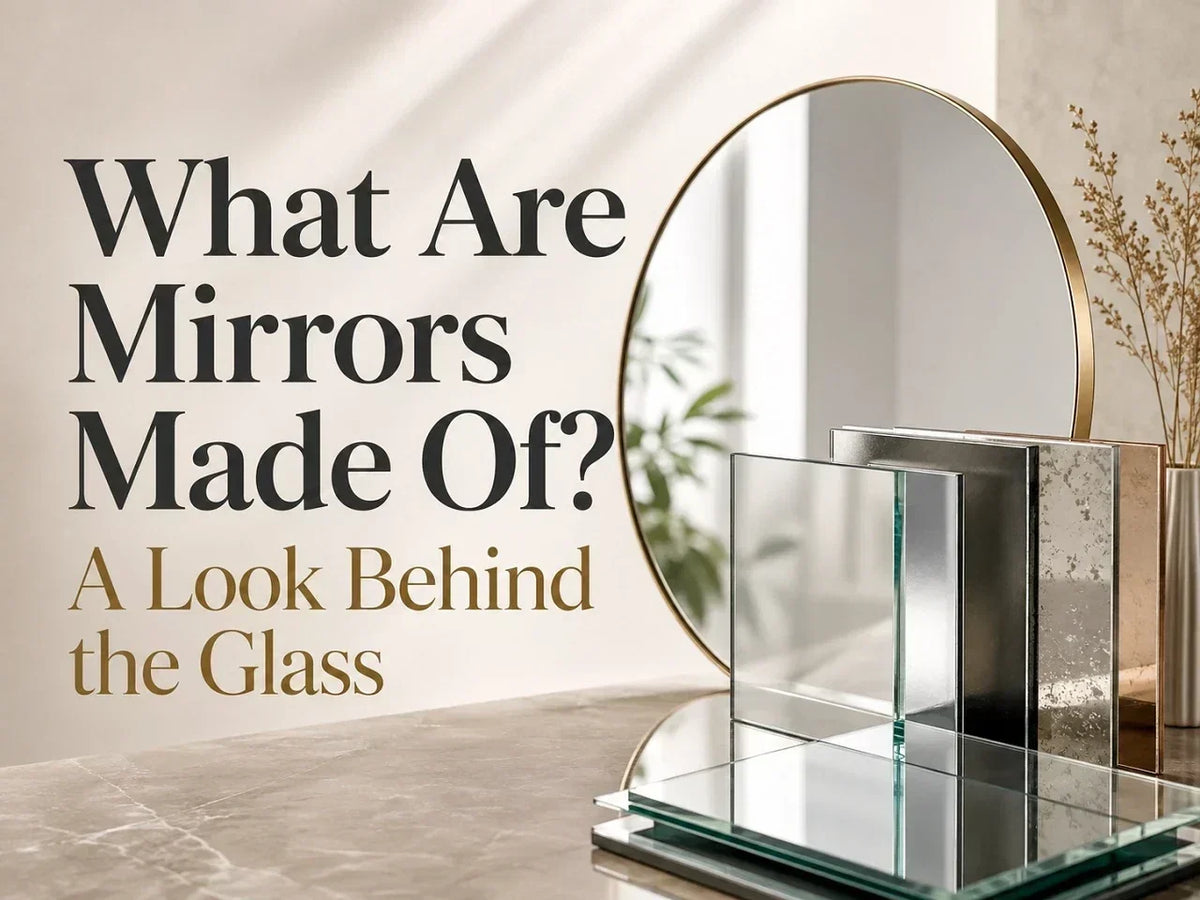
Most household mirrors combine smooth float glass, a reflective layer made from silver or aluminum, and protective backing coats. A frame, safety film, LED system, mounting board, or hardware may be added according to the mirror’s job. The quality of those layers affects clarity, color, durability, weight, and the chance of dark edges forming later.
The short video behind this guide explains the basic mystery: light travels toward a mirror, bounces from its reflective surface, and returns to our eyes. Here, we are taking that idea a step further and looking at what homeowners can learn from the materials behind the reflection.

A Mirror Is a Layered Product
Ordinary window glass reflects a little light, especially at night, but most light passes through it. A household mirror needs a reflective layer to send far more of that light back.
A common glass mirror is built in layers:
- A smooth sheet of glass creates a flat, durable viewing surface.
- A thin metal coating supplies most of the reflection.
- One or more backing coats help protect the metal from scratches, moisture, and corrosion.
- Some designs add safety film, a support board, a frame, or lighting components.
This is called a back-silvered or second-surface mirror because the reflective metal sits behind the glass. Light passes through the glass, reaches the coating, and reflects back through the glass toward you.
The term “silvering” can be confusing. It describes the process of applying a reflective coating, even when the coating is made from a metal other than silver.
What Does the Glass Actually Do?
The glass gives the mirror its shape, stiffness, smoothness, and cleanable front surface. It also shields the delicate metal layer from fingers, cleaning cloths, and everyday abrasion.
Most home mirrors use soda-lime float glass, the familiar type used across many architectural and interior applications. During float-glass production, molten glass spreads across a bath of molten tin. The process creates broad, smooth sheets that can later be cut and coated.
Glass quality matters because reflected light follows the surface. A subtle bow, wave, or uneven thickness can bend straight lines in the image. That is why mirror quality becomes especially noticeable in full-length and wall-size mirrors. A small imperfection that barely shows in a compact mirror can stretch across a much larger reflection.
Thickness can help a mirror remain stable, but thickness alone does not promise an accurate image. Flatness, processing, backing support, mounting pressure, and the condition of the wall all play a part.
Standard Glass and Low-Iron Glass
Standard clear glass often carries a faint green tint, most visible along a polished edge or across thicker panels. The color comes largely from iron compounds in the glass.
A low-iron mirror uses glass made with less iron, so the material looks clearer and has less of that green cast. It can give whites, skin tones, makeup shades, and room colors a more neutral appearance. This difference is useful in beauty spaces, dressing rooms, salons, displays, and interiors where color accuracy matters.
Low-iron glass is not automatically the right answer for every room. Standard mirror glass can provide an excellent everyday reflection. Surface flatness and manufacturing quality may matter more than a small color difference for a hallway or decorative wall mirror.
The Reflective Layer: Silver, Aluminum, and Other Metals
Glass is transparent. The metal behind it is what turns the panel into a working mirror.
Silver-Backed Mirrors A silver-backed mirror uses a very thin layer of silver deposited on the rear surface of the glass. Silver reflects visible light efficiently and can produce a bright, neutral image. The metal is then covered to slow down tarnishing and physical damage.
In a common manufacturing method, the cleaned glass receives a treatment that helps silver bond to the surface. Guardian Glass describes a process that uses a tin-based preparation before the silver layer, followed by protective paint coats. Manufacturing systems vary, and newer products may use copper-free or low-lead processes.
Silver does not mean the mirror contains a thick plate of precious metal. The working layer is extremely thin. Its performance depends on even coverage and good protection more than visible thickness.
Aluminum-Coated Mirrors
Aluminum can also form a reflective mirror coating. It is widely used in mirrors and optical applications because it reflects a broad range of light and can be applied through vacuum-deposition processes.
Silver and aluminum are not simple “premium versus cheap” labels. The finished result depends on glass quality, coating control, protective layers, intended environment, and manufacturing tolerances. A well-made aluminum-coated mirror can serve its purpose better than a poorly made silver-coated panel.
Why Telescopes Use a Different Arrangement
The video briefly points to telescopes as another place mirrors appear. Precision optical instruments often use a front-surface mirror. Its reflective layer sits on the face rather than behind the glass, so light does not pass through the substrate before and after reflection.
That setup can reduce secondary reflections, but the exposed coating is more delicate. It makes sense for controlled optical equipment, not for a bathroom mirror that gets touched and cleaned every week.
What Is on the Back of a Mirror?
Turn over a frameless mirror and you may see gray, green, blue, or another opaque color. That visible surface is usually not the reflective metal itself. It is a mirror backing designed to cover and protect the thin coating beneath it.
Traditional silvering systems often used a copper layer over the silver, followed by paint. Many current mirrors use copper-free protective systems.
Backing protection matters most at the edges and around drilled openings. Moisture and harsh chemicals can reach a damaged coating through those vulnerable areas. Once the reflective metal begins to corrode, black spots, cloudy patches, or dark edges may appear.
How Does a Mirror Reflect Your Image?
Light travels in straight lines until it reaches another surface. When it hits a smooth mirror, it bounces back at the same angle. This is known as the law of reflection.
Light from a window or lamp falls on your face, clothing, and nearby objects. Some of that light travels toward the mirror, reflects from its coated surface, and enters your eyes. Your brain follows these reflected rays backward, making the image appear to sit behind the glass.
This is called a virtual image. In a flat mirror, the reflection appears the same distance behind the glass as the object is in front of it. Stand three feet from the mirror, and your image appears about three feet behind it.
This apparent depth also explains why a large wall mirror can make a room feel more open. It does not add physical space, but it extends the view and reflects light from other parts of the room.

Why Does a Mirror Seem to Swap Left and Right?
Wave with your right hand and the person in the mirror seems to wave with the left. Printed words look backward too. It is easy to say a mirror flips left and right, but the surface actually reverses front and back.
Your reflection faces you because the direction toward the mirror is turned into the direction away from it. Up remains up. Your right side remains opposite your right side. We imagine rotating ourselves to stand in the reflection’s place, and that mental turn creates the familiar left-right effect.
This has little impact on home decorating, but it does affect text and asymmetrical designs. A decorative word, clock face, or artwork seen mainly through a mirror may look very different from its direct view.
Why Do Some Mirrors Distort Your Reflection?
A distorted mirror reflection usually points to a surface that is not perfectly flat. The problem may come from the glass, backing, support, or installation.
Common causes include:
- Thin glass flexing across a wide area
- An uneven wall pushing or pulling on the panel
- Adhesive placed in heavy, irregular patches
- A frame or backing board applying uneven pressure
- Manufacturing waves in the glass
- Heat or moisture damage affecting materials over time
Check a large mirror from several feet away. Look at a doorframe, tile joint, or another straight architectural line. Move from the center toward the edges. A good flat mirror should keep those lines reasonably straight instead of making them ripple or pinch.
This simple check works better than judging the glass from a few inches away.
Why Do Mirrors Turn Black Around the Edges?
People often call this problem desilvering. Dark edges and spots appear when the reflective metal or its protection deteriorates. Bathrooms are common trouble areas because moisture can settle around exposed edges and hardware openings.
Several habits can reduce the risk:
- Keep standing water away from the lower edge.
- Spray cleaner onto a cloth instead of flooding the glass and frame.
- Avoid abrasive pads and strong chemicals that can reach the backing.
- Ventilate the bathroom after showers.
- Do not chip the edge during installation.
- Use a mirror and mounting method intended for a humid room.
Once corrosion has spread behind the glass, surface cleaning will not remove it. Small damaged areas may be hidden by a frame, but broad deterioration usually calls for replacement.
Tempered Glass, Safety Film, and “Shatterproof” Claims
A tempered glass mirror is made from glass strengthened through controlled heat treatment. When properly tempered glass breaks, it is designed to crumble into smaller pieces instead of long, sharp shards. This does not make it unbreakable.
Safety film takes a different approach. It helps hold broken fragments together and reduces scattering. Some mirrors combine tempered glass with a backing film; others use one safety measure or the other.
Product wording can be loose, so look past a “shatterproof” headline. Check the actual construction, glass thickness, safety backing, mounting hardware, and installation instructions.
A secure installation remains essential, especially for a full-length mirror, over-the-door design, home gym panel, or freestanding mirror around children and pets.
Choosing Mirror Materials for Different Rooms
The best construction depends on where the mirror will live and how people will use it.
| Room or use | Material features to prioritize | Why they matter |
|---|---|---|
| Bathroom | Protected backing, sealed edges, moisture-suited frame and bathroom-rated electrical parts | Steam and splashes can reach edges and components |
| Vanity or makeup area | Flat glass, neutral color, even lighting and optional magnification | Accurate detail and skin-tone visibility matter |
| Bedroom dressing area | Large flat surface, strong backing and secure hardware | Wide panels show distortion and need stable support |
| Home gym or yoga room | Clear plane mirror, safety backing or tempered glass and secure mounting | Movement needs a broad, dependable reflection |
| Entryway or living room | Good clarity, balanced scale and a frame suited to the room | The mirror works as both a view and a focal point |
| Garage or blind corner | Convex surface and weather-suited construction | A wider field of view matters more than normal scale |
Hasipu designs mirrors for daily routines across bathrooms, bedrooms, vanities, entryways, and workout spaces. The visible style matters, but the layers behind the glass decide how the mirror performs after it is hung.
A Quick Mirror Quality Check Before Installation
Set the mirror upright on a protected, stable surface and inspect it in normal room light. Do not peel away required safety materials or rest bare glass on a hard floor.
Key areas to check before mounting:
- Optical accuracy: Stand back and look for waves or distortion in straight reflected lines.
- Surface defects: Check the center and edges for dark spots, scratches, chips, or cloudy areas.
- Color rendering: Compare skin tones and white objects under neutral light.
- Backing integrity: Examine the backing for damage, especially near corners and mounting points.
Confirm that the included hardware suits your wall surface. Drywall, masonry, tile, and wood studs require different fasteners. Adhesive products must be explicitly compatible with mirror backings; unsuitable adhesives can chemically damage the coating or fail to support the panel's weight.
For a freestanding design, check that the base sits evenly and that all locks, straps, or anti-tip hardware function as intended.

Frequently Asked Questions
1. Are mirrors made of silver?
Many home mirrors use a thin silver coating behind glass, but the entire mirror is not made from silver. Aluminum and other reflective materials are also used.
2. Is a mirror just glass with paint on the back?
No. The paint-like surface you see is usually a protective backing. A thin metallic layer beneath it creates most of the reflection.
3. Is thicker mirror glass always better?
Thicker glass can add rigidity, especially across a large panel, but flatness, coating quality, backing support, and installation also affect the result.
4. What is the clearest type of mirror glass?
Low-iron mirror glass reduces the faint green tint seen in standard clear glass. It can improve color neutrality, though a well-made standard mirror may already suit most home uses.
5. Can mirror backing get wet?
Repeated moisture exposure can damage edges and protective layers. Keep water from collecting around the mirror and use materials designed for damp locations.
6. Why can I see two faint images near a mirror’s edge?
A back-silvered mirror reflects most light from the metal layer, while the front glass surface reflects a small amount too. At an angle, those reflections may separate slightly. Precision front-surface mirrors avoid this effect but are not typical household products.