Table of Contents
Makeup that looks smooth in your bedroom can appear completely different beside a window. Foundation lines become more noticeable, blush looks heavier than expected, and one eyebrow suddenly seems darker than the other. The problem may not be your makeup. It may be the mirror and lighting you used.
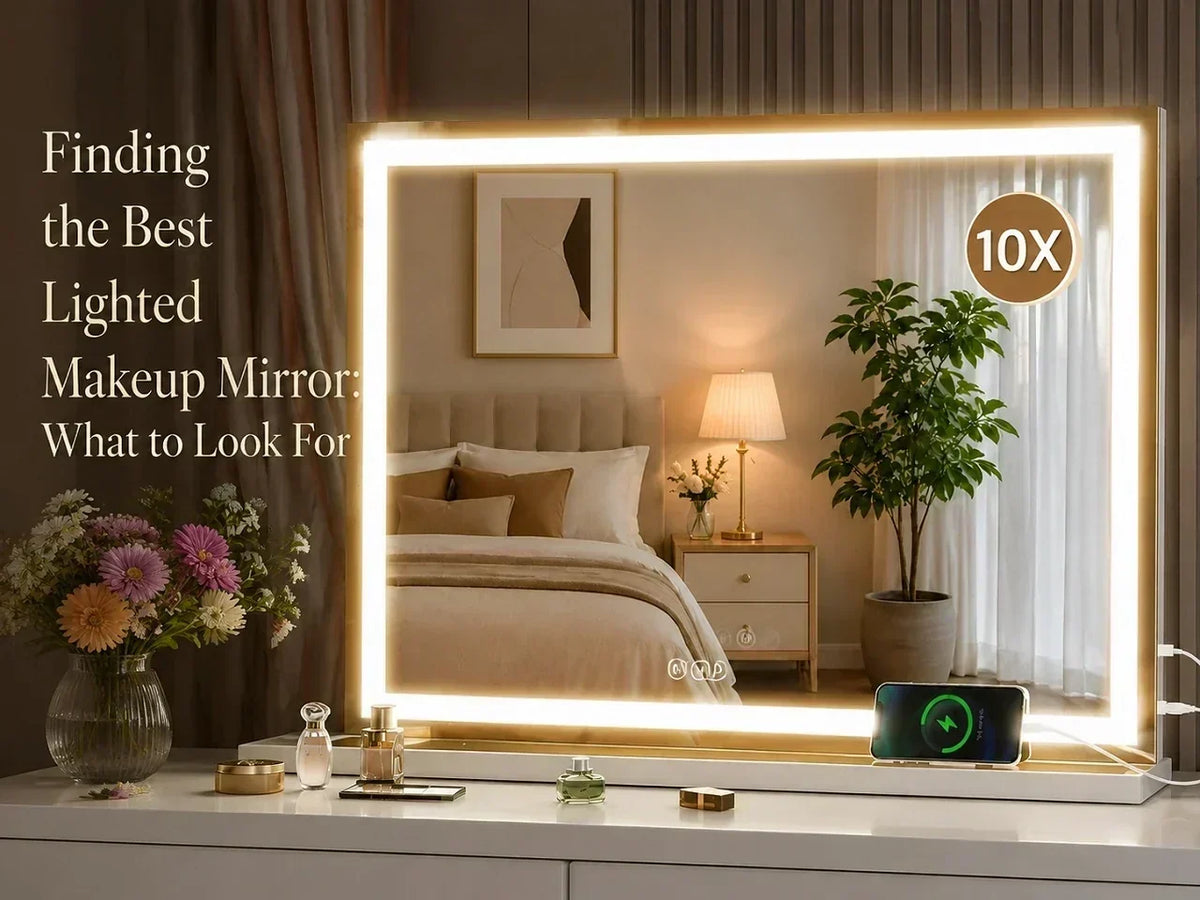
The best lighted makeup mirror is not simply the brightest or the one with the most features. It should illuminate your face evenly, show colors clearly, and give you a comfortable view from your usual sitting position. Its size, magnification, controls, and power source also need to work with your space.
Before choosing a mirror, think about where it will sit and what you normally do in front of it. A large Hollywood-style makeup mirror can be useful for full makeup and hairstyling, while a compact magnifying mirror may be better for eyeliner, brows, and skincare.
Which Lighted Makeup Mirror Fits Your Routine?
| Your routine or space | Best mirror type | Features to prioritize |
|---|---|---|
| Everyday makeup | Medium tabletop mirror | 1x view, dimming, neutral light |
| Eyeliner, brows, or contact lenses | Magnifying mirror | 5x or detachable 10x section |
| Full makeup and hairstyling | Hollywood vanity mirror | Wide view and even front lighting |
| Small makeup table | Compact rotating mirror | Small base and adjustable angle |
| Limited counter space | Wall-mounted mirror | Extendable arm and dual-sided view |
| Travel | Folding rechargeable mirror | Protective cover and low weight |
| Makeup for different settings | Multi-color LED mirror | Warm, neutral, and cool light modes |

Start With How You Use the Mirror
It is easy to compare specifications and forget about the actual routine the mirror needs to support.
Someone who applies tinted moisturizer and mascara each morning may only need a clear, medium-sized mirror with reliable lighting. A person who regularly applies false lashes, shapes brows, or wears contact lenses may benefit from a separate magnifying section. Hairstyling requires a wider viewing area than close-up skincare.
The room matters too. A makeup table beside a large window already receives plenty of daylight during the morning, but it may need stronger illumination at night. A vanity in a dark bedroom needs a mirror that can provide consistent light throughout the day.
Think about movement as well. Will the mirror remain on one table, move between rooms, or travel in a suitcase? A large mirror can give you a better overall view, but it becomes inconvenient when you need to carry it frequently.
The right lighted makeup mirror should fit the routine you already have rather than forcing you to rearrange your space every time you use it.
Look for Even Light, Not Just More Light
Brightness numbers can be useful, but they do not tell the whole story. A very bright mirror may still cast uneven light across your face or create glare around the glass.
Good makeup lighting should reach both sides of the face without leaving deep shadows beneath the eyes, nose, or chin. Light placed around the mirror or along several sides generally creates a more balanced view than a small light source positioned only at the top.
An adjustable brightness makeup mirror gives you more control than a mirror with one fixed setting. You can raise the brightness for detailed eye makeup, then lower it when checking how the finished look will appear in softer indoor light. Stepless dimming is especially convenient because it does not limit you to a few preset levels.
Pay attention to how the LEDs are covered. A diffuser can soften individual points of light and reduce harsh reflections. Exposed bulbs can work well on a Hollywood mirror, but they should be spaced evenly enough to illuminate the whole face.
The best lighting for a makeup mirror is comfortable, balanced, and strong enough to reveal detail without making you squint.
Which Color Temperature Is Best for Makeup?
Many modern mirrors offer warm, neutral, and cool lighting. These settings are useful because makeup does not look the same under every type of light.
Warm light resembles the softer lighting found in many bedrooms, restaurants, and evening spaces. It can help you preview a nighttime look, but using warm light alone may make certain foundation or blush tones harder to judge.
Neutral light is usually the most practical setting for everyday makeup. It gives the face a natural appearance without making the skin look overly yellow or blue. This is a helpful setting for foundation matching, blending, and checking the balance of a finished look.
Cool light reveals fine details and can resemble the lighting found in offices, stores, or other brightly lit spaces. Light that is too cool may make the complexion appear washed out, so it works better as a second check than as the only setting.
An LED makeup mirror with several color temperatures allows you to see how your makeup may appear in different environments. The goal is not to switch colors constantly. It is to avoid preparing your entire look under one misleading light source.
Some manufacturers also publish a Color Rendering Index (CRI). A higher CRI generally indicates that colors appear more faithful under the light. CRI can be helpful when it is available, but lighting uniformity and comfortable brightness still deserve attention.
Choose Magnification for the Task
More magnification is not always better. The useful level depends on how much of your face you need to see.
A 1x mirror shows your face at its natural size. It is the best main view for applying foundation, blending blush, arranging hair, and checking whether both sides of your makeup look balanced.
Moderate 2x or 3x magnification brings details closer without removing most of the face from view. It can be comfortable for general skincare or light eye makeup.
A 5x mirror works well for eyeliner, brow shaping, contact lenses, and other tasks that need a closer look. Many people find it detailed enough without being difficult to use.
A 10x mirror is designed for small areas. It can help with tweezing, lash placement, or inspecting a precise section of the skin. Because the viewing area is narrow, it is not practical for applying an entire face of makeup.
When comparing a 5x vs. 10x makeup mirror, consider both the task and the viewing distance. High magnification requires your face to remain fairly close to the glass. From farther away, the reflection may look blurred or distorted.
For most setups, a clear 1x main mirror paired with a detachable or reversible 5x or 10x section provides more flexibility than a single high-magnification surface. A magnifying makeup mirror with light should support detailed work, not become the only view you use.

Pick the Right Type for Your Space
Lighted makeup mirrors come in several designs, and each one changes how the surrounding area can be used.
Tabletop Mirrors
A tabletop makeup mirror with lights works well on a bedroom vanity, dresser, or bathroom counter. It can usually be repositioned without installation, which makes it practical for renters and anyone who changes rooms often.
Check the base dimensions before buying. A mirror that looks compact in a product image may occupy more of the table than expected. The base should also remain steady when you rotate the mirror or use its touch controls.
Hollywood Vanity Mirrors
A Hollywood vanity mirror provides a broad view for makeup, hair, and getting dressed. These mirrors often use exposed bulbs or a wide illuminated frame, creating a familiar backstage-style appearance.
They suit larger makeup tables and permanent beauty stations. On a narrow desk, the mirror may leave too little space for brushes, skincare products, or organizers. Measure the full frame rather than only the reflective area.
Wall-Mounted Mirrors
A wall-mounted lighted makeup mirror keeps the counter or tabletop clear. Models with extendable arms can move closer for detailed grooming and fold back against the wall afterward.
Installation height is critical. Test the position while sitting and standing before drilling. The arm should extend far enough to reach a comfortable viewing distance without making you lean forward.
Compact and Travel Mirrors
A rechargeable makeup mirror is useful when there is no nearby outlet or the mirror needs to move between rooms. Travel versions often fold flat and include a cover that protects the glass.
For travel, weight and construction matter more than having the largest possible surface. Look for a hinge that holds its position, a cover that does not open easily in a bag, and enough battery life for your typical trip.
Tri-Fold Mirrors
Tri-fold mirrors offer a main front view and smaller side views. They can help with hairstyling or viewing the face from different angles. Some models also place several magnification levels on the side panels.
Check whether the side panels are large enough to be useful. Loose hinges can cause them to shift while you work.
Measure the Mirror and the Vanity Together
A mirror should look balanced on the table, but appearance is only part of the calculation.
Sit in your usual chair and measure the distance from the tabletop to your eyes. The mirror should adjust high enough to show your complete face without making you bend your neck. If several people will use it, a tilting or rotating design can accommodate different heights.
Measure the available width and depth of the table. Leave room for the items that stay on the surface every day, including brush holders, skincare, trays, and hair tools. Large frames and wide bases can take up more usable space than the product photos suggest.
Check the distance to the nearest outlet when considering a plug-in lighted vanity mirror. A cord stretched across a walkway or crowded behind furniture will quickly become frustrating.
Wall clearance also matters. A rotating mirror may hit the wall before reaching the angle you need. Marking the mirror’s outline with removable painter’s tape is a simple way to judge its scale before purchasing.
Check the Angle, Base, and Controls
A mirror can have excellent lighting and still be uncomfortable to use if it will not stay at the right angle.
Rotation should feel controlled rather than loose. After adjusting the glass, it should remain in place without slowly tilting downward. This becomes more noticeable with heavier mirrors and double-sided magnifying models.
The base should not slide when you tap a control. A wider or weighted base often provides better stability, though it also uses more table space. Non-slip pads can protect the furniture and reduce movement.
Touch controls are convenient when their placement makes sense. Buttons located where you naturally hold the frame may be activated accidentally. Controls should also be easy to locate in a dim room.
A memory function can save the most recently used brightness or color setting. It is a small feature, but it keeps you from repeating the same adjustments every morning.
Plug-In, Battery, or Rechargeable?
Plug-in mirrors suit permanent vanity setups. They deliver steady power and do not need to be recharged, making them practical for larger mirrors or longer beauty routines.
Rechargeable mirrors keep cords off the table and can be carried to a window or another room. Look at the charging port as well as the battery description. A common USB or USB-C connection is usually easier to replace than a proprietary cable.
Mirrors powered by replaceable batteries can be convenient for occasional use. Frequent users may find that changing batteries becomes less practical over time.
There is no single best power source. A fixed vanity mirror with lights benefits from dependable plug-in power, while a smaller mirror gains more value from being cordless.
Extra Features: Useful or Just More to Pay For?
Adjustable brightness, multiple color temperatures, stable rotation, and a clear magnifying option directly affect how the mirror works. These features deserve priority.
Auto shutoff can be helpful for anyone who sometimes leaves the light on. Brightness memory saves setup time. A USB charging port may be useful when the vanity has limited outlets.
Phone holders, Bluetooth speakers, storage trays, and motion sensors depend more on personal habits. A phone holder makes sense for someone who records makeup tutorials. A Bluetooth speaker adds little value when another speaker already sits in the room.
Extra technology should not compensate for uneven lighting, a blurry reflection, or an unstable base. Choose the features you expect to use each week, not the longest specification list.

Common Buying Mistakes
Choosing the brightest model without considering light distribution is a common mistake. Harsh light can make details visible while still creating shadows that interfere with blending.
Another problem is treating 10x magnification as the main view. High magnification is helpful for precision but makes it difficult to judge balance across the whole face.
Desk measurements are often overlooked. The mirror may fit the width of the vanity but leave no room for products once its base and cord are added.
Smart features can also distract from the basics. Bluetooth, sensors, and phone controls are optional. Clear glass, even light, a stable frame, and a useful viewing angle are the features that shape the daily experience.
Finding the Mirror That Fits Your Routine
The best lighted makeup mirror should make your routine easier without taking over your space. Look for even illumination and a useful dimming range rather than chasing the highest brightness. Use 1x for full-face makeup, then turn to 5x or 10x magnification for close detail work.
A wide Hollywood mirror suits a permanent beauty station. A compact tabletop mirror is easier to fit into a smaller bedroom, while wall-mounted and rechargeable designs solve different space and power problems.
Measure the table, check your seated eye level, and think about the features you will actually use. Hasipu offers lighted makeup mirrors in different sizes and styles, with adjustable lighting and practical viewing options for everyday makeup, skincare, and grooming. The right mirror should feel comfortable from the first step of your routine to the final check.
Frequently Asked Questions
1. What lighting is best for a makeup mirror?
Even neutral or natural-looking light is usually the most useful for everyday makeup because it helps you judge color and blending without a strong yellow or blue cast. Adjustable warm and cool settings can be used to preview how the makeup will appear in other environments.
2. Is 5x or 10x magnification better for makeup?
A 5x mirror is easier to use for eyeliner, brows, and general detail work. A 10x mirror provides a closer view for tweezing, lashes, or contact lenses. Both work best as secondary views beside a standard 1x mirror.
3. Are LED makeup mirrors worth it?
An LED makeup mirror can be useful in rooms with weak, uneven, or overhead lighting. Its value depends on the uniformity of the light, dimming range, reflection quality, and adjustability—not simply the number of LEDs.
4. What size lighted makeup mirror should I buy?
Choose a size that shows the area you need without crowding the table. Full makeup and hairstyling benefit from a wider mirror, while close-up skincare or eye makeup can be done with a smaller model. Measure the frame and base before buying.
5. Is a round or rectangular lighted makeup mirror better?
A rectangular mirror usually provides a wider viewing area and works well for full-face makeup and hairstyling. A round mirror feels lighter on a compact table and can be easier to rotate. The better option depends on the available space and how much of your reflection you want to see.
6. Should I choose a plug-in or rechargeable makeup mirror?
Choose a plug-in mirror for a permanent vanity where an outlet is nearby. A rechargeable mirror is more convenient when you need a cordless table, move between rooms, or travel frequently.