

Table of Contents
An anti-fog mirror that stays cloudy after a shower is not always broken. The defogger may be switched off, need more time to warm the glass, or only heat the center section of the mirror. Heavy steam, a dirty surface, a tripped bathroom circuit, or a failed demister pad can also cause the problem.
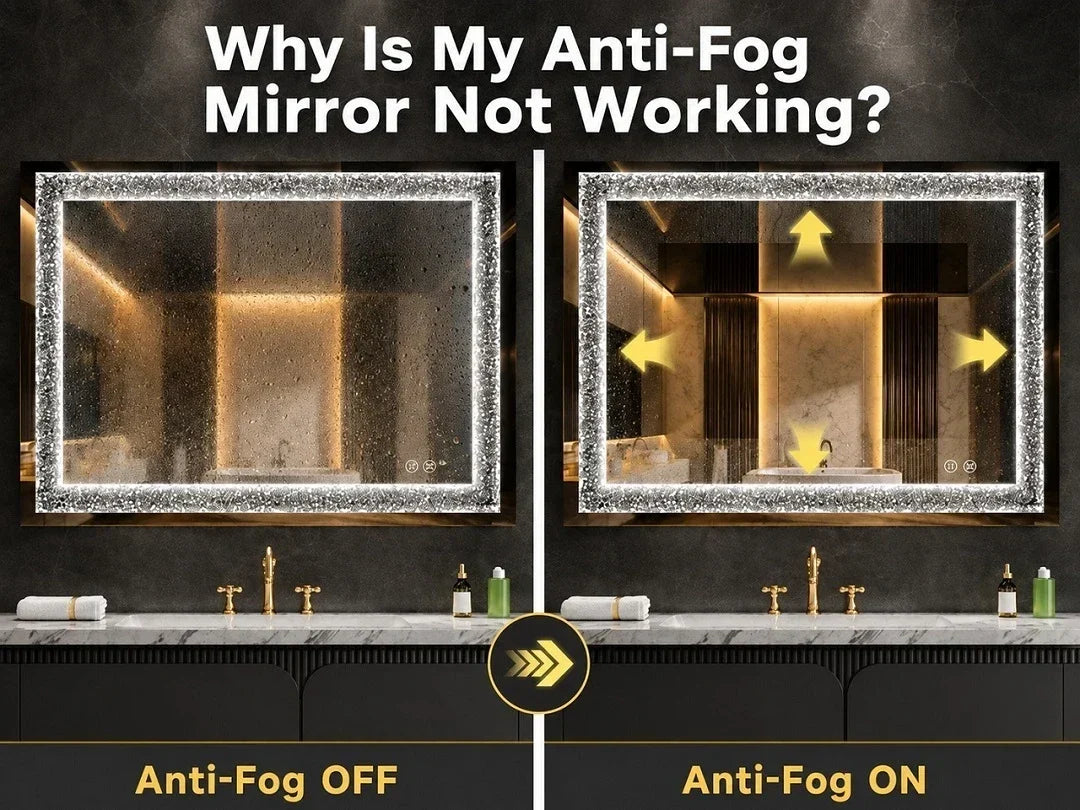
When an anti-fog mirror is not working, check the controls and warm-up time before assuming there is an electrical fault. Turn on the defogging function before showering, wait for the time listed in the product manual, and look for a clear area in the center of the glass.
Do not remove a hardwired mirror or open its electrical housing yourself.
Quick Troubleshooting Guide
| What You See | Possible Cause | What to Try |
|---|---|---|
| The whole mirror stays foggy | The defogger is off, still warming up, or has no power | Press the anti-fog button and allow the full warm-up time |
| The center clears but the edges fog | The heating pad covers only part of the mirror | This is often normal; check the stated anti-fog area |
| The lights work but anti-fog does not | The light and demister use separate controls or circuits | Check the anti-fog icon and restart the mirror as directed |
| Neither the lights nor defogger works | The mirror may have lost power | Check the wall switch, plug, GFCI outlet, and breaker |
| The mirror clears very slowly | The room has too much steam or the glass started very cold | Start the defogger earlier and run the exhaust fan |
| The function starts and then stops | The automatic shutoff timer may be active | Check the timer information in the product manual |
| Only a small or uneven area clears | The heating pad may be undersized, damaged, or lifting | Contact the manufacturer or a licensed electrician |
How Does an Anti-Fog Mirror Work?
Bathroom mirrors fog when warm, humid air reaches cooler glass. Once the glass surface is below the air’s dew point, moisture condenses into tiny droplets. Those droplets scatter light and make the reflection look cloudy.
Most lighted bathroom mirrors use a thin heater called a mirror demister pad. It is attached behind the glass and gently warms the covered area. This reduces the temperature difference between the mirror and the humid bathroom air, making condensation less likely to form.
The heater does not remove humidity from the room. It also may not warm the entire mirror.
Some mirrors use an anti-fog coating instead of an electric heater. A coated mirror needs different care and may lose performance when soap, oils, or unsuitable cleaners collect on the surface.
Before troubleshooting, check whether your mirror uses:
- A heated demister pad
- An anti-fog coating
- A removable anti-fog film
- A separate anti-fog button
- A defogger connected to the main light control
The correct solution depends on how the mirror was designed.
1. The Anti-Fog Function Is Not Turned On
On many LED mirrors, the light and defogger are separate functions. Turning on the LED lighting does not always activate the heating pad.
Look for a touch button marked with rising steam lines, a wavy symbol, or the word “defog.” The icon may light up when the feature is active.
If the touch panel is wet, dry it with a soft cloth and try again. Water on a capacitive touch control can prevent the sensor from recognizing a normal tap.
Some mirrors connect the defogger to a wall switch. Others have one button for lighting and a different button for anti-fogging. A mirror with a memory function may remember the previous brightness but not the last defogger setting.
This often explains why an LED mirror anti-fog function is not working even though the mirror lights are on.
2. The Mirror Has Not Had Enough Time to Warm Up
A heated mirror does not clear instantly. The glass needs time to warm before it can resist condensation.
The warm-up time depends on:
- Mirror size
- Demister pad size
- Heater output
- Room temperature
- Glass thickness
- Amount of steam in the bathroom
Some demister pads begin working within several minutes. Other mirrors need to be switched on well before the shower.
For example, the instructions for this Hasipu LED bathroom mirror recommend pressing the anti-fog button before showering and allowing about 15 minutes for the defogger to heat.
That time only applies to the listed model. Check the manual for your own mirror because another Hasipu model may work differently.
Turning on the feature after the mirror is already covered in condensation usually produces a slower and less even result.

3. Only Part of the Mirror Is Heated
“My anti-fog mirror is fogging up around the edges” is a common complaint. In many cases, the mirror is working normally.
The demister pad usually sits behind the main viewing area. It may not extend to the top, bottom, and side edges of the glass.
After a hot shower, you may see:
- A clear rectangle in the center
- Fog along the outer edges
- A clear area around eye level
- A visible line between heated and unheated glass
This does not automatically mean the demister is defective.
Check the product page for terms such as:
- Anti-fog area
- Heated area
- Demister zone
- Defogging section
- Heating pad size
Test the central area used for shaving, skincare, or makeup instead of judging the feature by an unheated corner.
If the product was advertised as having much wider coverage and only a very small patch clears, take a photo after the recommended warm-up time. Customer support can compare the result with the intended heating area.
4. The Bathroom Is Producing Too Much Steam
An anti-fog heater reduces condensation on the warmed glass. It cannot remove moisture from the bathroom.
The mirror may struggle when:
- The shower is very hot
- The shower runs for a long time
- The bathroom is small and tightly closed
- The exhaust fan is off or blocked
- The fan is too small for the bathroom
- The mirror is installed on a cold exterior wall
- Several people shower one after another
Turn on the exhaust fan during the shower and leave it running afterward according to the fan manufacturer’s instructions.
A working exhaust fan helps remove moisture from the whole room. It can reduce condensation on the mirror, walls, cabinets, grout, ceiling, and windows.
The U.S. Environmental Protection Agency recommends controlling indoor moisture by ventilating bathrooms and directing exhaust outdoors.
If the bathroom mirror keeps fogging up, check the room’s ventilation as well as the mirror itself.
5. The Mirror Surface Is Dirty
Toothpaste, hairspray, skin oils, soap residue, and cleaning products can leave an invisible film on the glass. The mirror may look hazy even when the demister is heating correctly.
Residue can also reduce the performance of certain anti-fog coatings.
Clean the front of the mirror with:
- A soft microfiber cloth
- A cleaner approved by the manufacturer
- A small amount of mild glass cleaner
- A dry cloth for removing streaks
Avoid using:
- Abrasive cleaning pads
- Scouring powders
- Razor blades
- Strong acids or alkaline cleaners
- Large amounts of liquid around touch controls
- Unapproved anti-fog sprays on coated glass
Apply cleaner to the cloth instead of spraying it directly onto an electrical mirror. This helps keep liquid away from the edges, controls, and internal components.
If the glass looks cloudy while completely dry, clean a small test area. The problem may be residue rather than condensation.
6. The Anti-Fog Coating Has Lost Performance
Not every fog-free mirror uses electricity. Some mirrors have a soft anti-fog coating on the front surface.
These coatings can become less effective when covered by:
- Soap residue
- Cosmetic products
- Hairspray
- Hard-water deposits
- Oils from hands
- Unsuitable cleaning chemicals
Use the cleaning method recommended for the product. Standard glass-cleaning methods may be too aggressive for a coated mirror.
Some coated mirrors also have a protective film when new. If that film was not removed, the anti-fog performance may be poor.
Do not scrape a coated mirror or polish it with an abrasive product. Once the surface coating is physically damaged, cleaning may not restore it.
7. The Auto-Off Timer Has Stopped the Defogger
Many LED bathroom mirrors with anti-fog include an automatic shutoff timer. This prevents the heating pad from staying on indefinitely.
The LED lights may remain on after the demister turns off. This can make it look as though the anti-fog function has failed.
Watch the anti-fog indicator rather than the main light.
If the icon turns off after a set period, check the product manual for the timer duration. Some mirrors switch off after 30 minutes, while others may run longer.
An automatic timer can also explain why a mirror stays clear during a short shower but begins fogging during a longer bathroom session.
Restart the function only as permitted by the product instructions.
8. The Mirror Has Lost Power
When both the lighting and defogging stop, check the power source before blaming the heating pad.
For a plug-in mirror:
- Make sure the plug is seated correctly
- Check whether the wall switch is on
- Look for a tripped GFCI outlet
- Check the circuit breaker
- Test whether the outlet powers another suitable device
A GFCI outlet may protect several bathroom outlets. The reset button may be located on a different outlet nearby.
Only use the normal external reset buttons. Do not remove the outlet cover or open the mirror.
If the GFCI or breaker trips again, leave the power off and contact a licensed electrician. Repeated tripping may point to damaged wiring, moisture, an overloaded circuit, or an internal electrical fault.
For a hardwired mirror, do not pull the unit away from the wall to inspect the connections. An electrician can safely test the power supply, switch, wiring, and protective devices.
9. The Touch Control Needs to Be Reset
Touch-controlled mirrors contain sensors, relays, and control modules. A temporary problem can appear after:
- A power outage
- A voltage interruption
- A storm
- Recent electrical work
- Installation
- Repeated rapid button presses
If the manual allows it, turn off the mirror using its normal power supply. Wait briefly, restore the power, and activate the anti-fog button again.
Allow the mirror to complete a full warm-up cycle before judging the result.
Do not reset the mirror repeatedly. A control that fails after every power interruption, flashes unexpectedly, or responds only sometimes may need professional service.
10. The Demister Pad Has Failed
When the mirror has power, the anti-fog indicator turns on, and the correct warm-up time has passed, the heating pad may have a fault.
Possible causes include:
- A damaged heating element
- A loose internal connection
- A failed control relay
- A defective touch sensor
- Moisture inside the electrical housing
- Damage during installation
- Separation between the pad and mirror backing
This is more likely when the lights work normally but the central section of the mirror remains completely fogged.
A damaged bathroom mirror defogger is not a front-of-glass repair. Reaching the pad normally requires removing the mirror from the wall and accessing electrical components.
Contact the seller, manufacturer, or a licensed electrician. Prepare the model number, order information, installation date, photos, and a short video showing the controls.
11. The Heating Pad Is Too Small or Poorly Positioned
A demister pad needs close, even contact with the back of the mirror. If it is too small or installed away from the main viewing area, the useful clear section may be limited.
This problem is more common with:
- Very large vanity mirrors
- Custom mirror installations
- Aftermarket heating pads
- Pads added to an existing mirror
- Mirrors mounted with uneven backing
- Pads that have started lifting
A pad that has separated from the glass may produce patchy results. Do not try to reattach it using general-purpose household glue. Heat, moisture, and incompatible adhesive can create another failure.
An electrician or professional mirror installer should check whether the pad is compatible with the mirror and installation method.

Is It Safe to Keep Using the Mirror?
A mirror that clears slowly may still be safe to use. Stop using it when you notice:
- A burning smell
- A hot-plastic odor
- Buzzing or crackling sounds
- Sparking
- Repeated flickering
- A breaker or GFCI that keeps tripping
- A cracked mirror
- A damaged power cord
- Water behind the glass
- One area becoming unusually hot
- Tingling when touching the controls or frame
Turn off the power through the normal safe control and contact a qualified professional.
Do not:
- Remove a hardwired mirror yourself
- Open the electrical housing
- Touch exposed wiring
- Bypass the GFCI
- Cover the mirror while the heater is on
- Add another heating pad over the existing pad
- Use household glue on a lifting demister
- Continue operating cracked glass
Electrical work in a humid bathroom requires extra care.
How to Test an Anti-Fog Mirror Safely
You can learn a lot without taking the mirror apart.
- Clean and dry the mirror and touch-control area.
- Confirm that the bathroom circuit and wall switch are on.
- Press the anti-fog button and check whether its indicator lights up.
- Wait for the complete warm-up time stated in the manual.
- Run a normal shower with the exhaust fan operating.
- Photograph the mirror immediately afterward.
- Check whether the center, edges, or entire surface is foggy.
A clear central shape usually shows where the heating pad is located.
If nothing changes after correct activation and warm-up, the problem is more likely related to the control, power connection, or demister pad. Leave electrical testing to a licensed electrician.
When to Contact Hasipu?
For a Hasipu mirror, confirm the model number and follow its specific warm-up instructions before requesting service.
If the mirror demister is not working after the basic checks, prepare:
- Your order number
- Mirror model number
- Installation date
- A photo of the installed mirror
- A video showing the anti-fog control
- The warm-up time you allowed
- A photo taken immediately after a normal shower
- Information about whether the lights still work
These details help separate a timing or coverage question from a possible component fault.
You can reach Hasipu through the Contact Us .
An anti-fog mirror should make the bathroom easier to use. Start with the button, warm-up time, heated area, cleaning, and ventilation. When the mirror has power but the center never warms or clears, contact support or a licensed electrician instead of opening the unit yourself.
Frequently Asked Questions
1. Why does only the center of my anti-fog mirror stay clear?
The heating pad may cover only the central viewing area. The unheated edges can still collect condensation. Check the product description for the stated anti-fog area before treating this as a defect.
2. How long does an anti-fog mirror take to work?
The time depends on the model, mirror size, room temperature, and heating system. Some products begin working within a few minutes. The Hasipu model linked in this guide recommends allowing about 15 minutes.
Follow the instructions supplied with your mirror.
3. Why does the LED light work when the defogger does not?
The LEDs and heating pad may use separate buttons, relays, or circuits. Working lights confirm that part of the mirror has power, but they do not prove that the demister pad is operating.
4. Should the entire mirror stay clear?
Not always. Many anti-fog pads only heat the central section. The edges may still fog during a hot shower.
5. Why is my anti-fog mirror warm but still foggy?
The bathroom may be producing more steam than the heated section can handle. The surface could also have cleaning residue, or the heating pad may not cover the area you are checking.
Start the defogger earlier, clean the glass correctly, and run the exhaust fan.
6. Why did my anti-fog mirror suddenly stop working?
A power interruption, tripped GFCI, automatic timer, failed touch control, loose connection, or damaged heating pad could be responsible. Start with the external controls and power supply. Do not open the mirror yourself.
Written by the Hasipu Editorial Team
Last updated: July 21, 2026