

Table of Contents
You’ve picked the vanity, chosen the faucet, and found a light fixture you love. Then comes a surprisingly tricky question: What size mirror should go above the bathroom vanity?
A mirror can look perfect online and feel completely different once it’s on your wall. It might crowd the sconces, sit too high for everyday use, or look smaller than you expected above the sink.
The good news is that you don’t need a complicated formula. Start with the width of your vanity, then check the position of the sink, the available wall space, and the people who will use the mirror.
For most bathrooms, a mirror that measures roughly 70% to 90% of the vanity width is a useful starting point. A wider mirror, including one that matches the vanity width, can also work if you prefer a more continuous look and have enough room around it.
This guide will help you compare common sizes and choose a mirror that feels right in your bathroom.
Bathroom Vanity Mirror Size Chart
The chart below gives you a starting range for one mirror above a bathroom vanity. The suggested widths refer to the outside measurement of the mirror, including any frame.
| Vanity width | Suggested single mirror width | Example to consider |
|---|---|---|
| 24 inches | 18–22 inches | 20-inch-wide mirror |
| 30 inches | 22–26 inches | 24-inch-wide mirror |
| 36 inches | 28–32 inches | 30-inch-wide mirror |
| 42 inches | 30–36 inches | 32- or 36-inch-wide mirror |
| 48 inches | 36–42 inches | 36- or 40-inch-wide mirror |
| 60 inches | 45–54 inches | 48- or 54-inch-wide mirror |
| 72 inches | 54–64 inches | 60-inch-wide mirror |
These ranges are design suggestions, not fixed rules. Check the sink position, wall space, lighting, and mirror height before ordering. For a double vanity, you can also choose two individual mirrors.
For example, a 30-inch-wide mirror above a 36-inch vanity leaves approximately 3 inches of vanity width visible on each side when both are centered. That creates a balanced look while leaving a little breathing room around the mirror.
A 36-inch-wide mirror could also work above the same vanity if you prefer the edges to line up. Just make sure nearby walls, cabinets, and lights won’t crowd it.
How Wide Should a Bathroom Mirror Be?
A bathroom mirror generally looks balanced when it is slightly narrower than the vanity beneath it. Many homeowners like a mirror around 70% to 80% of the vanity’s width, while a wider mirror can give the bathroom a more spacious, streamlined appearance.
Consider these three approaches:
- A narrower mirror: Leaves more wall visible and works well when you have sconces or a decorative backsplash.
- A mirror that is a few inches narrower than the vanity: Offers a balanced, versatile look for many bathrooms.
- A mirror as wide as the vanity: Creates a clean, continuous look and provides more reflective surface.
None of these is automatically the best choice. A compact powder room with wall sconces may need a narrower mirror, while a wide frameless mirror could be a great fit above a floating vanity.
Also, remember to measure the countertop, not just the cabinet below it. Some countertops extend beyond the sides of the cabinet, and that extra width affects how the mirror appears.
Should the mirror be wider than the vanity?
It can be, particularly if you’re creating a wall-to-wall look or working with a custom mirror. A wider mirror may also make sense when the vanity sits in a recessed area.
For a standard wall-mounted mirror, however, a mirror that extends noticeably beyond the vanity can be harder to balance. Check whether it overlaps nearby outlets, cabinets, or light fixtures before choosing an oversized design.
How to Measure for a Bathroom Vanity Mirror
Before choosing a mirror from the chart, take a few measurements in your bathroom. A tape measure and a roll of painter’s tape can save you from ordering a mirror that looks right on screen but doesn’t fit the wall.
1. Measure the vanity and countertop
Measure the full width of the countertop from one outside edge to the other. If the countertop is not installed yet, use its planned finished width.
Next, decide whether you want the mirror to sit within those edges or line up with them.
For example, above a 30-inch vanity:
- A 24-inch mirror leaves about 3 inches on each side.
- A 26-inch mirror leaves about 2 inches on each side.
- A 30-inch mirror lines up with the vanity edges.
These examples assume the mirror and vanity share the same center.
2. Find the center of the sink
In many bathrooms, the sink is centered on the vanity. In others, especially vanities with extra counter space or storage, it may sit closer to one side.
When the sink is off-center, a mirror centered above the sink often feels more natural to use than one centered on the entire cabinet.
For example, imagine a 48-inch vanity with the center of the sink 18 inches from the left edge. A 32-inch-wide mirror centered over that sink would begin about 2 inches from the left edge of the vanity and end 14 inches from the right edge.
The wall space on each side won’t be equal, but the mirror will line up with the person standing at the sink.
3. Check the usable wall space
Measure the open area above the vanity, including the space between:
- Side walls or tall cabinets
- Windows and wall-mounted fixtures
- Sconces or other vanity lights
- The backsplash and any fixture above the mirror
Pay attention to light shades as well as their wall plates. A sconce may project farther toward the mirror than its mounting plate suggests.
4. Include the frame and mirror depth
A product listing may show the mirror’s full outside dimensions, while the reflective glass is smaller. This difference matters when a mirror has a thick frame, a decorative border, or a wide lighted edge.
If you’re choosing a medicine cabinet mirror, check its depth and door swing too. Make sure the door can open without hitting a wall, light fixture, or nearby cabinet.
5. Mark the outline on the wall
Use painter’s tape or a paper template to mark the size you’re considering. Step back and look at it from the doorway, then stand at the sink.
This helps you see whether the mirror feels too small, too close to the lights, or too high for the people who use the bathroom.
What Size Mirror for a Double Vanity?
For a double vanity, you can choose one large mirror across both sinks or two individual mirrors, one above each sink.
Both arrangements can look beautiful. The right choice depends on how much wall space you have and how you want the vanity area to feel.
One large mirror over a double vanity
A single wide mirror creates one continuous reflection and gives the vanity a clean, connected appearance. It can also help reflect more of the room, which may make a bathroom feel more open.
For a 60-inch vanity, you might start by comparing mirrors around 45 to 54 inches wide. For a 72-inch vanity, you might look at options around 54 to 64 inches wide.
Before deciding, make sure the mirror provides a useful view from both sinks. The position of the sinks matters just as much as the total width of the vanity.
Two mirrors over a double vanity
Two mirrors give each sink its own defined space. This arrangement can work especially well if you want a wall sconce between the mirrors or prefer the look of two matching shapes.
Instead of simply dividing the vanity width in half, measure:
- The distance between the centers of the sinks.
- The space from each sink center to the nearest vanity edge.
- Any room needed for a center sconce or side fixtures.
- The outside width of each mirror, including the frame.
Here’s an example: A 60-inch vanity has sink centers 15 inches and 45 inches from its left edge. Two 26-inch-wide mirrors centered on those sinks would leave approximately 2 inches at each outer edge and 4 inches between the mirrors.
If a light fixture needs to go between them, you may want narrower mirrors. If your sinks are positioned differently, the measurements will change too.
For more help comparing the two layouts, read our guide to one mirror vs. two mirrors over a double vanity.
How Tall Should a Bathroom Vanity Mirror Be?
Mirror height is just as important as width. A mirror can fit the vanity beautifully and still be frustrating if someone has to bend down to see their face.
Many rectangular bathroom mirrors are available in heights around 28 to 36 inches, but the best height depends on the room and the people using it.
Before you choose, consider:
- The height of the vanity and backsplash
- The tallest part of the faucet
- The position of the vanity light
- The height of the people using the mirror
- Whether anyone uses the mirror while seated
- The shape and usable reflective area of the mirror
A taller mirror can provide more flexibility for people of different heights. A shorter, wider mirror may work better beneath a low light fixture or across a long vanity.
How high above the vanity should the mirror hang?
A gap of around 4 to 8 inches above the countertop can be a useful starting point, but it isn’t a rule for every bathroom.
A tall faucet, raised backsplash, wall-mounted fixture, or the height of the mirror may call for a different position. The important thing is to check the full layout and make sure the mirror is comfortable to use.
Here’s one way to think through the measurements:
- The countertop is 34 inches above the floor.
- You place the bottom of the mirror 6 inches above the countertop, at 40 inches from the floor.
- A 30-inch-tall mirror would then reach 70 inches from the floor.
If the bottom of your light fixture is at 72 inches, this layout leaves 2 inches between the top of the mirror and the fixture. Whether that gap works depends on the fixture and installation requirements, so check those before buying.
Most importantly, have the people who use the bathroom check the proposed position. The goal is a comfortable view—not a specific number on the wall.
Does Mirror Shape Affect the Size You Need?
Yes. Two mirrors can have the same maximum width but provide different amounts of reflective glass.
Rectangular mirrors
A rectangular mirror makes good use of its outside dimensions because the glass extends toward the corners. It’s a practical choice when you want a generous viewing area or need one mirror to span a wide vanity.
A horizontal rectangle works well above a long countertop, while a vertical rectangle can make use of height in a narrower space.
Round mirrors
A round mirror can soften the straight lines of a vanity, tile, and countertop. Because the corners are curved away, a round mirror may provide less viewing area than a rectangular mirror with the same maximum width.
For a 30-inch vanity, a 24-inch round mirror is one option to consider. Above a 36-inch vanity, you might compare a 28- or 30-inch round mirror, depending on the wall and lighting.
Remember that the diameter is both the width and the height. A larger round mirror needs enough vertical room as well as enough width.
Oval and arched mirrors
Oval and arched mirrors add a softer outline while making use of vertical wall space. They can work especially well between sconces or above individual sinks in a double vanity.
An oval mirror may be narrower than a round mirror while still offering a taller view. An arched mirror often gives you a mostly rectangular viewing area with a curved detail at the top.
If you’re deciding between curved shapes, our round vs. oval mirror guide takes a closer look at how they fit different spaces.
Irregular mirrors
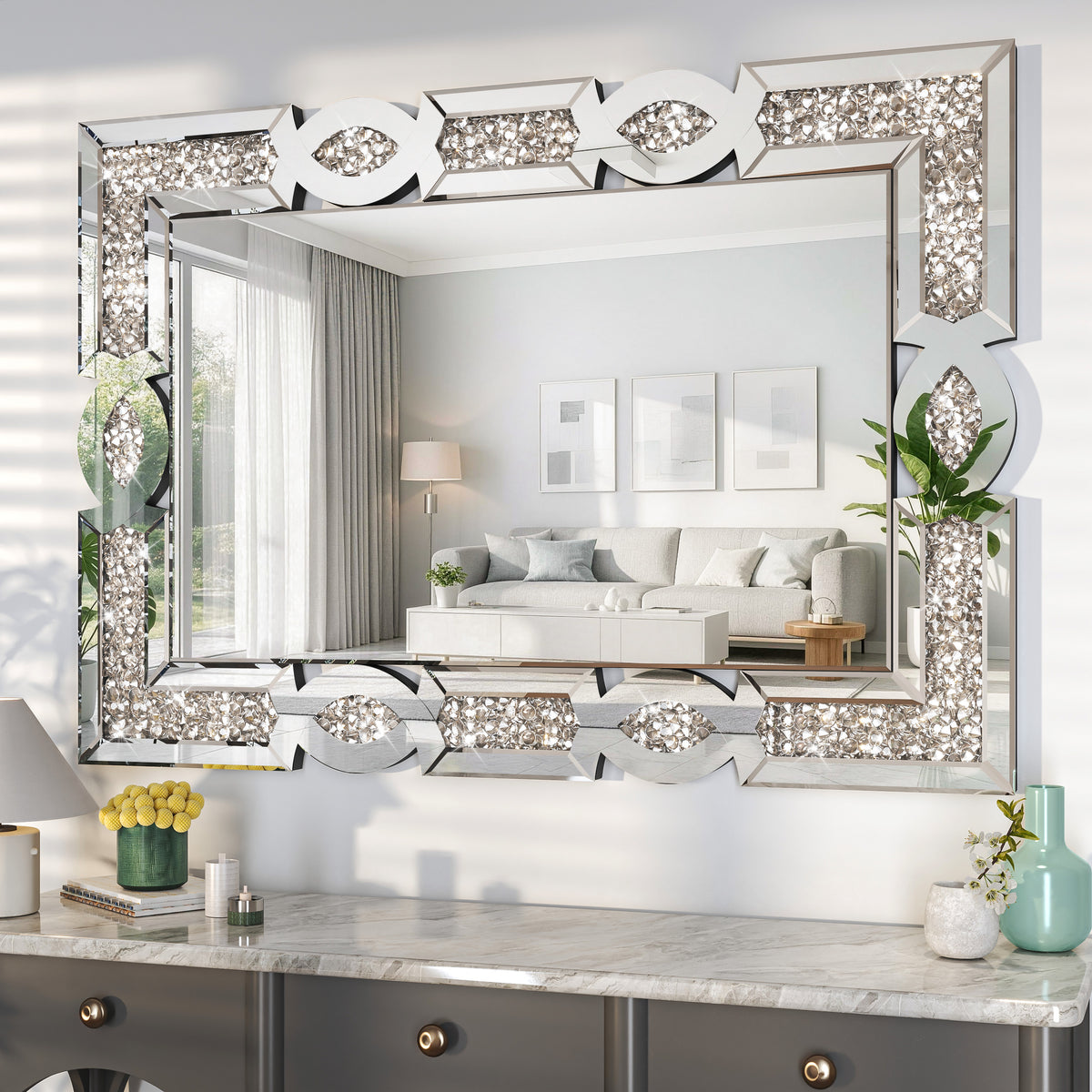
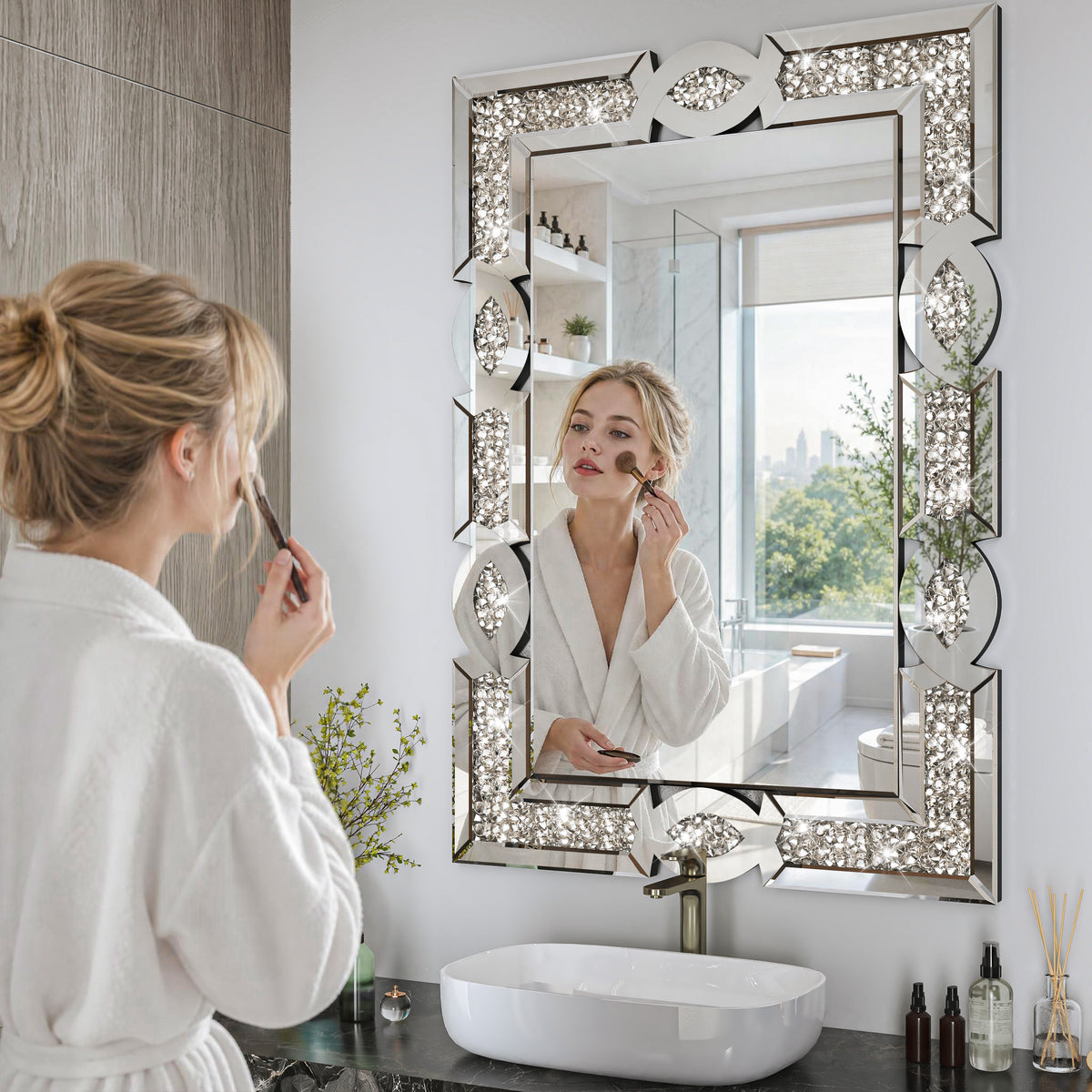
An irregular mirror can turn the vanity area into a decorative focal point. When measuring, use the widest and tallest points of the mirror, then check how much usable glass remains in the center.
The overall dimensions may be generous, but an uneven outline can leave less reflective area where you need it for grooming.
Should You Choose a Larger Mirror for a Small Bathroom?
You don’t have to choose a tiny mirror just because the bathroom is small. A mirror with a generous reflective surface can bounce light around the room and help the space feel more open.
The key is to choose a size that fits the wall comfortably.
For a small bathroom, try these ideas:
- Use the vanity as your guide. A mirror that relates to the width of the sink area usually feels more intentional than a very small mirror on a large wall.
- Look at frameless or slim-frame designs. They can provide more visible glass without adding a heavy border.
- Check the vertical space. A tall mirror may give you more viewing area when the wall is narrow.
- Consider what the mirror reflects. A window, a nice tile detail, or an uncluttered wall can improve the view.
- Leave room around nearby fixtures. A larger mirror should still fit comfortably beside lights, cabinets, and walls.
A big mirror can work in a small bathroom, but it should still leave the vanity easy to use and maintain.
Don’t Forget About Lighting
The mirror and lighting should be planned together. If you choose the mirror first and the lights later, you may discover that there isn’t enough space for the combination you want.
With lights above the mirror
Measure from the countertop or backsplash to the bottom of the light fixture. Then check whether the mirror height you want will fit within that space.
A wide rectangular mirror can look great beneath a horizontal vanity light. Be sure to consider the actual size and position of the fixture rather than relying on the size shown in a styled photo.
With sconces beside the mirror
Side sconces can frame a mirror and provide light from both sides of the face. They also reduce the width available for the mirror.
Measure between the parts of the fixtures closest to the mirror, including their shades. Follow the fixture manufacturer’s instructions when planning the installation.
With an LED bathroom mirror
An LED mirror combines the mirror and lighting in one piece, which can be useful when you want a cleaner-looking wall.
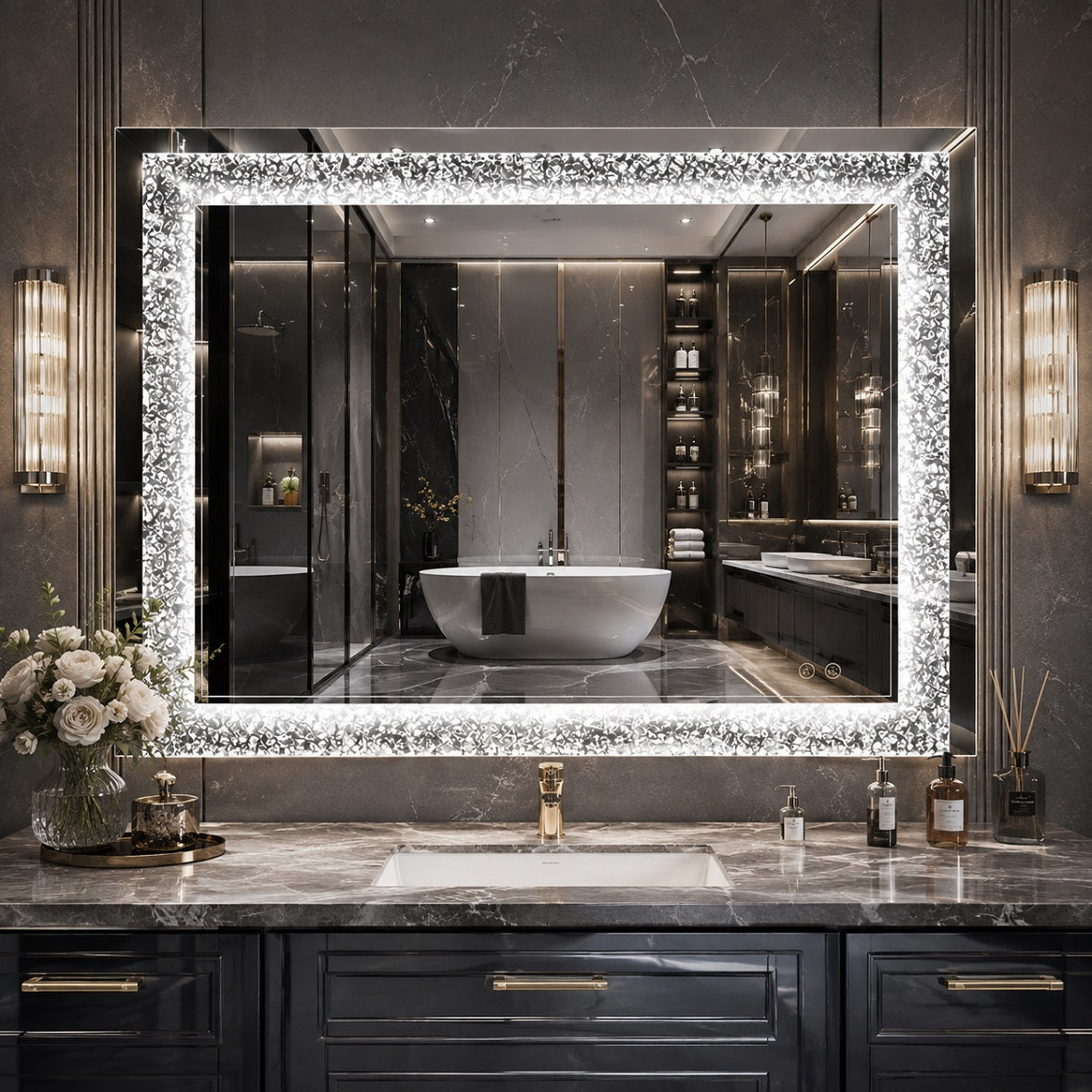
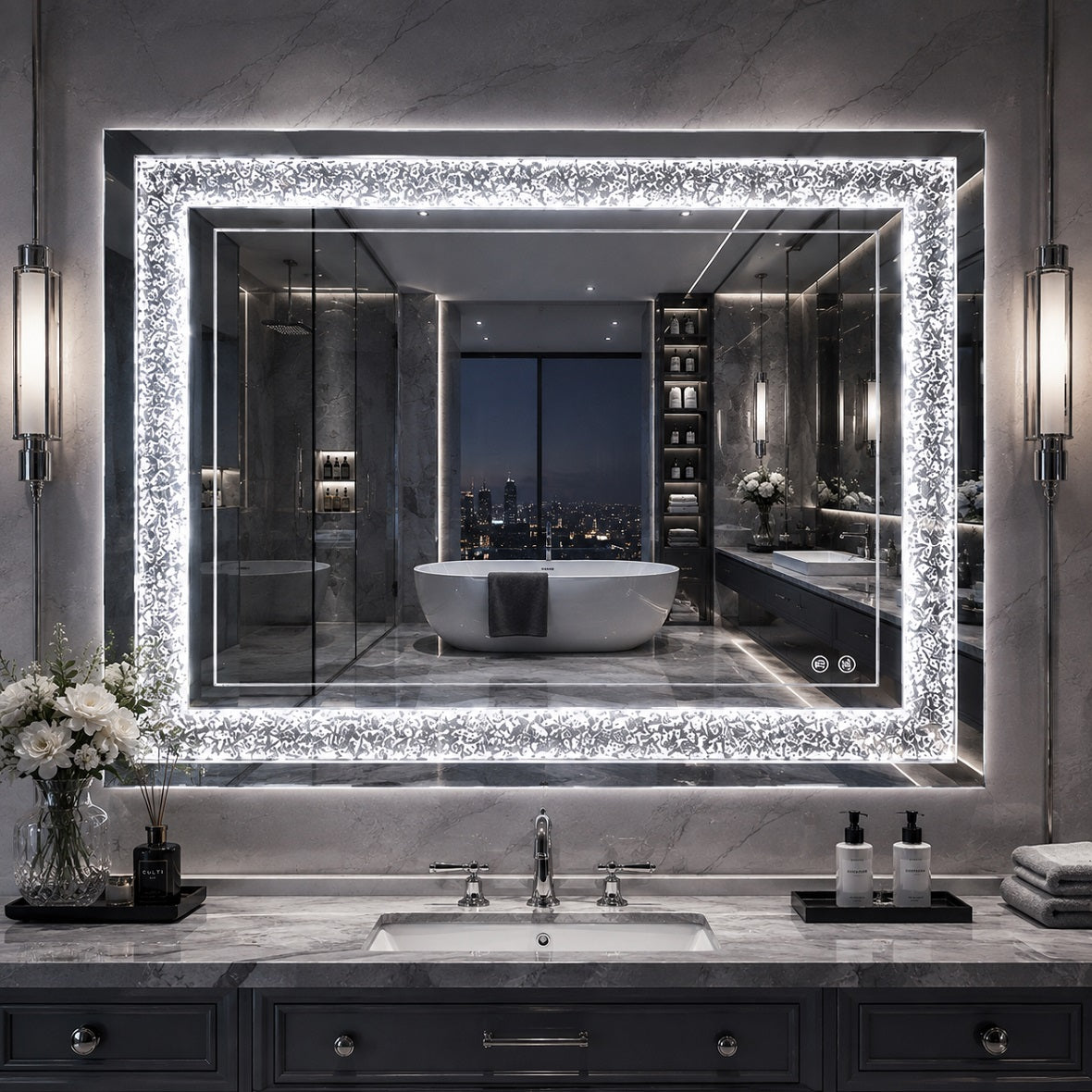
When comparing sizes, check whether the listed dimensions include the illuminated border. Also consider how the mirror connects to power and whether its features fit your routine. Depending on the model, features may include dimming, adjustable light colors, or an anti-fog function.
For hardwired models, follow the manufacturer’s instructions and use a qualified electrician where required.
Choosing a Hasipu Bathroom Mirror for Your Vanity
Once you know your available width and height, choosing a mirror becomes much easier.
For a simple look, a framed rectangular mirror can bring structure to the vanity area. If you prefer softer lines, a round, oval, or arched mirror may be a better fit. And if you want integrated lighting, an LED mirror can bring light and reflection together in one design.
As you compare options, look beyond the headline dimensions. Check the outside size, hanging orientation, frame or lighted border, and installation requirements. For a shared bathroom, make sure the mirror works for everyone who uses the sink.
You can explore Hasipu bathroom mirrors to compare different shapes, sizes, and features.
Final Thoughts
The right bathroom mirror size starts with the vanity, but it doesn’t end there. Your sink position, wall space, lighting, and daily routine all matter.
Use the size chart to narrow down your options, then mark the mirror on the wall and check it from the sink. Whether you choose one wide mirror, a pair of individual mirrors, or a simple round design, the best fit is the one that feels comfortable to use and at home in your bathroom.
Frequently Asked Questions
What size mirror should I use for a 30-inch vanity?
A mirror around 22 to 26 inches wide is a useful starting point. A 24-inch mirror leaves approximately 3 inches on each side when centered above a 30-inch vanity. Check the sink position and nearby lights before making your final choice.
What size mirror looks best over a 36-inch vanity?
Many bathrooms can accommodate a mirror around 28 to 32 inches wide above a 36-inch vanity. A 30-inch mirror is a balanced option if the sink and vanity are centered. A full-width 36-inch mirror can also work when the wall layout allows it.
What size mirror should go over a 48-inch vanity?
For one mirror above a 48-inch vanity, start by comparing widths around 36 to 42 inches. If the sink is off-center, measure from the sink center to the vanity edges before deciding how wide the mirror can be.
Should a bathroom mirror be centered over the sink or the vanity?
In most single-sink bathrooms, centering the mirror over the sink gives the person using it a comfortable view. If the sink is off-center, this may leave more wall visible on one side. You can also center a wide mirror over the entire vanity if it still provides a useful reflection at the sink.
Can a mirror be the same width as the bathroom vanity?
Yes. A mirror that matches the vanity width can create a clean, continuous look. Measure the available wall space carefully, especially if there are sconces, cabinets, or side walls close to the vanity.
How much space should be between two mirrors over a double vanity?
There is no single spacing that works for every bathroom. Start with the sink centers, the outside width of each mirror, and any light fixture between them. A few inches of open wall can create visual separation, while a center sconce may require more room.
Is a round mirror too small for a bathroom vanity?
Not necessarily. A round mirror can work well above a vanity when its diameter fits the wall and gives you enough reflective space. Keep in mind that the curved shape provides less glass near the corners than a rectangular mirror of the same width.