Table of Contents
A mirror above the dresser is practical. A mirror with an unexpected curve can change how you feel about that whole corner of the room.
That’s the appeal of irregularly shaped mirrors. Their outlines give an ordinary wall something interesting to work with, even when the furniture and paint stay exactly as they are. Some have gentle curves that resemble a smooth stone. Others have deep waves or an uneven silhouette that catches your eye from across the room.
The shape is only part of the story, though. Where the curves fall, what appears in the glass, and how the mirror relates to the furniture nearby all affect the result. A few details are easy to miss when you’re looking at a product photo.
The Shape Can Do the Work of a Piece of Art
An irregular mirror can fill the spot where you might otherwise hang a painting or a group of framed prints.
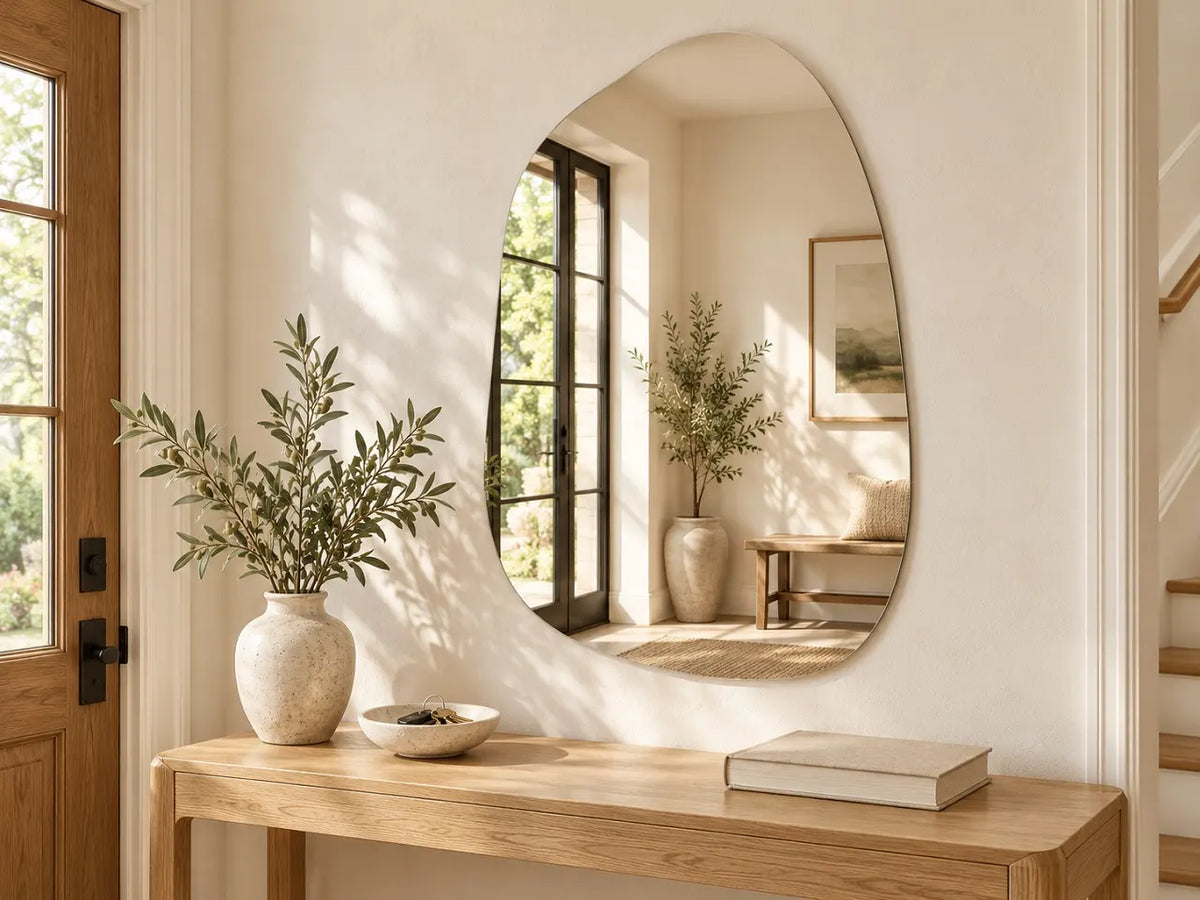
Think about a small entryway with a wood console and an empty wall above it. A mirror with a loose, flowing outline introduces a focal point while giving you somewhere to check your reflection before heading out. You may find that a lamp and a shallow bowl for keys are all the console needs.
The wall around the mirror helps define its shape. Crowding the edges with shelves, tall branches, or several small pictures can make those curves harder to appreciate. Let a little of the wall remain visible, especially around the most unusual part of the outline.
This doesn’t mean the whole room needs to be minimal. An irregular mirror can sit comfortably among books, patterned upholstery, and collected objects. It simply helps to give its own section of wall some breathing room.
When browsing Hasipu’s irregular mirror collection, consider how much of the decorating you want the shape to do. A subtle curve can quietly finish a room. A pronounced wave will draw more attention.
Wavy and Asymmetrical Mean Different Things
The names often appear together, but they describe different features.
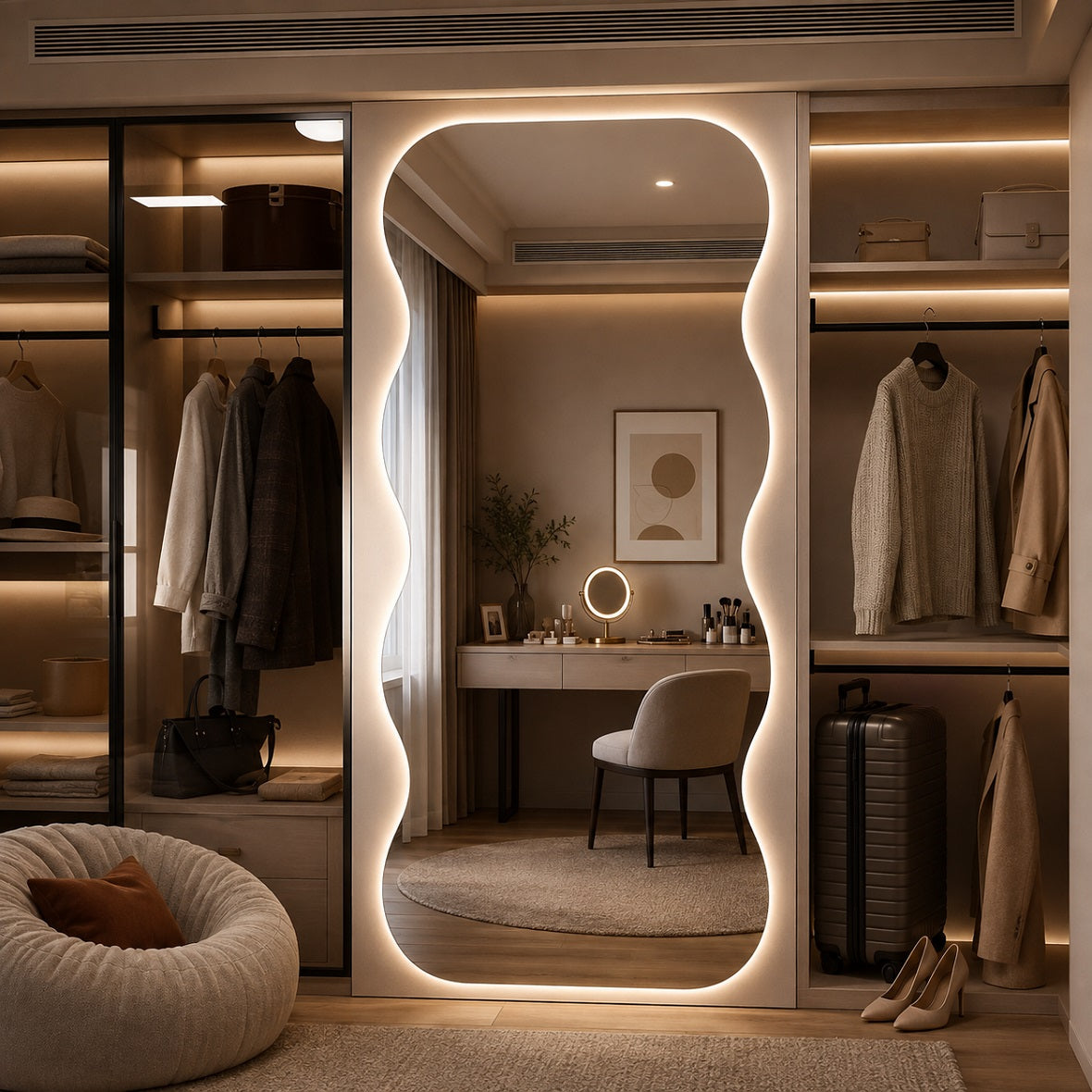
A wavy mirror has curves that repeat along its edge or frame. Those waves may be evenly arranged, so the overall design can still have matching sides.
An asymmetrical mirror has an uneven outline. One side might bulge outward while the other narrows, or the top may curve in a different direction from the bottom.
Then there are organic-shaped mirrors, which take their visual cues from natural forms. Picture the outline of a pebble or the edge of a small pool of water. These shapes often feel softer than a sharply defined geometric design.
The distinctions are useful when you’re shopping. A deeply rippled frame might bring more movement than you want above a quiet bedroom dresser. A gently uneven, frameless shape could give you the softer effect you had in mind.
Look at the glass as well as the frame. Sometimes the frame supplies most of the unusual shape while the reflective opening remains fairly conventional.

Your Reflection Should Still Look Like You
A wavy outline doesn’t automatically create a wavy reflection.
The shape around a flat mirror determines where the reflected view ends. It doesn’t, by itself, stretch your face or change your proportions. A mirror cut into an uneven silhouette can still provide the same kind of everyday reflection you expect from a rectangular one.
What can change is how much you see.
A narrow section may crop part of your shoulders. A wide frame can reduce the visible glass. A tall, tapered tip might add height to the product without adding much useful viewing space.
That’s why two mirrors with the same listed dimensions can feel quite different in use. For a decorative spot above a sideboard, the silhouette may be your main concern. For getting dressed or doing your hair, pay closer attention to the broad, continuous area of glass.
A Small Room Can Handle a Bold Mirror
A compact room doesn’t always need a tiny mirror.
In a narrow entryway, one generously sized mirror above a slim console can make a more coherent arrangement than several small decorations scattered around the wall. The irregular outline supplies interest without requiring more furniture on the floor.
Scale still matters. A mirror squeezed against door trim or pushed tightly beneath a light fixture can feel cramped, no matter how attractive its shape is. Measure the available wall, then leave enough space for the outline to remain clear.
A paper cutout is useful here. Make an approximate silhouette at the intended size and place it on the wall. You’ll quickly see whether the widest curve crowds a doorway or whether the mirror looks too small above the furniture.
The reflected view matters, too. A mirror that catches a bright window or a view into the next room can add a sense of depth. One facing a crowded coat rack will repeat the coats.
The shape adds character; the placement determines what that character comes with.
Perfectly Centered Can Still Look a Little Off
With a rectangle, the midpoint is easy to see. An irregular shape can make things less obvious.
Imagine a mirror with a full, rounded section on the left and a much slimmer edge on the right. Centering its outer measurements above a dresser may still make the arrangement appear heavier on one side.
Before drilling, look at a paper template from the places where you’ll actually see the mirror. The doorway often gives you a better sense of the overall arrangement than standing directly beneath it.
A small shift may help. Sometimes moving the lamp or lowering a nearby vase makes more difference than moving the mirror itself.
Above a bathroom vanity, daily use should guide the decision. The people using the sink need a comfortable view of their faces, even when a slightly different position might look more balanced in a photograph.
For ideas on arranging the surrounding pieces, our guide to styling an asymmetrical mirror explores how the shape can work with consoles, dressers, and other furniture.
They Can Feel at Home Beyond Modern Interiors
An irregular mirror doesn’t require a room full of curved furniture or a completely new decorating style.
The frame finish and the strength of the curves help determine how it fits.
A gently uneven mirror with a warm metallic finish can sit comfortably above a traditional wood dresser. A thin black frame can relate to existing cabinet hardware or a nearby lamp. A frameless design may suit a room where you want the outline to feel light and unobtrusive.
In a relaxed bedroom, try a soft, rounded silhouette alongside linen bedding and familiar wood furniture. The mirror brings a new shape into the room without demanding a new color scheme.
A more playful interior can accommodate a deeper wave or a stronger frame color. That kind of mirror will become a noticeable decorative feature, so choose a spot where you want the attention to land.
You don’t need to repeat the exact outline elsewhere. A curved chair back or a round lampshade can provide enough connection. Keeping some straight lines around the mirror gives its shape definition.

What Appears in the Glass Becomes Part of the Room
It’s easy to choose a mirror by looking only at its outline. Once it’s installed, the reflection occupies most of what you see.
That reflected view changes as you move.
From the doorway, the mirror might catch a window. From the sofa, it might show a bookcase. An inward curve can crop a detail you hoped to include, while a wider section may reveal something you hadn’t considered.
Think about the room from those everyday viewpoints. In a living room, a reflection of a plant or a favorite piece of art can bring a pleasant detail into another part of the space. In an entryway, an open view into the house may feel more welcoming than a close-up of the shoe storage.
Check the lighting from those positions as well. A lamp can look inviting in the reflection until its exposed bulb lines up with your eyes from a chair.
You can also improve the view without moving the mirror. Adjusting a plant, clearing a small surface, or relocating a lamp may be enough to make the reflection feel more intentional.
Lighting Gives the Same Shape a Different Mood
An irregular mirror can look quite different after sunset.
During the day, you may notice its outline against the wall and the room reflected in the glass. With integrated lighting switched on, the illuminated edge can become a more prominent part of the design.
That can be especially appealing above a vanity, where the mirror has both a decorative role and an everyday purpose.
For an irregular LED mirror, think about how you want to use the light. A gentle glow may suit the room in the evening. Getting ready requires enough useful light on your face. A bright-looking outline in a product photo doesn’t tell you everything about that experience.
The Hasipu KM-BGZ LED irregular mirror combines a cloud-shaped silhouette with adjustable brightness and three color-temperature settings. Those controls let you vary the lighting to suit your preferences and the other fixtures in the room.
Consider the mirror with the rest of the bathroom lighting on, too. The combination is what you’ll live with each morning.
Frequently Asked Questions
1. Can an irregular mirror work as a full-length mirror?
Yes. Look for enough continuous glass to see your full reflection from your usual standing position. Pay attention to narrow sections, wide frames, and installation height. A tall outer measurement alone doesn’t tell you how useful the mirror will be for checking an outfit.
2. Can I use an irregular mirror in a bathroom?
Choose a model intended for that environment. Check the manufacturer’s guidance for the frame, backing, and any electrical components. A mirror’s shape doesn’t establish its suitability for moisture, and an anti-fog feature doesn’t mean it can be installed anywhere near water.
3. Can I hang an asymmetrical mirror sideways?
Only when its mounting hardware and instructions support that orientation. The outline may look good turned sideways, but the brackets, controls, and cord placement can limit the approved positions. Try the different layouts with a paper template before choosing your installation.
4. Will two identical irregular mirrors make a balanced pair?
They can create an attractive repeated arrangement, particularly above a double vanity. They won’t necessarily form matching left and right outlines, though. Rotating an asymmetrical shape doesn’t always reverse it. Compare the two silhouettes in their approved hanging positions, with enough useful glass above each sink.