Table of Contents
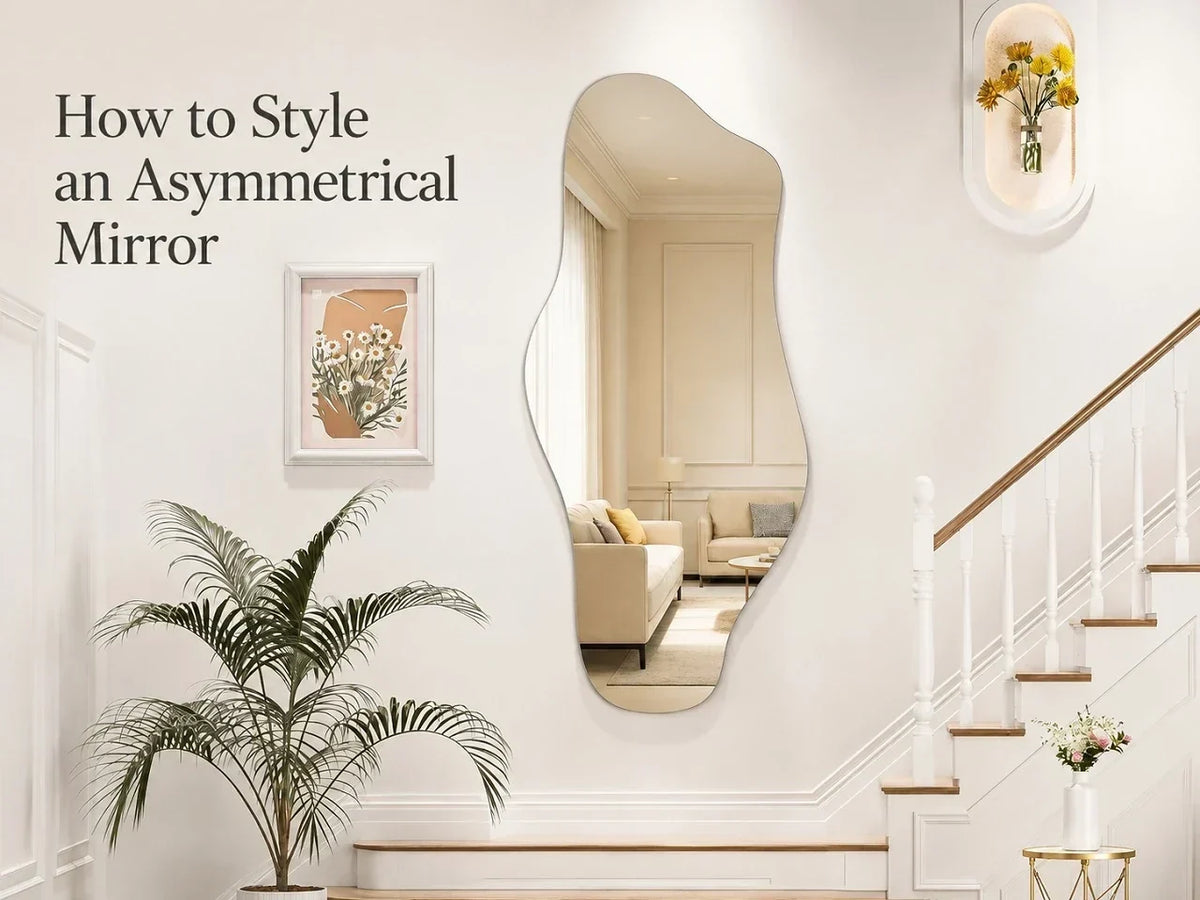
An asymmetrical mirror doesn’t need much help to get noticed. Its uneven outline draws the eye on its own, even when the rest of the room is quiet and simple.
The tricky part is deciding what belongs around it. Centering every object may make the arrangement feel stiff, while adding too many accessories can hide the shape that made the mirror interesting in the first place. In most rooms, the better approach is to leave some open wall, relate the mirror to the furniture below, and check what will appear in the reflection.
This guide explains how to style an asymmetrical mirror above a console, dresser, bathroom vanity, or fireplace. It also covers size, hanging height, lighting, orientation, and the placement mistakes that can make an irregular mirror feel awkward.
What Is an Asymmetrical Mirror?
An asymmetrical mirror is not perfectly round, square, or evenly balanced on both sides. Its outline may dip in one area, stretch outward in another, or curve in a way that feels loose and unexpected.
You may also see these designs called irregular mirrors, organic-shaped mirrors, wavy mirrors, pebble mirrors, pond mirrors, or freeform mirrors. The names vary, but they generally describe the same idea: a mirror with a less formal shape than a standard rectangle or circle.
That uneven outline is what makes the design useful. It softens the straight edges created by cabinets, doors, tile, tables, and other furniture. The mirror brings shape and movement to the wall without requiring several pieces of art around it.
Some asymmetrical mirrors are frameless and almost disappear into the room. Others have black, brass, wood, or colorful frames that make the outline even more noticeable. Neither approach is automatically better. The right choice depends on how much attention you want the mirror to receive.

How to Style an Asymmetrical Mirror
An asymmetrical wall mirror already behaves a little like artwork. Begin with the mirror itself, then add only what helps it feel connected to the room.
Try Different Orientations Before Hanging It
Many irregular mirrors don’t have an obvious top or bottom. Turning the same mirror 90 degrees may give it a completely different character.
Place it on the floor or ask someone to hold it against the wall in several positions. Take a photo of each arrangement and compare them from across the room. Photos make an awkward tilt or unbalanced gap much easier to spot.
Look at the mirror’s widest curve. If one side of the wall already feels heavy because of a tall cabinet, lamp, or doorway, pointing the fuller part of the mirror in the opposite direction may create better balance. A narrow edge can also point toward a window, shelf, or light fixture and quietly connect the two elements.
Don’t assume the orientation shown in a product photo is the only correct one. The room should decide.
Check the Reflection Before Choosing the Wall
A mirror repeats part of the room, so the reflected view matters as much as the frame and shape.
Stand where you plan to hang it and face the opposite direction. You’re now looking at roughly what the mirror will show every day.
A window, plant, attractive light fixture, artwork, or open doorway can make the room feel brighter and deeper. A pile of shoes, cluttered counter, television, toilet, or open closet will also become more noticeable once it is reflected.
Watch for glare as well. Direct sunlight or an exposed bulb may look harmless from the side but become uncomfortable when reflected at eye level. Test the position at different times of day if the mirror will face a window.
Use Simple Furniture to Ground the Shape
Freeform curves look especially good above furniture with a clear horizontal line. A console, dresser, vanity, sideboard, fireplace mantel, or floating shelf gives the irregular outline a stable base.
This contrast works well in rooms dominated by square furniture. A bathroom may have rectangular tile, a boxy vanity, and sharp cabinet lines. Replacing another rectangle with an organic-shaped mirror loosens the room without changing anything else.
The mirror should usually be narrower than the furniture below it. Around two-thirds of the furniture’s width is a useful starting point, but treat it as a visual guide rather than a strict formula. Measure the mirror at its widest point—not through the center—because an uneven edge may take up more wall than expected.
A very small mirror over a long console often looks lost. One that extends beyond both sides of the furniture may feel top-heavy. Use painter’s tape to mark the approximate outline before ordering or drilling.
Keep the Surface Below It Relaxed
An asymmetrical mirror doesn’t need matching lamps or identical objects on both sides. A less formal arrangement usually suits it better.
Try a taller object on one side and two lower objects on the other. For example, place a slim table lamp at one end of a console, a tray near the middle, and a short stack of books with a small ceramic piece at the opposite end.
The objects don’t have to match. They only need enough visual weight to keep one side from feeling empty.
Leave some of the surface uncovered. A little open space gives the eye somewhere to rest and keeps the arrangement useful. Entryway consoles still need room for keys and mail. Dressers need space for everyday items. A beautiful setup becomes annoying quickly if it takes over the entire surface.
Avoid placing your tallest vase directly in front of the mirror’s most interesting curve. Covering the irregular outline defeats the point of choosing it.
Repeat One or Two Curves in the Room
A curved detail elsewhere in the room helps the mirror feel connected rather than random. It might be a globe lamp, round vase, arched chair back, oval tray, curved faucet, or softly shaped rug.
There’s no need to repeat the exact mirror shape. A small relationship between forms is enough.
Too many wavy accessories create the opposite problem. When the lamp, rug, table, shelf, vase, and wall art all have irregular edges, the mirror loses its impact. Let it be the most unusual shape in the room.
Use Color and Lighting to Define the Outline
A frameless mirror may blend into a pale wall, especially when it reflects another light-colored surface. That soft look can be beautiful, but the irregular edge won’t be as easy to see.
Muted green, warm taupe, clay, navy, or charcoal creates more contrast. Wallpaper is another option. The solid glass gives the eye a break from the pattern while allowing the print to show around every curve.
On a white or cream wall, a thin black frame produces a clean outline. Wood adds warmth, and brass brings a dressier finish without making the shape feel heavy.
Lighting should support the room rather than trace every curve. In an entryway or living room, a nearby table lamp may be enough. Position it so the glow appears in the mirror without reflecting a bare bulb directly toward the viewer.
Bathroom lighting needs more care. A centered fixture above an irregular mirror can look off if the glass is much wider on one side. Side sconces may provide more even facial light, but their spacing must account for the mirror’s widest edges.
An asymmetrical LED mirror can create a soft outline against the wall. Check whether its lighting is intended for makeup and grooming or mainly for ambiance. Decorative backlighting may still need support from ceiling or vanity lights.

Asymmetrical Mirror Ideas for Different Rooms
The same mirror won’t work the same way in every setting. An entryway mirror is mostly decorative with a quick practical purpose. A bathroom mirror needs a usable reflection, safe placement, and good lighting.
In an Entryway
An asymmetrical mirror can give a small entry more character without occupying floor space. Hang it above a narrow console or floating shelf, then keep the styling useful: a lamp, a bowl for keys, and perhaps one vase or small plant.
A vertical irregular mirror works well in a narrow foyer because it fills height without crowding the walkway. A wider shape suits a longer console and can make the entrance feel more open.
Look at the reflection from the front door. Seeing greenery, artwork, or a softly lit room creates a pleasant first view. Reflecting a coat rack, shoe pile, or bright exterior light may make the entrance feel busier.
Make sure the door can open fully without striking the mirror or nearby furniture.
In the Living Room
Treat a living room mirror much like a large piece of art. It can sit above a fireplace, sideboard, low cabinet, or console. A large organic mirror may also hold an empty wall on its own.
Curved glass is particularly helpful when the room contains a rectangular sofa, square coffee table, linear shelving, and large windows. It breaks up those repeated angles without adding another color or material.
Be cautious about placing the mirror directly opposite the sofa. Constant movement in the reflection can feel distracting while people are seated. Shifting the mirror to a nearby wall may still spread light without keeping everyone’s reflection in view.
Above a fireplace, check the distance from the mantel and the heat requirements for both the mirror and mounting materials. The mirror should feel connected to the fireplace rather than floating close to the ceiling.
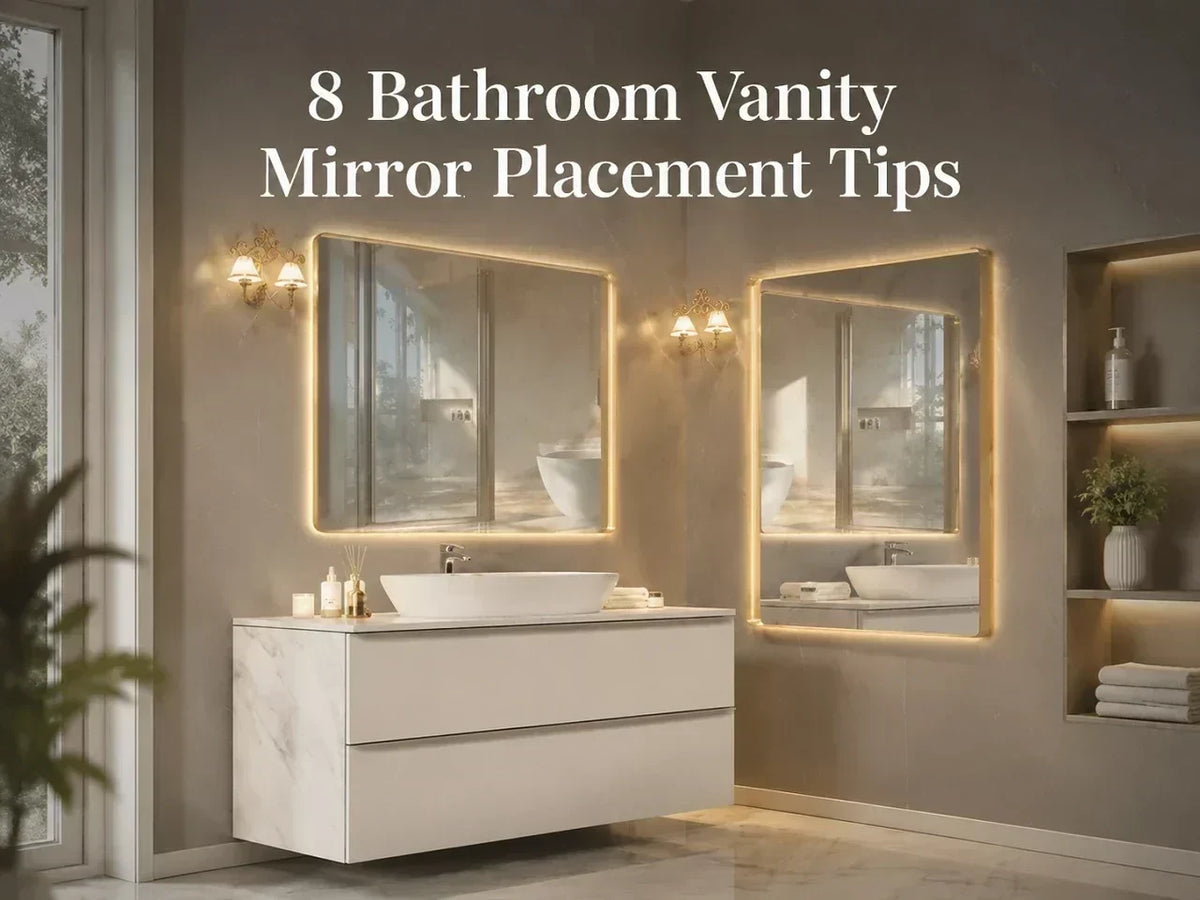
Above a Bathroom Vanity
An asymmetrical bathroom mirror can make an ordinary vanity look custom, but function comes before perfect visual balance.
Center the usable glass over the sink instead of centering the complete outline. With an irregular design, those two centers may not be in the same place. Stand in front of the vanity and confirm that each person using the bathroom can see their face and upper body comfortably.
Check the faucet, backsplash, outlet, wall switches, sconces, ceiling, and any cabinet doors before choosing the final position. Measure every outer curve. One edge may reach farther toward a light or cabinet than it appears to in a product photo.
For a shared double vanity, two matching organic mirrors create a strong design feature. Keep their orientation consistent for a calmer look, or rotate one if you want a more playful arrangement. The second approach works best when the rest of the bathroom is fairly simple.
Confirm that the mirror and any built-in electrical features are suitable for the intended bathroom location. Follow the manufacturer’s installation instructions, and use a qualified electrician for hardwired connections where required.
Above a Bedroom Dresser
A freeform mirror softens the long horizontal lines of a dresser and gives the bedroom a less formal feel.
Leave roughly 6 to 10 inches between the dresser and the lowest edge of the mirror as an initial guide. The ideal distance depends on the dresser’s height, the shape of the glass, and how the mirror will be used. A lower placement may feel better when the mirror is mostly decorative. A functional dressing mirror needs a clear view at standing height.
Keep the dresser styling light. A lamp, jewelry tray, perfume bottle, or short stack of books is usually enough. Let some of the mirror extend into open wall rather than surrounding it with framed pictures.
If you don’t want the bed reflected, test the view before installation. A small shift left or right may solve the problem.
Getting the Size, Height, and Placement Right
An irregular mirror can be harder to position than a rectangle because the visual center may not match its physical measurements.
Measure the Widest and Tallest Points
Product dimensions usually show the maximum width and height. Use both when planning the wall.
Mark those measurements with painter’s tape. Then add smaller pieces of tape to suggest the main curves. The outline doesn’t need to be exact; you’re checking scale, clearance, and the amount of open wall around the mirror.
Step back to the place where you normally enter or view the room. A mirror that seems large while you’re standing close to the wall may look surprisingly small from the doorway.
Use Eye Level as a Starting Point
On an open wall, placing the functional center of a mirror around average eye level—often somewhere between 57 and 65 inches from the floor—is a practical starting point. Adjust that height for the people in your home and the way the mirror will be used.
Above furniture, the relationship between the two pieces matters more than a standard floor measurement. If the gap is too large, they may look disconnected. If it is too small, the arrangement feels cramped and leaves no space for lamps or accessories.
The lowest point of an asymmetrical mirror may sit several inches below the rest of the glass. Measure from that curve when checking clearance, but judge the overall position from across the room.
Don’t Center It Automatically
Centering is safe, but it isn’t always the best answer. An asymmetrical shape may look more balanced when it sits slightly to one side of the furniture below.
An offset mirror needs support from another object. A tall lamp, vase, pendant, or piece of artwork can occupy the open side and make the composition feel deliberate.
Move it enough for the placement to look intentional. A one-inch shift tends to resemble an installation mistake. A more noticeable offset, balanced by the decor below, reads as a design decision.
Leave Some Empty Wall Around It
The outline needs room to be seen. Squeezing an irregular mirror between a doorway, cabinet, shelf, and light fixture makes the curves harder to understand.
Try to preserve visible wall around at least part of the mirror. Frameless designs need this breathing room most because there is no contrasting frame to separate the glass from its surroundings.
If the wall is narrow, choose a simpler vertical shape instead of forcing a wide mirror into the space.
Matching an Asymmetrical Mirror to Your Decorating Style
Asymmetrical mirrors often appear in modern rooms, but they aren’t limited to one decorating style.
A thin black frame suits contemporary and industrial spaces. Pale oak or walnut works naturally with Scandinavian and organic-modern interiors. Brass pairs well with midcentury furniture, rich wall colors, and vintage-inspired lighting.
In a traditional room, a freeform mirror can be the unexpected element. Surround it with familiar materials such as dark wood, linen, stone, or antique brass. The contrast keeps the room from feeling like a showroom assembled from one matching collection.
Frameless designs are usually quieter. They work well when the room already contains strong colors, patterned wallpaper, or distinctive furniture. A thick or brightly colored frame has more personality and may suit a bedroom, creative workspace, or eclectic living room.
At Hasipu, we see the mirror’s shape as part of the room rather than a separate decoration. Look at the lines already present. If everything is square and rigid, a soft organic curve may be just what the wall needs. If the room already contains many sculptural pieces, choose a calmer irregular outline.

Asymmetrical Mirror Styling Mistakes to Avoid
A few placement problems appear again and again.
Choosing a mirror that is too small: A tiny freeform mirror on a large wall looks unfinished. Relate its widest measurement to the furniture below and the amount of surrounding wall.
Ignoring the reflected view: A beautiful outline won’t improve a reflection filled with cords, clutter, or harsh glare.
Adding too many accessories: An irregular mirror already supplies movement. It doesn’t need decor packed around every edge.
Repeating the wavy shape everywhere: One or two curved details connect the room. More than that can make the design feel themed.
Forgetting the functional center: In a bathroom or dressing area, the useful section of glass needs to be in the right place even if the complete outline looks slightly off-center.
Hanging it without testing the orientation: Rotate the mirror and photograph each option before installing it. The difference may be larger than expected.
Using unsuitable mounting hardware: Mirrors are heavier than they look. Follow the supplied instructions and choose fasteners appropriate for the mirror’s weight and the wall construction. Use studs or rated anchors where required.
Final Thoughts
Learning how to style an asymmetrical mirror isn’t about making both sides of the arrangement equal. It’s about making the visual weight feel settled.
Check the reflection, give the outline enough room, and connect it to the furniture below. Add a lamp, vase, or curved accessory only when the space needs it. The mirror should still be the first thing you notice.
When the size and placement are right, an irregular mirror can make a plain wall feel finished without filling it with extra decoration.
Frequently Asked Questions
1. Are asymmetrical mirrors still in style?
Asymmetrical mirrors continue to suit contemporary, midcentury, eclectic, and organic-modern rooms because they combine wall decor with an everyday function. A simple frame and useful size will usually age better than a highly exaggerated novelty shape.
2. What looks good next to an asymmetrical mirror?
Simple lamps, greenery, ceramic objects, books, trays, and furniture with straight edges all work well. Keep enough empty space around the mirror for its outline to remain visible.
3. Should an asymmetrical mirror be centered?
It can be, but it doesn’t have to be. An offset position may look better when a lamp, vase, or another object balances the open side. Test both arrangements with painter’s tape before drilling.
4. Can you place an irregular mirror over a bathroom sink?
Yes. Center the useful portion of the glass over the sink and make sure it provides a comfortable reflection. Check lighting, faucet clearance, outlets, cabinets, mounting requirements, and bathroom suitability before installation.
5. How big should a mirror be above a console?
A mirror around two-thirds the width of the console is a reasonable starting point. Measure the asymmetrical mirror at its widest point and adjust the scale for the wall, ceiling height, and other objects on the console.
6. Can an asymmetrical mirror work in a traditional room?
Yes. Pair it with familiar materials such as wood, stone, linen, or warm metal. The contrast between a freeform outline and traditional furniture can make the room feel collected rather than overly coordinated.