Table of Contents
A mirror changes how a home gym works. It gives you a clear view of your posture, helps you check lifting form, and makes a basement or spare room feel brighter and less boxed in. The harder decision comes next: should you cover the wall with small mirror tiles or install large mirror panels?
For most permanent home gyms, full-panel gym mirrors provide the clearest reflection and the cleanest finished look. Mirror tiles make more sense when the budget is tight, the wall is small, or you want an installation that can be arranged around outlets and other obstacles.
The right answer also depends on the wall itself. A slightly uneven surface may barely show under one large mirror, yet it can make a grid of small tiles look misaligned and distort the reflection from one section to the next.
What Are Mirror Tiles?
Mirror tiles are individual mirrored pieces installed next to one another to create a larger reflective area. Square tiles are common, though rectangular and geometric versions are also available.
Some are made from glass, while lighter products may use acrylic mirror or another reflective material. They are usually attached with adhesive strips, mirror-compatible adhesive, clips, or a combination specified by the manufacturer.
Their main appeal is flexibility. You can cover only the section of wall needed for a workout area, build a tall vertical arrangement, or work around a receptacle, vent, column, or wall-mounted accessory.
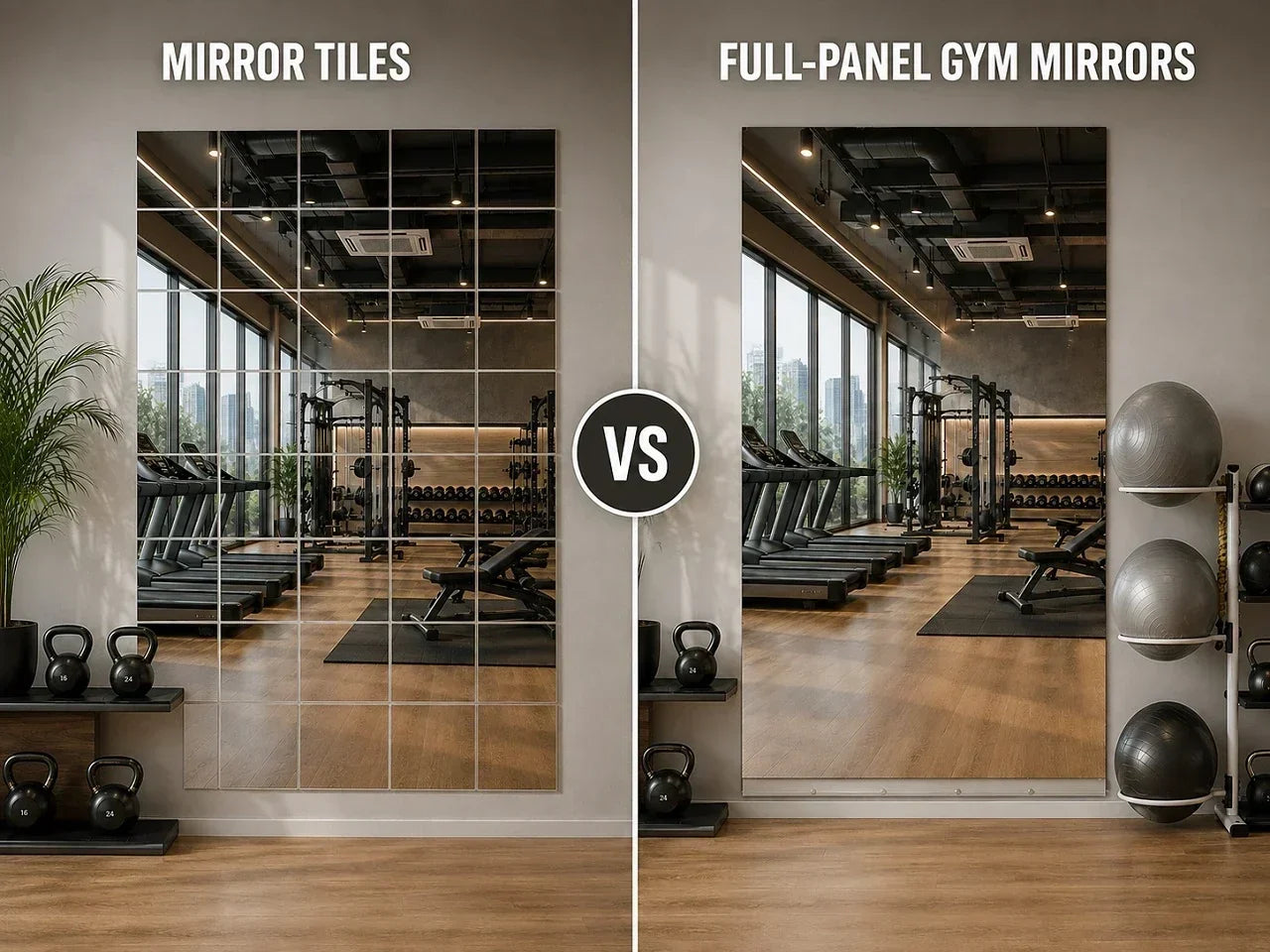
The tradeoff is visible seams. A wall made from 12 small mirrors will always read differently from a wall covered by two or three large panels.

What Are Full-Panel Gym Mirrors?
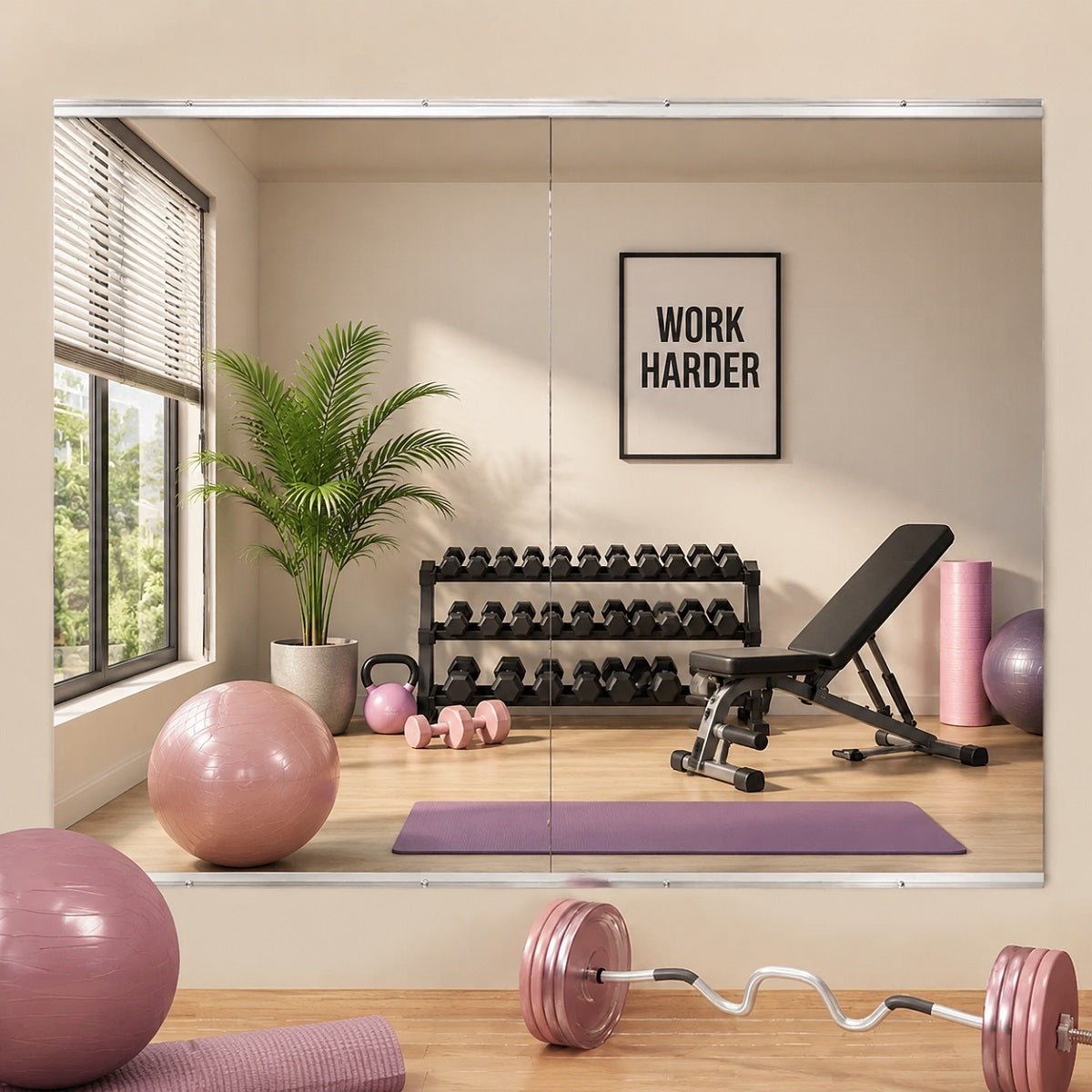
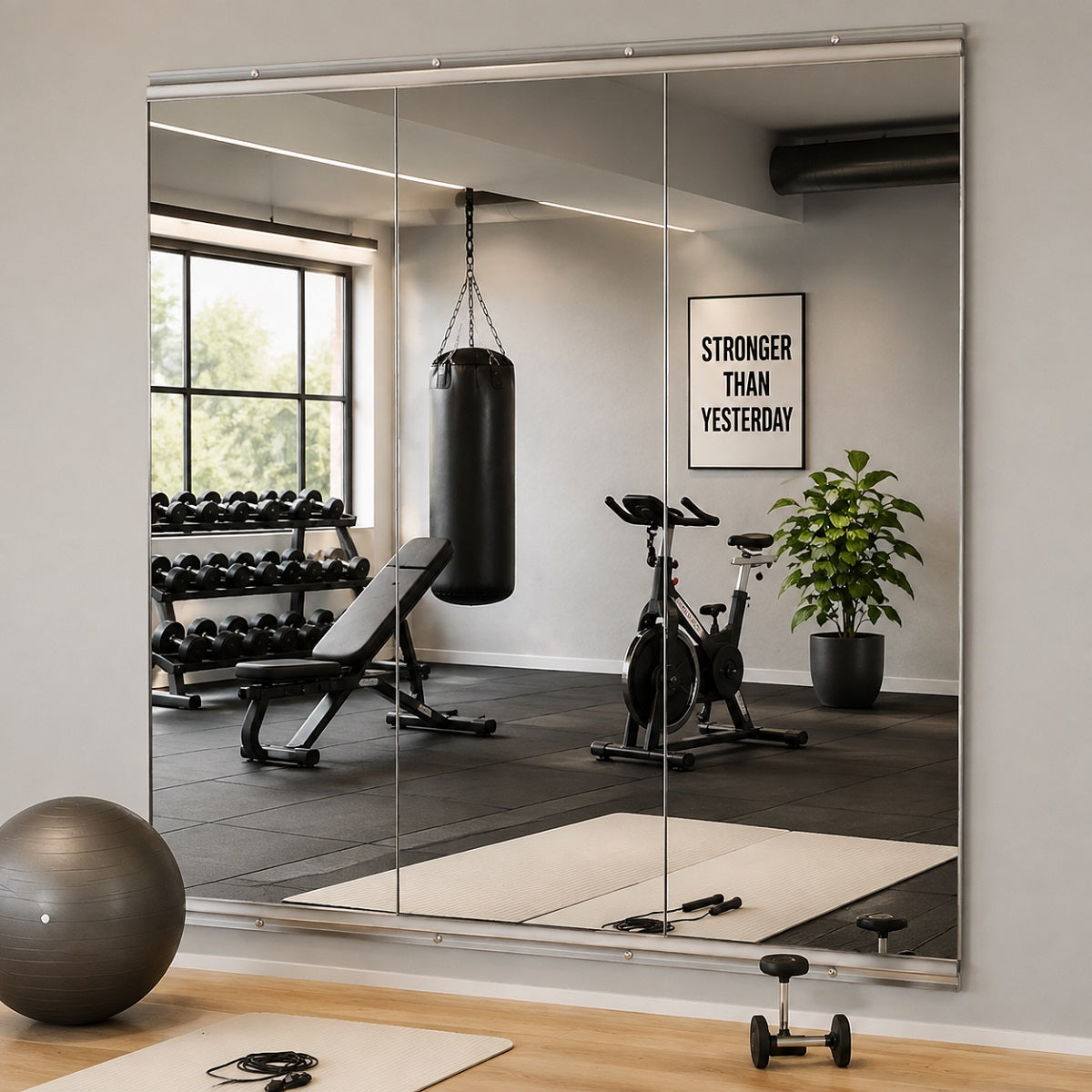
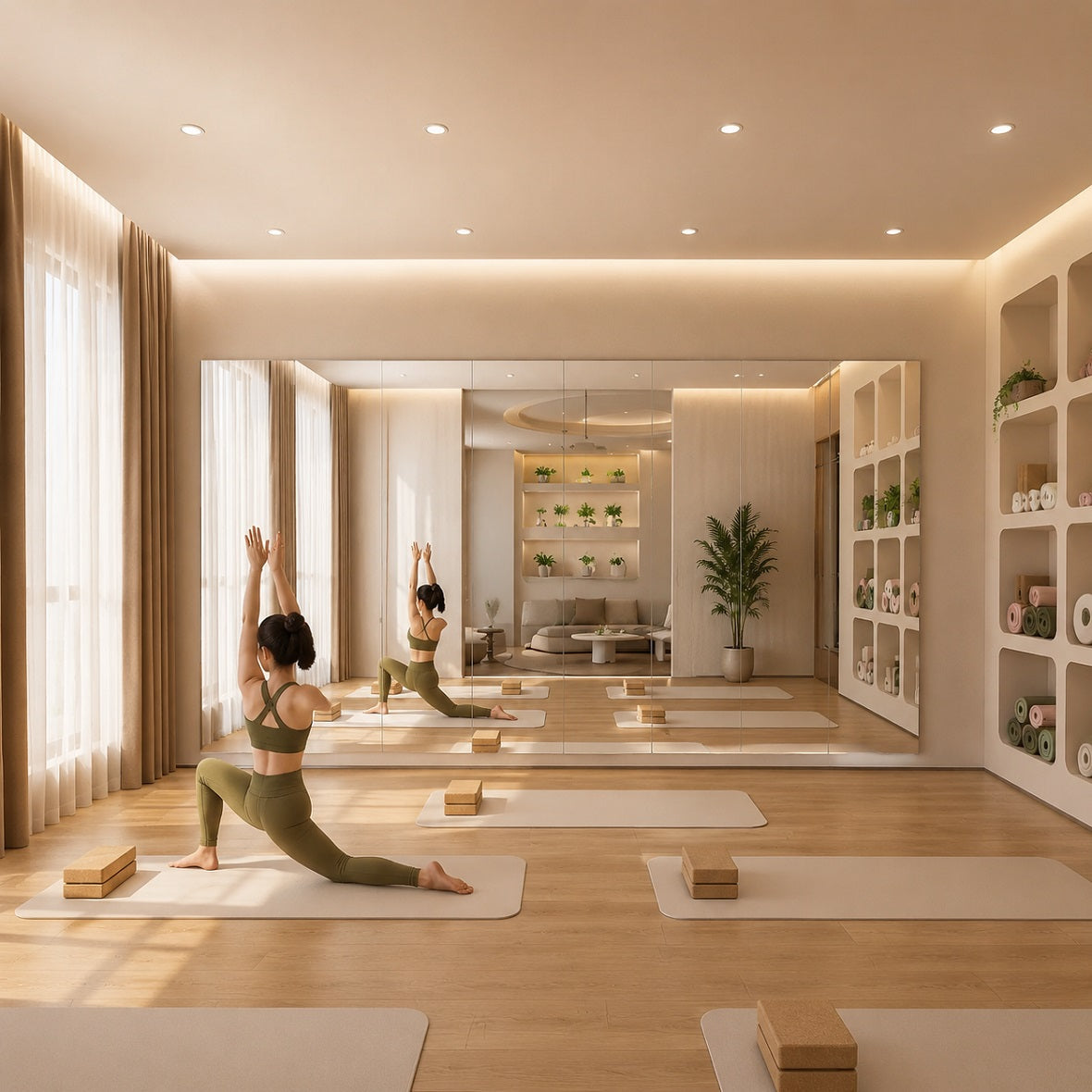
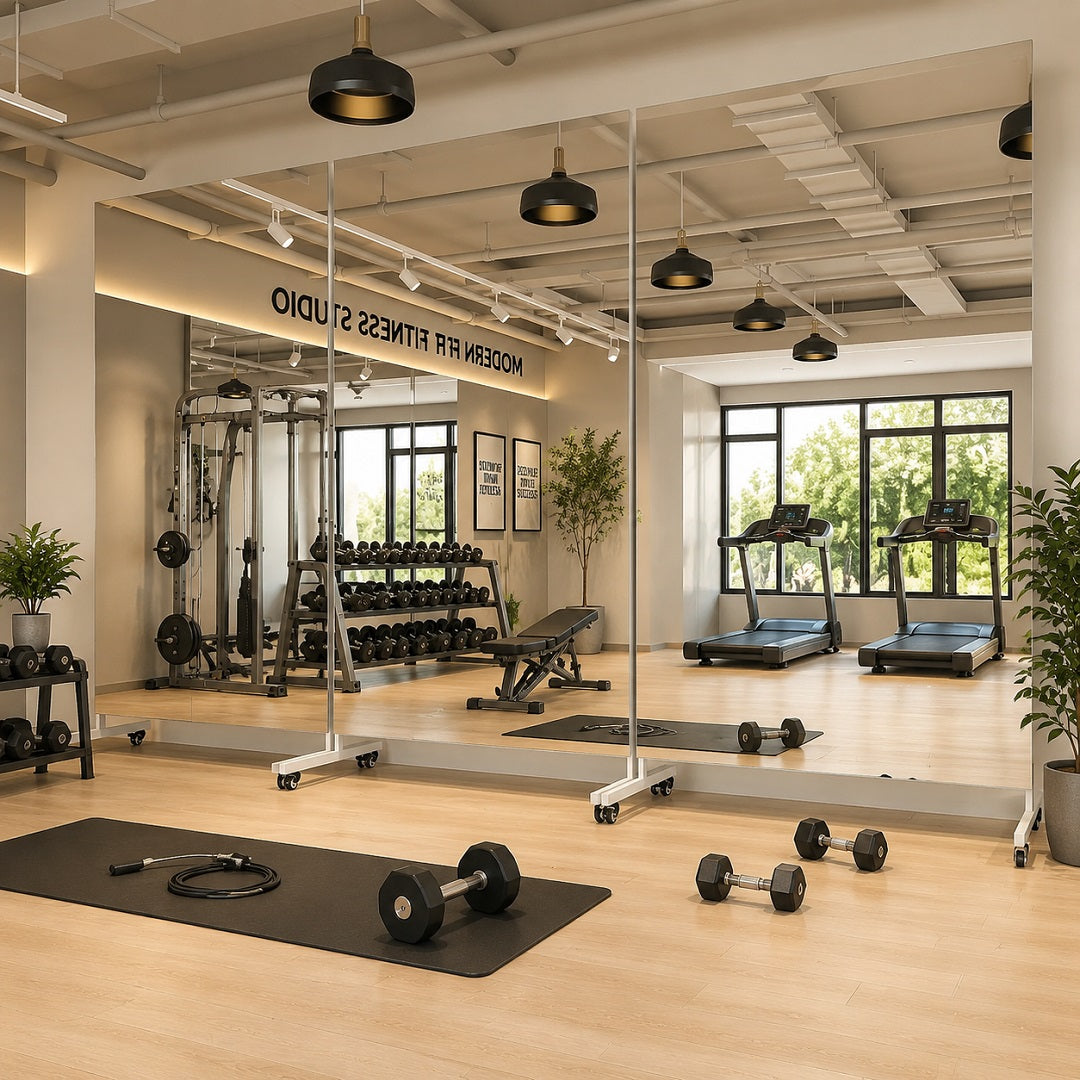
Full-panel gym mirrors are large mirror sections designed to cover a substantial portion of a workout wall. Smaller walls may need only one panel, while wider spaces usually use two or more panels fitted closely together.
Because each panel covers more surface than a mirror tile, there are fewer seams across the wall. This creates a cleaner reflection and makes it easier to follow your posture as you move.
You will often see large mirror panels in home gyms, weight rooms, yoga and dance studios, martial arts spaces, and personal training rooms. They work especially well for exercises such as squats, lunges, overhead presses, and stretches, where seeing your full body helps you check alignment and movement.
Mirror Tiles vs. Full-Panel Gym Mirrors at a Glance
| Comparison Mirror Tiles Full-Panel Gym Mirrors | ||
|---|---|---|
| Reflection | Divided by many seams | Broad and nearly continuous |
| Appearance | Modular or grid-like | Clean and professional |
| Best coverage | Small sections of wall | Wide workout walls |
| Installation | Easier to lift, harder to align | Harder to lift, fewer pieces to align |
| Wall condition | Unevenness becomes obvious quickly | Also needs a flat, stable surface |
| Cost | Lower for limited coverage | Higher upfront cost |
| Layout flexibility | Easy to work around obstacles | May require custom cutting |
| Replacement | One tile may be replaced | A damaged panel costs more to replace |
| Portability | Easier to carry into the room | Delivery access must be checked |
| Best for | Casual home workouts | Dedicated gyms and movement training |
What Is the Difference Between Mirror Tiles and Full Panels?
Gym mirror tiles are small pieces arranged together to create a larger mirrored area. Square and rectangular tiles are common, and some sets allow you to choose the height, width, and shape of the finished layout.
A full-panel gym mirror uses one or more large sheets of glass. A wide wall may still need two or three panels, but there are far fewer joints than there would be with small tiles.
The difference is easy to see once you start moving. Tile seams divide the body into sections. Large panels keep more of your reflection on the same surface.
That is why the decision should be based on more than wall coverage. You also need to compare reflection quality, installation, cost, safety, and the type of exercise performed in the room.
Reflection Quality: Full Panels Give You a Clearer View
Reflection quality is the strongest reason to choose full panels.
A wall covered with mirror tiles may look fine while you are standing still. During squats, lunges, dance practice, or lateral movements, your reflection passes across several separate pieces. Seams can cross your shoulders, hips, knees, or feet.
The effect becomes more noticeable when the tiles are not perfectly aligned. A small change in angle between neighboring pieces can make your reflection shift as you move from one tile to another.
Full panels have fewer visual breaks. You can see more of your body within a single reflective area, making it easier to check:
- Knee position during squats
- Back alignment during lifting
- Shoulder height during presses
- Foot placement during lunges
- Balance during yoga poses
- Full-body lines during dance or barre
Winner: Full-panel gym mirrors
Mirror tiles still work for general posture checks, but large panels are better when you need to follow movement accurately.
Seams and Distortion: Tiles Require a Flatter Wall
Both mirror types need a stable, properly prepared wall. Tiles are less forgiving when the surface is uneven.
Each tile follows the section of wall directly behind it. If one area bows outward and another dips inward, the pieces may sit at slightly different angles. The glass can be clear while the combined reflection still looks uneven.
A large panel may visually bridge minor surface variations, though it should never be forced against a badly bowed wall. Too much pressure can place stress on the glass or keep it from sitting securely.
Before choosing either style, check the wall with a long level or straightedge. Look for:
- High and low spots
- Heavy wall texture
- Loose paint
- Damaged drywall
- Moisture problems
- Protruding fasteners
- Uneven baseboards
Winner: Full panels on walls with minor visual irregularities
Neither option should be installed over an unstable or seriously uneven surface. Wall problems should be corrected before the mirror goes up.
Cost: Tiles Are Cheaper for Small Areas
Mirror tiles often have a lower starting price. You can buy enough to cover only the section in front of a weight bench, yoga mat, or squat rack.
That makes tiles practical when you do not need a complete home gym mirror wall.
The calculation changes when you cover a large surface. A full wall may require dozens of tiles, extra adhesive, layout tools, spacers, and several hours of installation. Quality glass tiles can also cost more per square foot than expected.
Large panels carry a higher upfront price. The quote may include:
- Custom measurement
- Glass cutting
- Polished edges
- Safety backing
- Delivery
- Mounting hardware
- Mirror-compatible adhesive
- Professional installation
Access to the room can affect labor and delivery charges. A ground-floor garage is easier to reach than a basement with a tight staircase.
Winner for limited coverage: Mirror tiles
Winner for long-term value on a full wall: Depends on the installed price
Compare the total cost of covering the same area. Do not compare one box of tiles with a complete custom mirror installation.

Installation: Tiles Are Easier to Lift but Harder to Align
Small tiles are much easier to carry. One person can usually position an individual tile without handling a heavy sheet of glass.
Alignment takes patience. Every piece has to match the height, angle, and spacing of the pieces around it. A small error in the first row can spread across the entire layout.
A tile wall requires careful planning:
- Measure the complete reflective area.
- Lay out the tiles before applying adhesive.
- Mark level reference lines on the wall.
- Check where the seams will cross your reflection.
- Follow the mounting and curing instructions supplied with the product.
Large panels require fewer alignment decisions, but their weight makes installation more difficult. A panel can be awkward to lift even when two people are involved. Oversized glass may require suction equipment and an experienced installer.
Winner for handling: Mirror tiles
Winner for faster professional installation: Full panels
A tile project is more approachable for a capable DIY homeowner. A large glass installation is usually better left to a professional.
Adhesive and Mounting: Both Need the Correct System
A peel-and-stick label can make mirror tiles look simple, but the wall surface still matters. Dust, texture, moisture, loose paint, or an incompatible finish can weaken the bond.
Large panels may use mirror-compatible adhesive together with clips, channels, or other mechanical supports. The exact mounting system depends on the mirror, wall construction, glass size, and manufacturer’s instructions.
Never assume that general construction adhesive is safe for mirror glass. Some adhesives can damage the reflective backing and leave dark marks visible through the front.
For either option:
- Use adhesive approved for the specific mirror backing.
- Confirm that the wall material is compatible.
- Follow the stated bead pattern and curing time.
- Use temporary or permanent support when required.
- Do not drill or cut glass unless you have the right equipment and experience.
- Do not rely on improvised mounting methods for heavy panels.
Winner: Tie
Small tiles are lighter, but a large number of poorly bonded tiles can still create a hazard. Installation quality matters more than the format.
Appearance: Full Panels Look More Like a Professional Gym
A large mirrored wall gives a room the visual character of a fitness studio. It reflects more of the floor, equipment, lighting, and surrounding space at once.
The result is especially effective in:
- Finished basements
- Dedicated weight rooms
- Yoga studios
- Dance rooms
- Narrow workout spaces
- Rooms with low ceilings
Mirror tiles create a visible grid. In a garage gym or casual workout corner, that may not be a problem. The grid can even look intentional when the dimensions and spacing are carefully planned.
Poor alignment changes the effect. Uneven gaps, mismatched edges, or incomplete rows can make the room feel unfinished.
Winner for a polished look: Full-panel gym mirrors
Winner for a modular or geometric look: Mirror tiles
Layout Flexibility: Tiles Fit Awkward Walls Better
Outlets, switches, vents, doors, columns, and wall-mounted storage can make a large mirror installation complicated.
Tiles give you more control over the layout. You can stop the pattern before an obstacle or leave an intentional opening around it. There may be no need to order glass with custom cutouts.
Full panels work best on broad, open walls. If the selected area contains a receptacle or switch, the glass may need to be measured and fabricated for that location.
Do not permanently cover electrical boxes, ventilation openings, shutoffs, or other required access points.
Winner: Mirror tiles
They are the more practical choice for narrow walls, interrupted surfaces, and unusual room layouts.
Replacement: One Damaged Tile Is Easier to Manage
If one mirror tile chips or breaks, you may be able to replace only that piece. The challenge is finding an exact match.
A replacement tile needs the same:
- Dimensions
- Thickness
- Edge treatment
- Mirror tone
- Reflection quality
- Mounting depth
Buying a few spare pieces with the original order can prevent a mismatched repair later.
A damaged full panel is more expensive to replace. Removing an adhered sheet of glass may also damage the wall behind it. If the mirror uses a channel or clip system, replacement may be more controlled, though the work still requires care.
Winner: Mirror tiles
They are easier to replace in sections, provided matching tiles remain available.
Moving or Remodeling: Tiles Are More Adaptable
Mirror tiles are easier to bring through a narrow hallway or down a basement staircase. They also arrive in smaller packages and can be stored until the installation begins.
That does not mean they will come off the wall cleanly. Strong adhesive can pull away paint, drywall paper, or plaster during removal. Peel-and-stick mirror tiles should not automatically be treated as renter-friendly.
Large panels require more planning before delivery. Measure:
- Door widths
- Hallway turns
- Staircase width
- Ceiling clearance
- Elevator dimensions
- Basement landings
- The final approach to the wall
A mirror that fits the wall may still be too large to reach the room.
Winner: Mirror tiles
They are easier to transport and better suited to spaces with difficult access.
Glass vs. Acrylic Mirror Tiles
Not all mirror tiles are glass. Some use acrylic or another lightweight reflective material.
Glass mirror usually offers a sharper and more natural reflection. It is heavier and requires careful handling.
Acrylic mirror is lighter and does not break in the same way as standard glass. Large acrylic sheets can flex, and that movement may create a wavy reflection. The effect is more obvious when the material is mounted on an uneven wall.
| Material Main Advantage Main Limitation | ||
|---|---|---|
| Glass mirror | Clearer, more natural reflection | Heavy and can break |
| Acrylic mirror | Lightweight and easier to handle | More likely to flex or distort |
| Safety-backed glass | Helps retain fragments if damaged | Product specifications must be verified |
For detailed form checks, glass is generally the better fit. Acrylic can work where low weight and general visibility matter more than a perfectly accurate reflection.
Which Is Better for Weight Training?
Full panels are usually better for a dedicated weight room. They make it easier to see the full body during squats, presses, deadlift setup, and accessory movements.
The mirror should not be placed inside the path of a barbell, weight plate, cable attachment, or moving bench. Leave enough clearance for equipment to travel through its complete range.
Mirror tiles may be sufficient when you only need a narrow viewing area beside a rack or in front of a dumbbell station.
Better choice: Full-panel gym mirrors
Which Is Better for Dance Practice?
Dance requires a wide field of view. You may need to see your arms, feet, body line, and movement across the floor at the same time.
A wall of small tiles creates repeated seams that can become distracting during turns and lateral movement. Several large panels will still have joints, but the reflective sections are much wider.
Better choice: Full-panel gym mirrors
Which Is Better for a Small Apartment Workout Area?
A full mirror wall may be unnecessary in an apartment or multipurpose room. A planned arrangement of tiles can create enough coverage for stretching, bodyweight workouts, or online fitness classes.
Tiles also make it easier to work around furniture and existing wall features.
Better choice: Mirror tiles
Check the mounting method before installation. Strong adhesive may damage the wall when removed.
Which Is Better for a Garage Gym?
The answer depends on how finished you want the garage to feel.
Mirror tiles are practical for a basic training area and can cover only the section you use. Full panels create a more professional gym environment and give you a wider reflection.
Garage walls should be checked for moisture, temperature changes, texture, and uneven surfaces. The mounting products must be suitable for the actual conditions.
Better choice for a basic setup: Mirror tiles
Better choice for a permanent garage gym: Full panels

How Much of the Wall Should You Cover?
You do not need to cover an entire wall simply because the room is used as a gym.
Stand in each normal exercise position and check how much viewing area you need. Use painter’s tape to mark the proposed mirror edges. Test the layout while standing, sitting on a bench, and moving through your widest exercise stance.
A tall, narrow mirrored section may be enough for:
- Squats
- Dumbbell exercises
- General posture checks
- Stretching in place
A wider mirror is more useful for:
- Dance
- Barre
- Yoga flows
- Martial arts
- Group workouts
- Lateral movement drills
Place the reflective area where you naturally look during exercise. A large mirror in the wrong position is less useful than a smaller mirror with the correct viewing angle.
Final Thoughts
Choose mirror tiles when you need an affordable mirrored section, have an awkward wall, or want pieces that are easier to carry and position. They work well in small apartments, basic garage gyms, and workout corners where a perfect studio reflection is not required.
Choose full-panel gym mirrors when reflection quality matters, the gym is permanent, or you need to watch full-body movement across a wider area. They are better suited to strength training, yoga, barre, dance, and other activities where seams can interfere with the view.
For most dedicated home gyms, full panels offer the stronger long-term result. For a small or flexible setup, tiles are often the more practical answer.
At Hasipu, we recommend starting with the workout rather than the wall. Map where you stand, how far you move, and which parts of your body must remain visible. Once those details are clear, the right mirror format becomes much easier to choose.
Frequently Asked Questions
1. Are mirror tiles good for a gym?
Mirror tiles are suitable for small home gyms and limited workout areas. They are easier to install in sections, but the seams may interrupt full-body reflections.
2. Do mirror tiles make you look distorted?
A single tile may provide a clear reflection. Distortion often appears when several tiles are mounted at slightly different angles or installed on an uneven wall.
3. Are full-panel gym mirrors completely seamless?
A small wall may use one panel. Wider walls usually require several large mirror panels placed next to one another. The installation will have fewer seams than a tile layout, but it may not be completely seamless.
4. Can mirror tiles be installed on textured walls?
It depends on the product and mounting system. Heavy texture can reduce adhesive contact and make neighboring tiles sit at different angles. Follow the manufacturer’s surface requirements.
5. Should gym mirrors go all the way to the floor?
They do not have to. The bottom edge should be low enough to show foot placement when needed, while remaining protected from baseboards, cleaning equipment, weights, and accidental impact.
6. How can I reduce visible seams between mirror tiles?
Use tiles with consistent dimensions and edge finishes, prepare the wall, mark level reference lines, and test the full layout before installation. Seams will still remain visible, even with careful placement.