Table of Contents
Your foundation looks like a match at your vanity, but near a window, it seems a little too pink. Before buying another shade, check the light around your mirror. It may be making colors harder to judge.
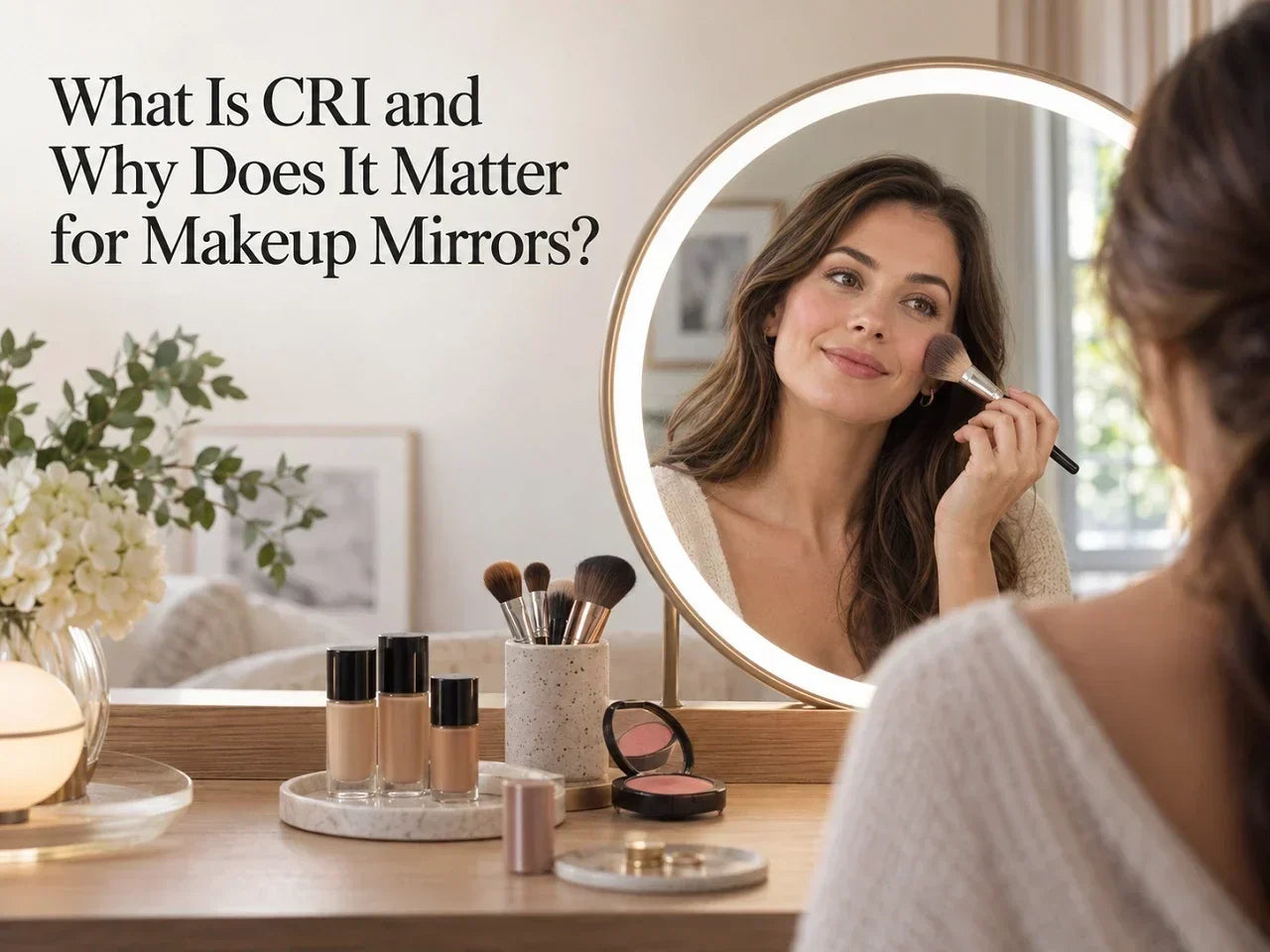
CRI, or Color Rendering Index, describes how faithfully a light shows colors compared with a reference light of a similar color temperature. For makeup, that matters when you’re comparing foundation shades, blending blush, or choosing a lip color.
When shopping for a lighted makeup mirror, look for a documented CRI of 90 or higher as a starting point. Here’s what that rating tells you—and how to weigh it alongside brightness and light placement.
What Does CRI Tell You About a Makeup Mirror?
A makeup mirror’s CRI rating describes its lighting. It doesn’t rate the glass, magnification, or reflection sharpness.
The highest possible score is 100. Higher scores indicate that the tested colors appear closer to how they look under the reference light.
There’s a detail that often gets lost in product descriptions: CRI isn’t a percentage of color accuracy. A CRI 95 mirror isn’t “95% accurate,” and the score doesn’t tell you exactly how every foundation or lipstick will look.
It also doesn’t tell you whether the light looks yellow, neutral, or bluish. That’s color temperature, which is a separate specification.
You can have a warm light with excellent color rendering. You can also have a cool, white-looking light that renders colors less faithfully. Choosing the whitest-looking mirror in the store won’t necessarily give you the most useful lighting at home.

How CRI Affects the Way Your Makeup Looks
Applying makeup means making a series of small judgments: how much coverage you need, whether a shade matches your neck, and when to stop adding color.
Lighting influences what you see while making those decisions. The practical value of better color rendering is a more dependable view of the products you’re applying.
Foundation: Checking the shade before blending it everywhere
Imagine comparing two foundation swatches along your jaw. One is slightly peachier; the other leans pink. Under some lighting, that difference may be harder to see.
A high-CRI makeup mirror can help you assess those subtle differences. That makes it useful when trying a new shade, switching formulas, or checking how your foundation looks against your neck.
It won’t make the wrong shade match your skin. It gives you better information before you commit to it.
For a new foundation, check the swatch in indirect daylight as well. Different viewing conditions can reveal a mismatch that wasn’t obvious at your vanity.
Blush and bronzer: Knowing when you have enough
With buildable products, the tricky part is often deciding whether to add another layer.
If your lighting makes a color look muted, you might keep applying it. If a shadow makes your cheek look darker, you might assume your bronzer needs more blending.
Color rendering helps with the first problem. More even illumination helps with the second. You need both to judge the result comfortably.
Try pausing between layers and looking at your whole face from a normal distance. A close-up view can be useful for placement, but it doesn’t always show the overall balance.
Lipstick and eyeshadow: Seeing the differences between similar shades
A rose-brown lipstick and a peachy nude can create very different looks, even when they seem close in their packaging.
Better color rendering is helpful when comparing those shades on your face. It’s also useful for checking whether an eyeshadow looks warmer, cooler, or more intense than you intended.
This doesn’t mean every everyday routine requires the highest-rated mirror available. But when color is the reason you’re buying a lighted mirror, CRI deserves a place on your checklist.
What Is a Good CRI for a Makeup Mirror?
We recommend looking for CRI 90 or higher when comparing lighted makeup mirrors. That recommendation uses the established lighting classification of 90+ as excellent color fidelity and applies it to a task where shade judgment matters. It isn’t a makeup-specific certification.
Use the following as a shopping guide:
| CRI rating | How to use it when choosing a mirror |
|---|---|
| Below 80 | Consider a higher-rated option if judging makeup colors is a priority. |
| 80–89 | May suit a familiar routine, but compare with 90+ models before buying. |
| 90–94 | A sensible starting point for a mirror used for regular makeup application. |
| 95–100 | Worth considering when the lighting, comfort, and price also suit your needs. |
| Not provided | Ask the seller for the rating rather than guessing from product photos. |
Avoid getting stuck on a small difference between two numbers. A CRI 95 mirror that creates distracting glare may be less useful to you than a CRI 92 mirror with comfortable, even light.
Also, treat phrases such as “professional lighting” and “true-color reflection” as descriptions to investigate. Look for specifications that explain what the product actually offers.
CRI, Color Temperature, and Brightness: What’s the Difference?
These three features are easy to confuse because they all affect how your reflection looks.
| Feature | What it tells you | What it means at your vanity |
|---|---|---|
| CRI | How faithfully the light renders colors relative to a reference | Helps you evaluate makeup shades. |
| Color temperature | How warm or cool the light appears, measured in kelvin (K) | Changes the overall lighting appearance. |
| Brightness | How much light is available | Affects how easily you can see detail. |
Turning up the brightness doesn’t improve CRI. Switching to a cooler mode doesn’t automatically improve it either.
Which color temperature should you use?
A neutral white setting around 4000K–5000K is a practical place to start. Consider it a setting to try, rather than a rule everyone needs to follow.
Apply your makeup under a consistent, comfortable setting. Then use another mode to check the finished look if that helps you prepare for where you’re going. A warmer setting may be useful before an evening in a warmly lit restaurant, for example.
Mode names aren’t enough to judge performance. “Daylight,” “natural,” and “office” can mean different things across products. Check the listed kelvin values when they’re available.
For an adjustable mirror, it’s also reasonable to ask which mode the advertised CRI applies to. Color-rendering performance can vary across the settings of a color-tunable light.

How bright should your makeup mirror be?
Bright enough to see blending edges without leaning forward or straining.
Start at a moderate setting while seated or standing in your usual position. Adjust until you can see your face clearly without squinting at the light.
If you can only see well when you move very close, check the mirror’s distance and position before turning the brightness all the way up. The problem may be how the light reaches you.
Why a High CRI Score Doesn’t Tell the Whole Story
CRI is an average based on a limited group of test colors. That makes it useful for comparison, but it can miss differences that matter for particular shades.
One extra specification is R9, which describes how a light renders a strong red test color. R9 isn’t included in the commonly advertised CRI average, and red rendering is relevant to the appearance of skin tones.
For most shoppers, there’s no need to spend hours studying lighting reports. Start with a documented CRI of 90+, then consider whether the manufacturer provides an R9 score if you’re choosing between premium options.
A missing R9 value doesn’t establish poor performance. It simply leaves you with less information.
The same applies to CRI itself: a useful specification supports your decision, but it can’t describe the entire experience of using the mirror.
What Else Should You Check Before Buying?
At Hasipu, we recommend choosing around your actual routine. Think about where you sit, how much space you have, and whether you mainly do quick touch-ups or spend time on detailed makeup.
Light that reaches your face evenly
Look straight ahead from your normal position. Can you see both cheeks clearly? Is one side noticeably darker? Do you need to lift your chin to get light under your eyes?
A practical preference is diffused illumination that reaches your face from the front and both sides.
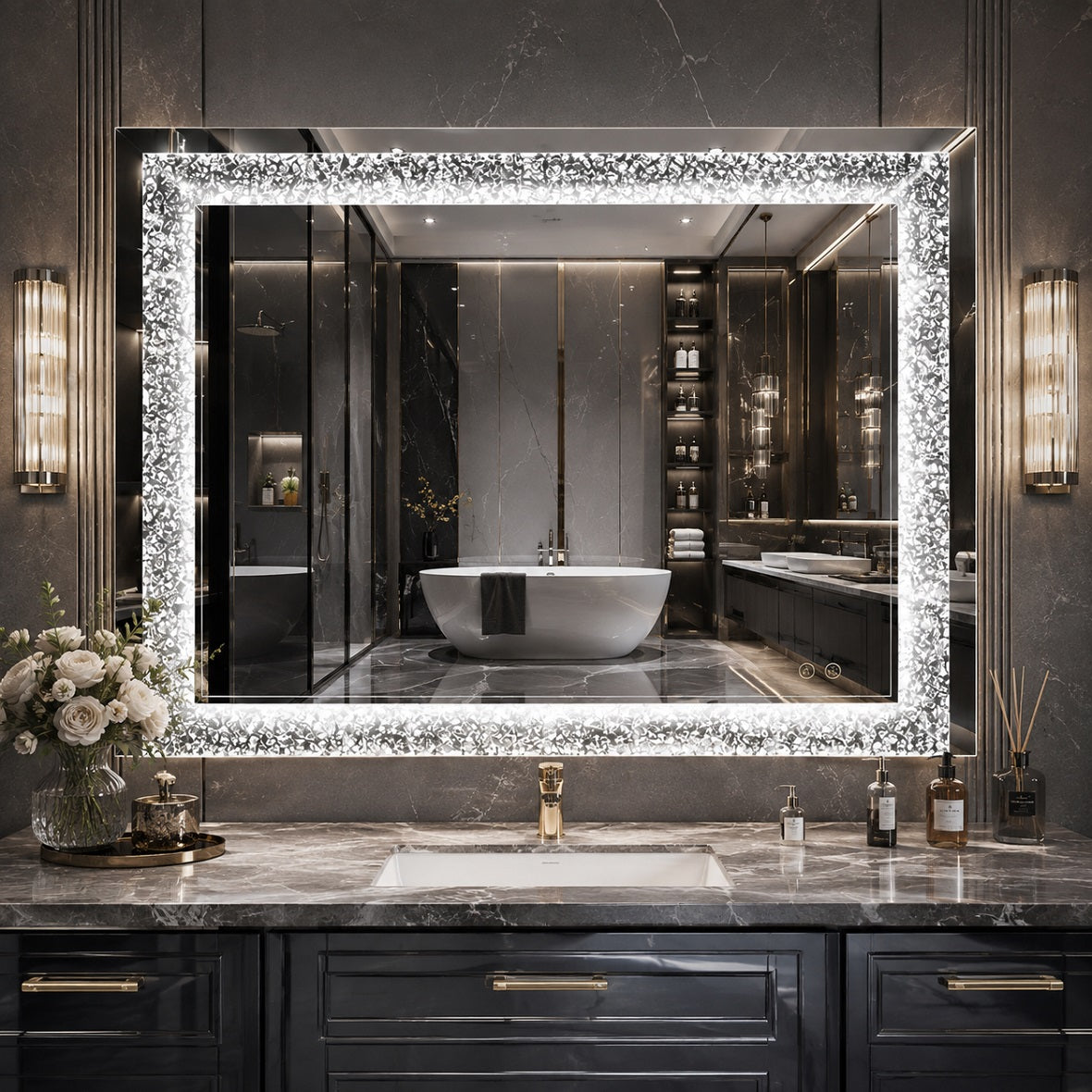
Pay attention to the difference between a backlit glow and forward-facing light. A halo behind a mirror may look attractive on the wall, but check whether the product also provides enough illumination for your face.
Comfortable brightness controls
Dimming is useful when your room’s lighting changes throughout the day.
The controls should be easy to reach while you’re using the mirror. Consider whether you can adjust the brightness smoothly and whether the available range suits your space.
A useful height and viewing distance
A mirror can have excellent lighting specifications and still be awkward to use if it sits too low on your vanity.
Check the dimensions before ordering. For a tabletop model, think about the height of both the table and your chair. For a larger vanity mirror, make sure you can see your face comfortably while seated.
Clear specifications for the individual model
Before buying, look for:
- A numerical CRI rating.
- Listed color temperatures or an adjustable range.
- Brightness controls.
- Dimensions and adjustment options.
- A return policy that allows you to evaluate the mirror at home.
Check the exact model. Different mirrors from the same brand may use different lighting components.
Choose a Makeup Mirror That Works for You
A high-CRI makeup mirror can help you judge makeup colors, but brightness and light placement matter, too. Look for a documented CRI of 90 or higher, then check whether the mirror lights both sides of your face comfortably at your usual distance.
Try it with foundation, blush, and lipstick you already know. Adjust the brightness, step back to check your blending, and compare the result in indirect daylight. This won’t measure CRI, but it can help you decide whether the lighting suits your routine.
At Hasipu, we recommend choosing a mirror around how you get ready each day. You should be able to see subtle shade differences and blending edges without leaning forward or squinting—and feel confident about when to put the brush down.

Frequently Asked Questions
1. Is CRI 80 enough for applying makeup?
It may be usable for an established routine, especially when you already know your products well. When purchasing a new mirror specifically for makeup, we recommend considering CRI 90+ alongside even lighting and comfortable brightness.
2. Is CRI 95 noticeably better than CRI 90?
The difference won’t be equally noticeable with every product or setup. Particular colors, the lights’ broader rendering characteristics, and the viewing conditions all matter. Don’t assume a five-point increase guarantees a dramatic improvement.
3. Will high CRI stop my foundation from looking different outside?
No mirror can guarantee that makeup will look identical under every light. High CRI provides a useful reference for application, but outdoor conditions, room lighting, and your surroundings can still change its appearance.
4. Do you need a new mirror if your current one has no CRI rating?
Not automatically. Ask the manufacturer whether the rating is available. If your current mirror is comfortable and helps you apply makeup consistently, an absent specification alone isn’t a reason to replace it.
5. Is CRI more important than magnification?
They serve different purposes. CRI relates to the lighting’s color rendering; magnification helps you see small details. For shade matching, prioritize lighting quality. For precise tasks such as tweezing, magnification may also be useful.
A good lighted makeup mirror should make your routine easier to judge: the foundation along your jaw, the amount of blush on your cheeks, and the edges that need another pass with a brush. Start with documented CRI 90+ lighting, then choose the size, placement, and brightness that help you see those details comfortably.