Table of Contents
A full-length mirror is useful until you want it somewhere else.
Maybe you need it beside your closet in the morning, in front of a window while getting ready, or across the room during a workout. A wall-mounted mirror cannot follow you, and a large leaning mirror can be awkward to move.
That is where a rolling mirror makes sense.
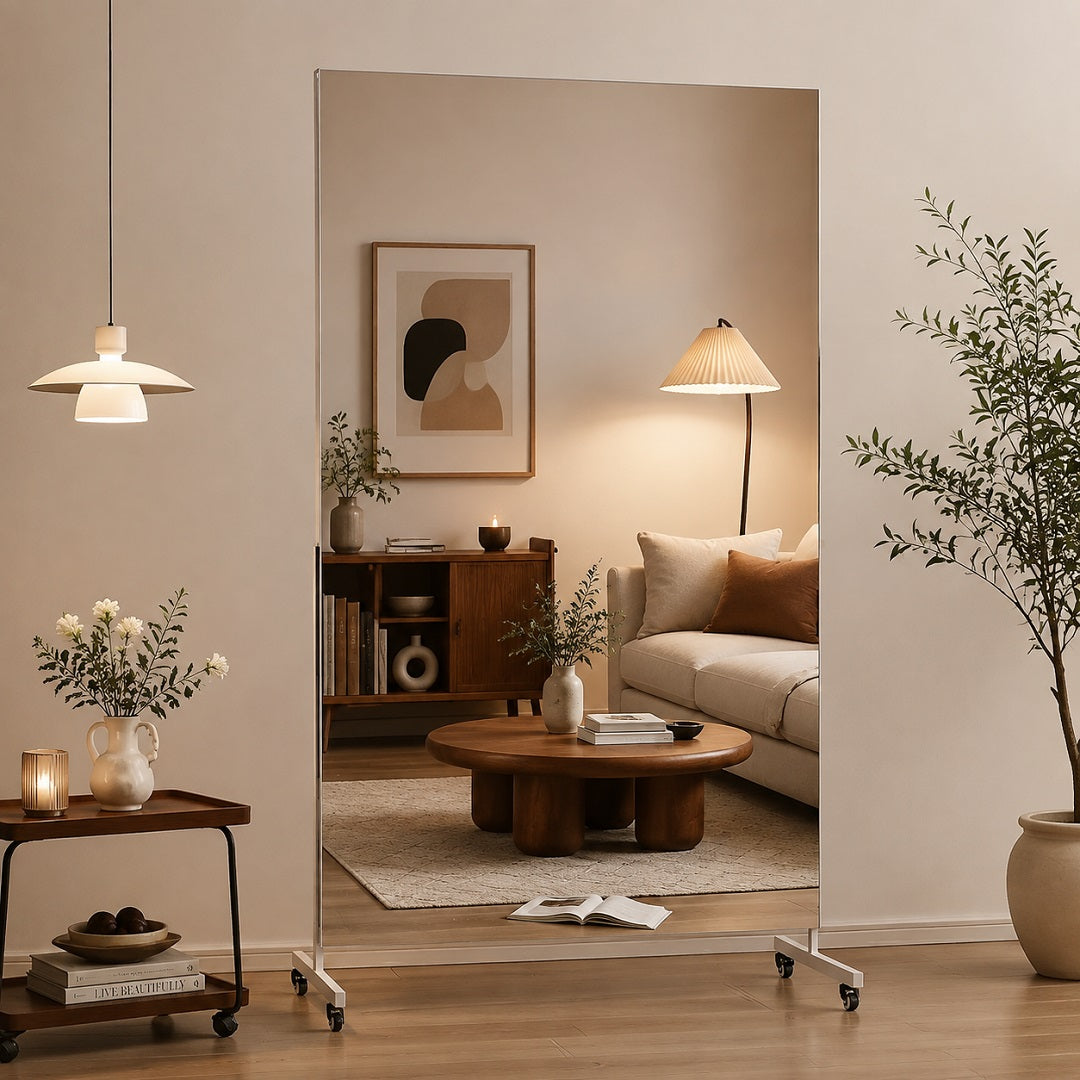
A rolling mirror is a full-length mirror supported by a freestanding base with wheels or casters. It gives you the large reflection of a floor mirror without permanently committing it to one wall.
For bedrooms, dressing rooms, home gyms, yoga spaces, dance practice, salons, and flexible multipurpose rooms, a full-length mirror on wheels can be much easier to live with than a fixed mirror.
The tricky part is choosing one that rolls well, stays steady once you stop moving it, and gives you a useful reflection instead of simply looking good in a product photo.
Here is what to look for in 2026.
What Is a Rolling Mirror?
A rolling mirror, sometimes called a mirror on wheels, mobile mirror, or standing mirror with wheels, is a freestanding mirror attached to a wheeled base.
Most are tall enough to show the body from head to toe. Larger versions may also be wide enough for exercise, dance practice, outfit checks, or use by more than one person.
The main difference between a regular floor mirror and a rolling model is mobility.
Instead of lifting a large mirror every time you want to move it, you can roll it across the floor and reposition it as your room changes.
Some models also tilt, rotate, lock in place, include LED lighting, or allow the mirror section to be removed from the base.
Who Should Consider a Rolling Mirror?
Not every room needs wheels.
A regular wall mirror may still be the cleaner choice for a small bathroom or hallway where the mirror will stay in one location for years.
A rolling full-length mirror becomes more useful when the way you use the room changes throughout the day.
It works especially well for:
-
Bedrooms where you frequently rearrange furniture
-
Walk-in closets and dressing areas
-
Home gyms
-
Yoga and Pilates spaces
-
Dance practice rooms
-
Makeup and styling areas
-
Photography and content-creation rooms
-
Shared bedrooms
-
Multipurpose guest rooms
-
Studios where permanent wall installation is difficult
It can also solve a simple rental problem: you get a large mirror without drilling a large mounting system into the wall.
Start With the Way You Will Actually Use It
Shopping by appearance alone is easy. Start with function instead.
A mirror used mainly for outfits has different requirements from one used to check squat form or dance movements.
For getting dressed
You need enough height to see your entire body from a comfortable standing distance.
Extra width is nice, but it usually matters less than having a clear head-to-toe reflection.
A full-length standing mirror with wheels also lets you roll the mirror closer to natural daylight when you want to check colors before leaving the house.
For a home gym
Width becomes more useful.
A narrow dressing mirror may show your body, but it may not show enough surrounding space to watch arm position, stance, or movement.
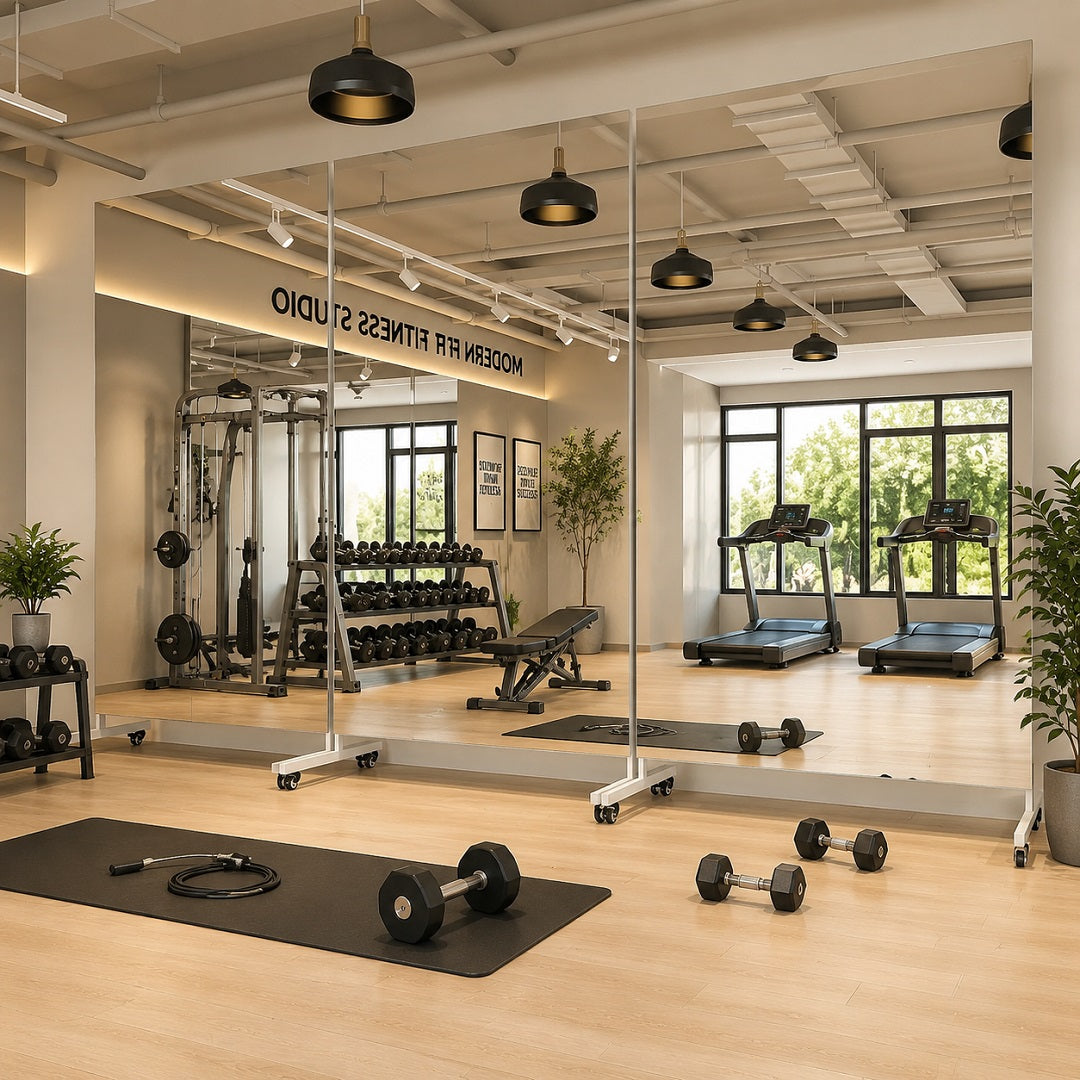
For a rolling gym mirror, look for a broad reflective area, a stable base, smooth casters, and wheels that can be locked once the mirror is positioned.
For yoga or dance
Being able to see a larger portion of your movement is useful.
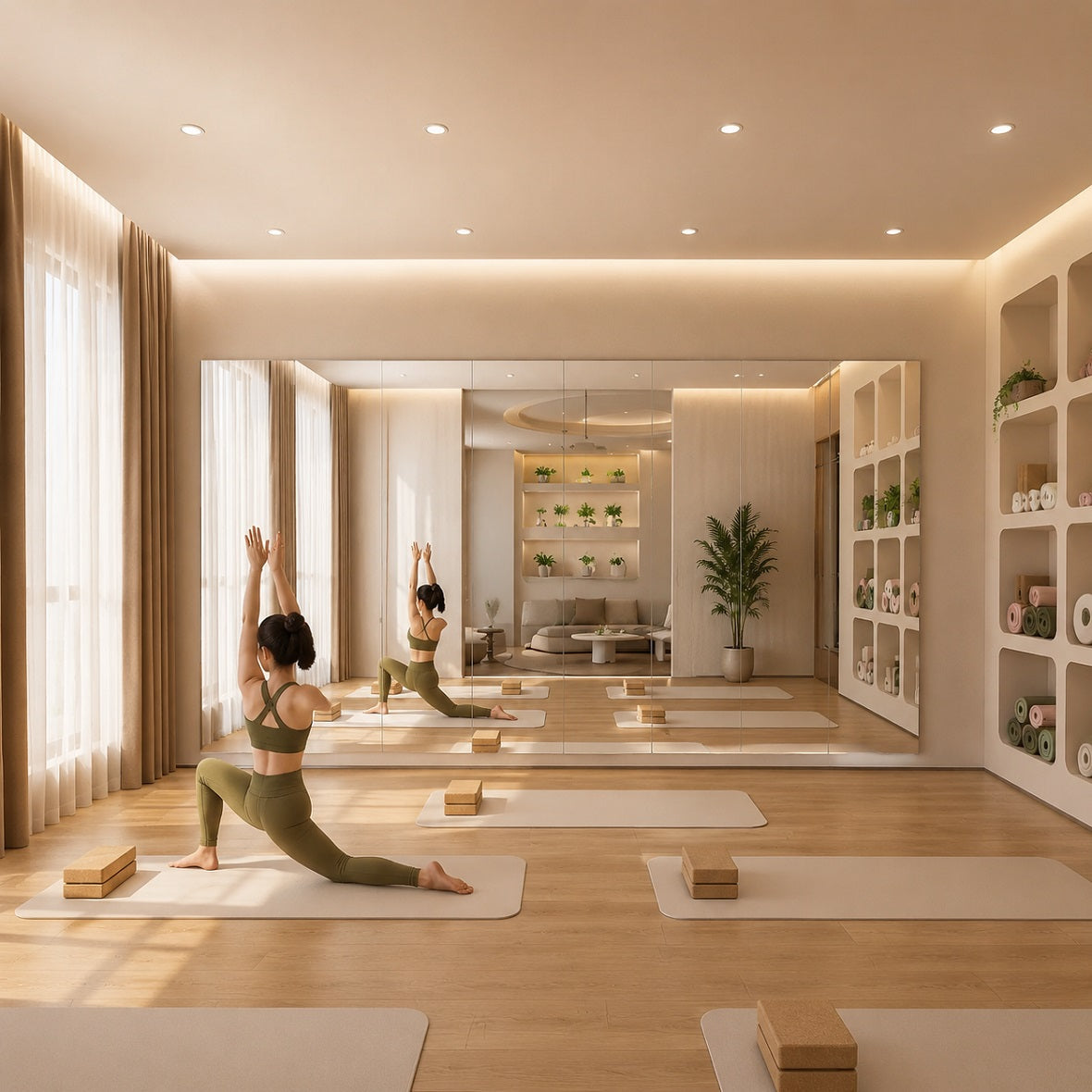
A wider mobile mirror can help you check alignment without installing several permanent wall panels.
It is also easier to move the mirror out of the room when you need the floor space for something else.
For makeup and hairstyling
Positioning and lighting matter more.
A rolling mirror that can be moved closer to a vanity, window, or other light source gives you more flexibility.
Models with built-in LED lighting can also be useful in rooms where the ceiling light creates strong shadows around the face.
How Big Should a Rolling Mirror Be?
There is no single best size.
Think about three measurements: height, width, and the footprint of the base.
Height
For a full-body view, taller mirrors usually feel more natural because you do not need to stand as far away or carefully position yourself in front of the glass.
Many full-length mirrors fall somewhere around the mid-60-inch range and above, while extra-large models can approach 80 inches tall.
A taller mirror can feel especially useful in bedrooms, closets, gyms, and dance spaces.
Width
Width changes the experience more than many shoppers expect.
A narrow mirror can be perfectly fine for checking an outfit.
Once you start using the mirror for stretching, strength training, yoga, dance, or two people getting ready at the same time, extra width becomes much more valuable.
Before ordering, use painter's tape to mark the proposed dimensions on your wall or floor.
It takes two minutes and gives you a much better sense of scale than staring at measurements on a phone.
Do Not Forget the Base
This is easy to miss.
A floor mirror with wheels takes up more floor space than the mirror itself.
The rolling base needs enough width and depth to support the glass.
Check the complete product dimensions before placing the mirror near a dresser, closet door, bed, desk, or narrow walkway.
A mirror that fits the wall perfectly can still feel oversized once the stand is sitting in the middle of the room.
The Wheels Matter More Than You Think
The biggest advantage of a rolling mirror disappears if the wheels are frustrating.
Look for casters that roll smoothly and turn easily when changing direction.
A good mobile mirror should not require you to drag the base sideways every time you reposition it.
Locking wheels are worth looking for
Movement is useful while positioning the mirror.
Movement is not useful while you are standing in front of it.
Wheel locks help keep the mirror from drifting after you have found the right spot.
This matters even more in workout rooms, dressing spaces, and homes where the floor is very smooth.
Think about your flooring
Hardwood, tile, vinyl, laminate, and carpet do not behave the same way.
Small hard casters may roll easily across smooth flooring but can struggle on thick carpet.
For carpeted rooms, pay closer attention to wheel diameter and the overall weight of the mirror.
For delicate flooring, check that the caster material is appropriate for the surface and keep the wheels clean. Small pieces of grit trapped around a wheel can scratch a floor as the mirror moves.
Look at the Glass, Not Just the Frame
A beautiful frame cannot fix a poor reflection.
Stand a few feet from the mirror and check straight lines in the background. Door frames, shelving, tiles, and furniture edges make distortion easier to notice.
The reflection should look natural instead of stretched, compressed, or slightly wavy.
This becomes especially noticeable on large full-length mirrors, where even minor distortion can be distracting.
Safety glass is useful for large movable mirrors
A rolling mirror gets moved more often than a wall-mounted mirror, so glass construction deserves extra attention.
Look for models that use tempered glass, safety backing, or another clearly explained safety treatment.
Do not rely only on phrases such as "HD mirror" or "crystal-clear mirror." Those are descriptions, not detailed glass specifications.
A useful product page should tell you what the mirror is actually made from.
Check the Frame and Support Structure
Rolling mirrors put extra stress on their frames because they are moved, turned, and stopped repeatedly.
The frame should feel rigid rather than flexible.
Metal frames, including aluminum and steel designs, are common because they can provide support without making the mirror look bulky.
Wood can work beautifully in a bedroom or dressing room, although a large solid-wood structure may be heavier to move.
Pay attention to the connection between the mirror, side supports, and base. That area does more work than the decorative edge around the glass.
Should You Buy a Tilting or Swiveling Mirror?
A fixed upright mirror is enough for most outfit checks.
A tilting rolling mirror gives you more control over the viewing angle.
This can be helpful when the mirror is shared by people of different heights or used for fitness and styling.
Some designs allow the mirror to rotate or swivel inside the frame. That gives you even more positioning freedom, but check how the adjustment mechanism locks.
A mirror that changes angle easily is convenient. A mirror that slowly changes angle by itself is annoying.
Do You Need LED Lights?
Not necessarily.
Natural window light and good room lighting may already be enough.
Built-in lighting makes more sense when the mirror doubles as a styling or makeup mirror, or when it will be used in a darker part of the room.
If you are considering a rolling mirror with lights, look beyond the fact that it lights up.
Useful features can include adjustable brightness and more than one color temperature.
Warm light can feel comfortable in the evening. Neutral or cooler light can make details easier to see during makeup, grooming, or styling.
For a home gym, lighting is usually less important than mirror size, stability, and reflection quality.
Arched or Rectangular?
This is mostly a design decision, but the shape changes how the mirror feels in the room.
Arched rolling mirrors
An arched top softens the look of a tall mirror.
It works well with modern, transitional, contemporary, and softer bedroom interiors. The curve also makes a large mirror feel less boxy.
Rectangular rolling mirrors
A rectangle uses more of its overall dimensions as reflective space.
That can make it practical for home gyms, dance rooms, dressing areas, and simple modern interiors.
Neither shape gives a "better" reflection. Pick based on how much mirror surface you want and how the shape works with the furniture around it.
Black or White Frame?
Black frames create a stronger outline.
They often work well with modern furniture, industrial details, darker hardware, and home gyms.
White frames blend more quietly into pale bedrooms, dressing rooms, studios, and neutral interiors.
There is no need to match every metal finish in the room. A mirror usually looks more intentional when it relates to a few nearby elements rather than trying to match everything perfectly.
What About a Rolling Mirror With Storage?
Some mobile mirrors combine the mirror with shelving, racks, or storage cabinets.
That can be useful in a small dressing room, but the tradeoff is usually a larger footprint and heavier construction.
Ask yourself what problem you are trying to solve.
If you need storage, the extra shelves may earn their space.
If you mainly want a mirror you can roll between a bedroom, workout area, and closet, a simpler base will usually be easier to move.
Rolling Mirror vs. Leaning Mirror
Both avoid permanent wall installation, but they behave very differently.
| Feature | Rolling Mirror | Leaning Mirror |
|---|---|---|
| Easy to move | Excellent | Fair |
| Requires wall mounting | Usually no | Usually no |
| Easy to reposition | Yes | Less convenient |
| Floor footprint | Larger base | Smaller footprint |
| Good for workouts | Very good | Depends on stability |
| Good for small spaces | Depends on base size | Often easier |
| Adjustable location | Excellent | Limited |
A leaning mirror makes sense when you love the relaxed look and expect the mirror to stay put.
A mirror on wheels earns its extra footprint when you actually plan to move it.
Rolling Mirror vs. Wall-Mounted Mirror
A wall-mounted mirror is hard to beat for saving floor space.
It can also look cleaner in narrow hallways, bathrooms, and compact bedrooms.
The drawback is commitment.
Once installed, the viewing angle and location are mostly fixed.
A rolling mirror gives up some floor space in exchange for flexibility.
For renters, changing room layouts, home gyms, and multipurpose rooms, that trade can be worthwhile.
What Should a Good Rolling Mirror Feel Like?
You should be able to move it without feeling nervous about the glass.
The base should stay balanced while turning.
Once the wheels are locked, the mirror should feel steady.
The reflection should remain clear from a normal viewing distance.
The frame should not visibly twist when the mirror is rolled.
And the size should make sense for your actual room, not just the room shown in the listing photos.
Those details are more useful than a long feature list.
Common Rolling Mirror Buying Mistakes
One of the most common mistakes is buying too small.
People often focus on finding a mirror that technically shows the full body. After a few weeks, they realize they wanted more width for outfit checks, workouts, or styling.
Another mistake is ignoring the stand dimensions.
A wide support base can interfere with furniture or door clearance.
Cheap wheels can also turn a mobile mirror into a mirror that rarely gets moved.
Then there is weight. A heavy mirror may feel reassuringly solid, but it still needs to be manageable enough for the people who will use it.
Finally, do not assume every "gym mirror" or "dance mirror" needs to cover an entire wall. For many home users, one large movable mirror gives them the view they need without permanently turning a bedroom into a studio.
Where Should You Put a Rolling Mirror?
One of the advantages is that you do not have to decide forever.
Still, a few locations tend to work especially well.
Beside a dresser or closet gives you an easy outfit-checking area.
Near a window lets natural light reach your face and clothing.
A corner can make a large mirror feel less intrusive when it is not being used.
In a home gym, place it where you can see the movements you actually want to check without forcing yourself to turn your head.
Try several positions before deciding where the mirror "belongs." That is the point of owning one with wheels.
Is a Hasipu Rolling Mirror Right for Your Space?
Hasipu rolling mirrors are designed around the same problem this guide addresses: sometimes a large mirror is more useful when it is not permanently attached to one wall.
A Hasipu full-length mirror on wheels can work well in a bedroom, dressing area, home gym, yoga room, dance space, or other room that needs a flexible full-body reflection.
Before choosing a model, start with the size of your space and the way you plan to use the mirror.
For daily dressing, prioritize comfortable full-body viewing.
For workouts and dance, put more weight on width and stability.
For makeup or styling, lighting and positioning may matter more.
That simple order makes it much easier to choose the right mirror instead of buying features you rarely use.
Quick Rolling Mirror Buying Checklist
Before ordering, check:
-
The full mirror height and width
-
The complete footprint of the base
-
Glass type and safety construction
-
Reflection quality
-
Frame and support materials
-
Wheel size and movement
-
Locking casters
-
Tilt or swivel adjustment, if needed
-
Total product weight
-
Suitability for your flooring
-
LED brightness and color settings, if included
-
Assembly requirements
-
Warranty and return policy
-
Replacement or customer-support options
You probably do not need every feature on that list.
You do want the features that solve the reason you started looking for a rolling mirror in the first place.
The Bottom Line
The best rolling mirror in 2026 is not necessarily the model with the longest feature list.
It is the one you can move easily, position where you need it, lock securely, and use without thinking about it.
Start with size. Check the base. Pay attention to the glass and wheels. Decide whether tilt, swivel, or lighting would actually improve the way you use the mirror.
For a bedroom, dressing room, home gym, yoga space, or flexible studio, a well-designed full-length mirror on wheels gives you something a fixed mirror cannot: the freedom to change the room without giving up a clear full-body view.
That flexibility is what makes a rolling mirror worth buying.
FAQs About Rolling Mirrors
What is a mirror on wheels called?
Common names include rolling mirror, mirror on wheels, mobile mirror, rolling full-length mirror, and standing mirror with wheels.
Larger models designed for exercise may also be sold as rolling gym mirrors, yoga mirrors, or dance mirrors.
Are rolling mirrors good for bedrooms?
Yes. A rolling mirror works especially well in bedrooms where you want a full-body view but do not want to permanently mount a large mirror.
You can also move it closer to a closet, vanity, or window when needed.
Are mirrors on wheels safe?
They can be, but construction matters.
Look for stable supports, locking casters, secure connections between the mirror and base, and clearly described safety glass or safety backing.
Place the mirror on a reasonably level surface and lock the wheels during use.
What size mirror is best for a home gym?
Choose a mirror large enough to show the movements you want to evaluate.
A narrow full-length mirror may be fine for basic posture checks. Wider mirrors are more useful when you want to see arm position, stance, stretching, yoga poses, or larger movements.
Can I use a rolling mirror on carpet?
That depends on the wheels and carpet thickness.
Low-pile carpet is generally easier for casters than deep or plush carpet. Check the wheel design and product weight before buying a large mirror for a carpeted room.
Is a rolling mirror better than a wall mirror?
It depends on your room.
A wall mirror saves floor space and works well when the location will not change.
A rolling mirror is better suited to spaces where flexibility matters and where you want to change the viewing position without reinstalling the mirror.