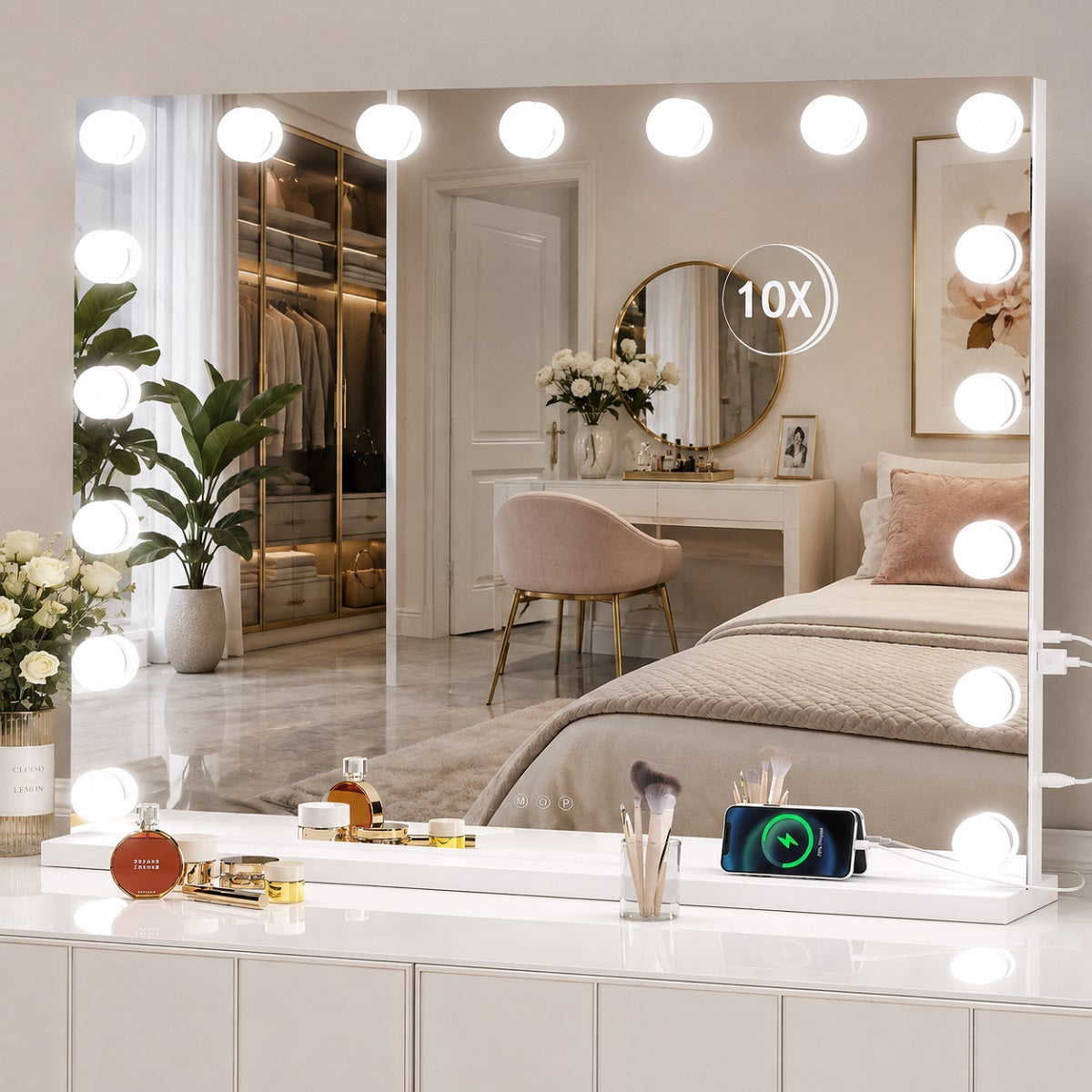

Table of Contents
A bathroom mirror can have a beautiful glow and still leave you leaning toward the glass to check your concealer. The room looks bright, but the light isn’t reaching the parts of your face you need to see.
Front lighting is generally better for makeup because it directs light toward your face, helping you see blending, edges, and uneven coverage. Backlighting mainly illuminates the wall behind the mirror, adding ambient light rather than direct facial illumination.
A backlit mirror can still work well with separate vanity lights. A mirror with both lighting types can serve both purposes. The useful question is how evenly the whole setup lights your face at the distance where you actually get ready.
What Is Front Lighting on a Mirror?
A front-lit mirror sends light toward the person using it. That light may come through a frosted strip inside the mirror’s edge, an illuminated perimeter, or other forward-facing sections.
For makeup, the advantage is straightforward: light reaches your face from near the direction you’re looking.
Well-positioned front lighting can make it easier to check foundation around your nose, blend concealer, and compare both eyebrows without repeatedly tilting your head.
The design still matters. A narrow, glaring strip across the top won’t necessarily light your face as evenly as a well-diffused arrangement that extends down both sides. “Front-lit” describes the direction of the light; it doesn’t guarantee a particular level of performance.

What Does Backlighting Actually Do?
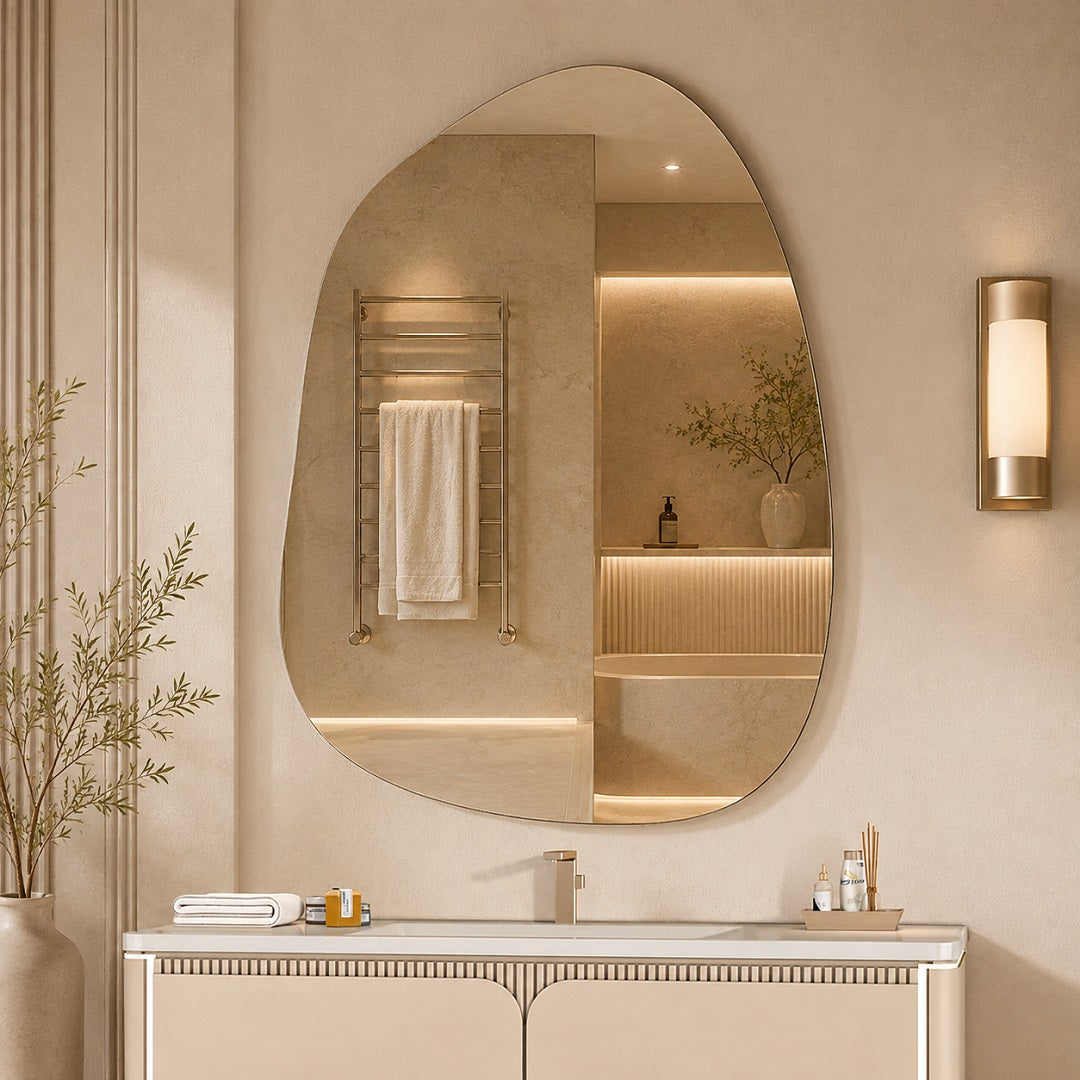
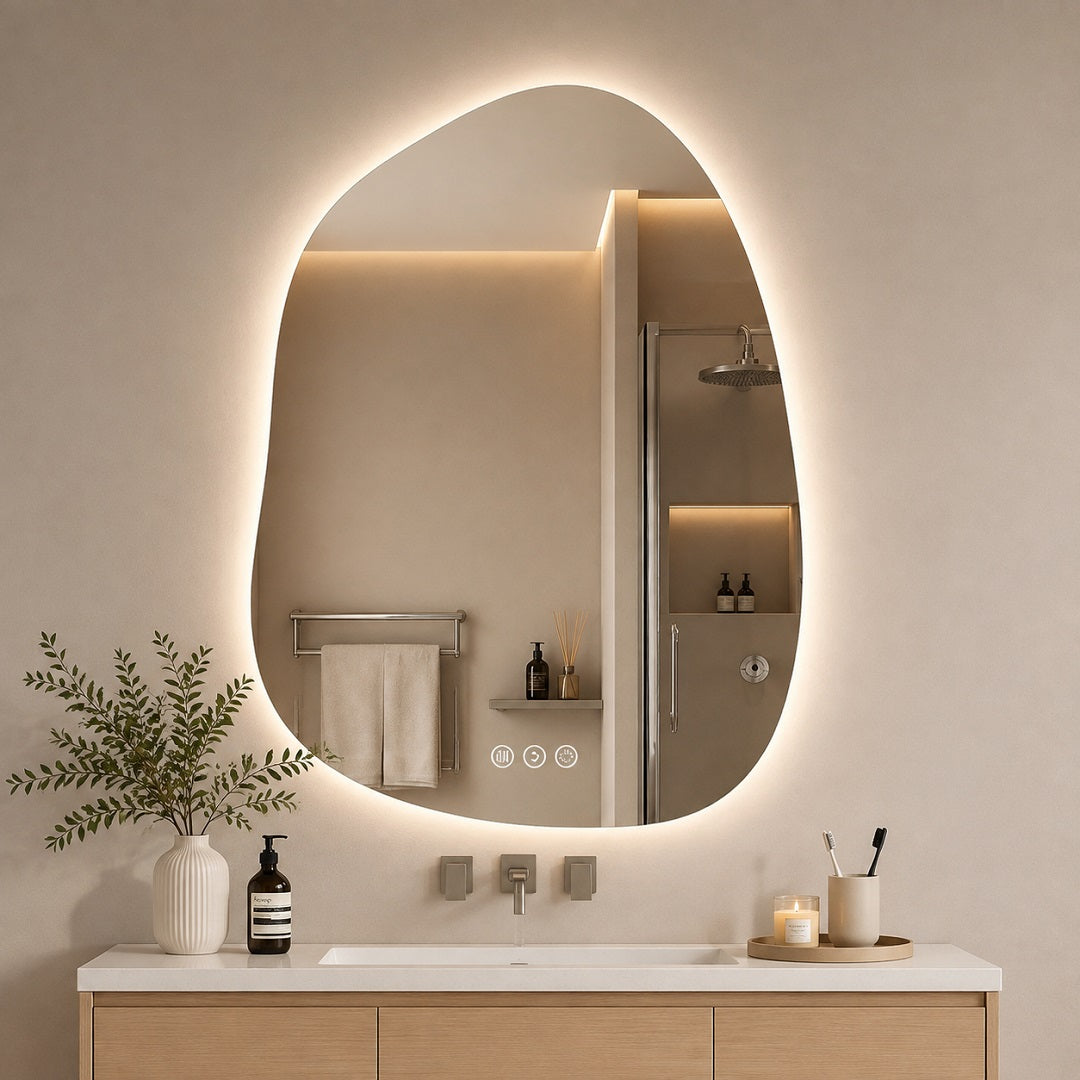
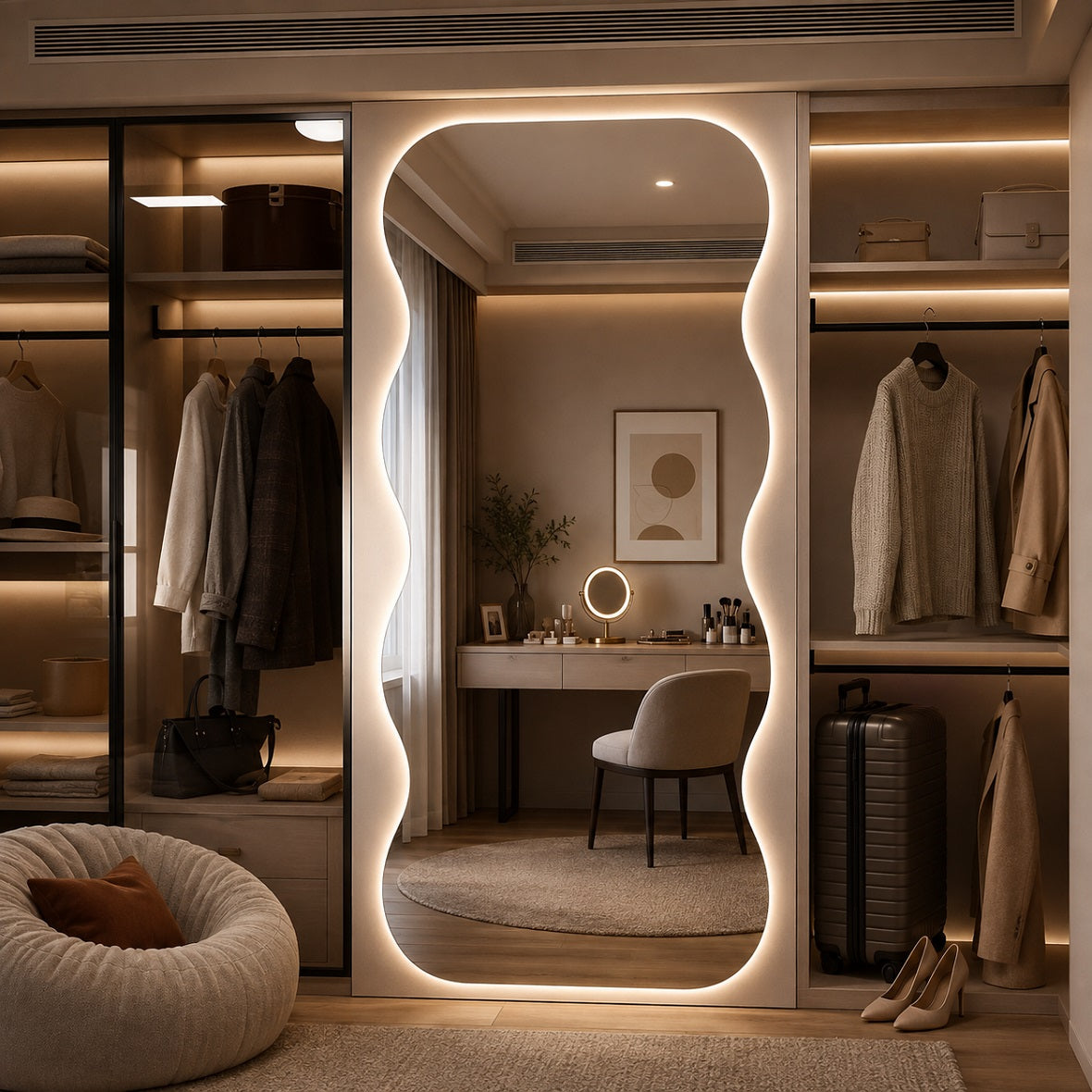
A backlit mirror has lighting behind the glass that shines toward the wall. The reflected light creates the halo effect around the mirror and contributes to the room’s ambient illumination.
That glow can make a vanity area feel softer and give the mirror a floating appearance. Some of the reflected light also reaches the user, but its usefulness depends on the output, wall finish, surrounding room, and mirror design.
A pale wall generally reflects more light than a dark one. Strongly colored surfaces can also affect the color temperature of reflected light.
This explains why a backlit mirror may look impressive in a product photo yet provide limited help with eyeliner. A bright wall behind the mirror doesn’t tell you how well your eyelids are illuminated.
Front Lighting vs. Backlighting for Makeup
The comparison below describes typical designs. Actual performance varies by mirror and room lighting.
| Factor | Front lighting | Backlighting |
|---|---|---|
| Facial illumination | Directs light toward the user | Relies mainly on light reflected from the wall and room |
| Shadow control | Can reduce uneven facial shadows with good placement and diffusion | Usually needs additional face-directed lighting for detailed tasks |
| Makeup precision | Generally more useful for blending, brows, and eyeliner | Depends heavily on other lighting |
| Ambient lighting | Contributes some room illumination | Creates a soft glow around the mirror |
| Decorative effect | Adds a visible illuminated edge or strip | Emphasizes the mirror’s outline and floating appearance |
| Nighttime use | Useful for getting ready; dimming helps adjust brightness | Useful for a softer atmosphere, depending on output |
| Extra vanity lights | May still be needed if output or coverage is limited | Often useful when makeup is a priority |
For a makeup-focused purchase, start with facial illumination. Then consider the decorative effect you want around it.
Why Light Direction Makes Such a Difference
A ceiling light can illuminate the countertop while leaving overhead shadows beneath your brows, nose, and chin. Turning it up may make the room brighter without resolving those shadows.
During makeup application, that can be misleading. A shadow beneath the eye may look like an area that needs more concealer. Uneven light across your cheeks can make it harder to judge whether blush is balanced.
Light arriving from in front of you—and distributed across both sides—can reduce that uneven lighting.
This is also why a plain mirror with good side lighting can be more useful for makeup than an LED mirror with poorly placed LEDs. The entire lighting arrangement matters more than the product label.
Try a quick check at your own vanity
Stand or sit where you normally apply makeup. Look at the area beneath both eyes, the sides of your nose, and your jawline.
Switch the available lighting options on separately, then together. Notice which combination lets you see both sides of your face clearly without leaning forward or raising your chin.
Keep your face in the same position as you compare. You’re checking the facial illumination you actually use, not how bright the LED mirror looks across the room.

Can You Use a Backlit Mirror for Makeup?
A backlit bathroom mirror can be part of a useful makeup setup when another light source illuminates your face.
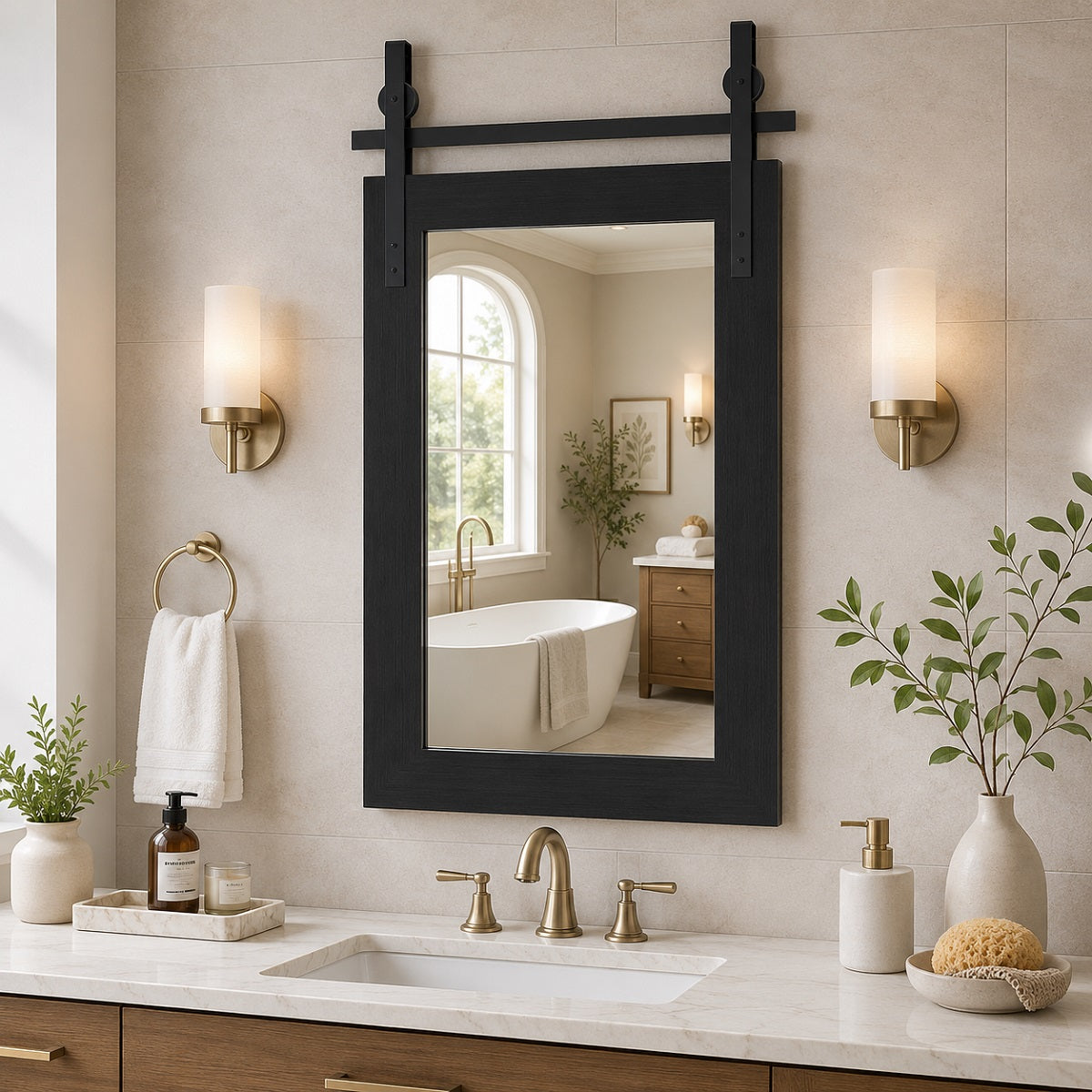
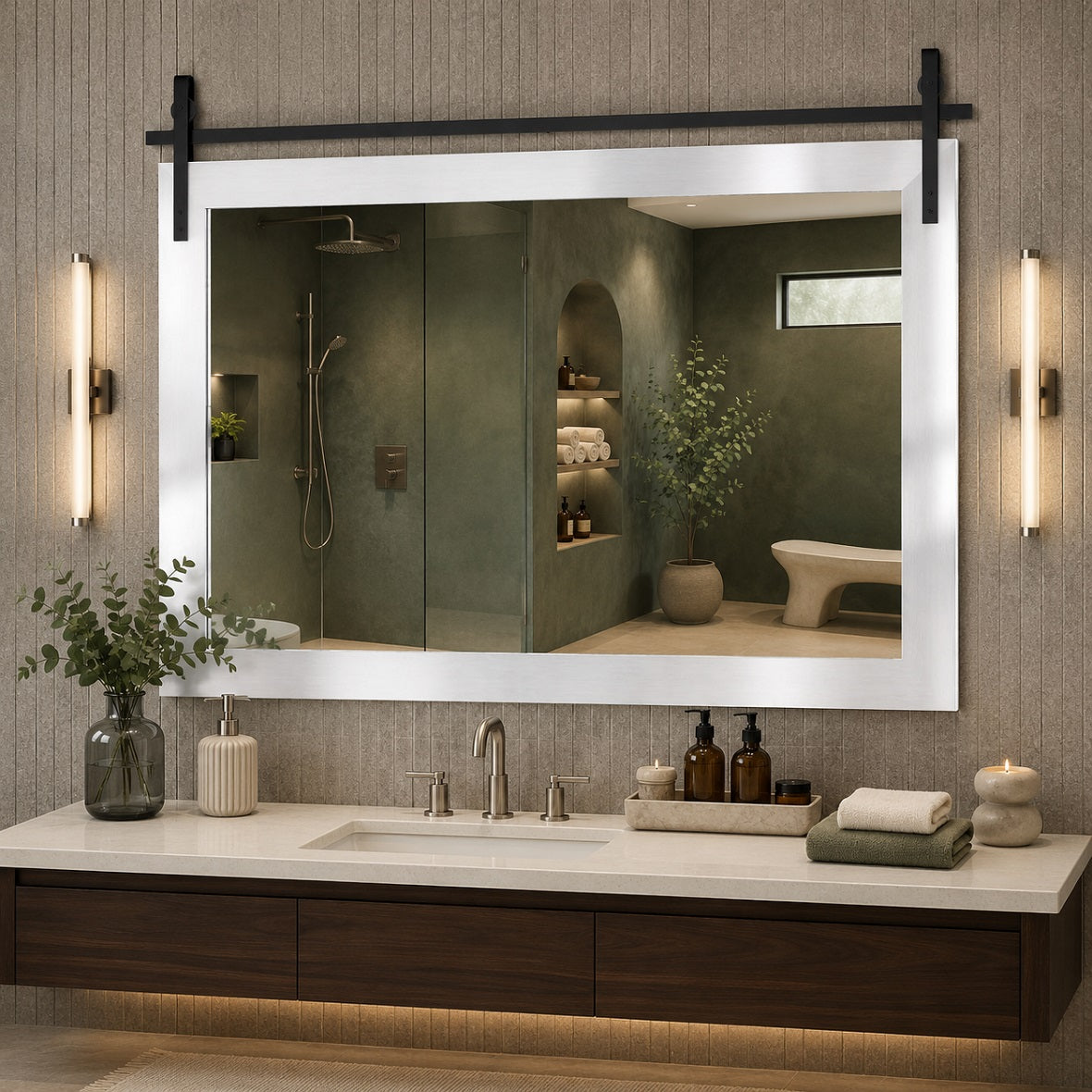
For example, a bathroom with well-positioned wall sconces on both sides of the mirror may already have the task lighting it needs. The mirror’s backlight then adds atmosphere and ambient light.
Soft natural daylight can also help, although its direction and availability change. A window beside the vanity area may leave one cheek brighter than the other. A ceiling fixture can contribute general brightness, but it shouldn’t automatically be treated as adequate facial illumination.
Before replacing a backlit mirror, check whether adding or improving your vanity lighting would solve the problem.
What About a Front- and Backlit Mirror?
A front- and backlit mirror combines forward-facing illumination with a glow behind the glass.
That combination can suit a bathroom vanity used for detailed morning grooming and quieter evening routines. The front lighting helps with makeup; the backlight contributes to the surrounding room's ambient lighting.
Look at the mirror controls as closely as the lighting description. Can you operate the two lighting zones separately? Can you dim them independently, or does one button change everything together? Those differences affect everyday use.
Dual lighting isn’t automatically better. A well-designed front-lit mirror may provide all the lighting you need, while a dual-lit model with weak forward output may still need additional vanity fixtures.
What Color Temperature Works Best for Makeup?
Neutral to daylight-like light is a useful starting point for makeup, but no single color temperature works best in every room or for every occasion.
Color temperature, measured in kelvins, describes how warm or cool white light appears. It doesn’t tell you how bright the light is or how faithfully it renders makeup colors.
Common mirror settings include:
| Setting | Typical appearance | Practical use |
|---|---|---|
| Around 3000K | Warm white | Checking a look under warmer indoor lighting |
| Around 4000K | Neutral white | A starting point for everyday makeup |
| Around 5000K–6000K | Cooler, daylight-like white | An additional check for looks worn in brighter daytime settings |
Treat these as appearance categories, not promises of accuracy. A “daylight” setting doesn’t reproduce every property of natural daylight.
For foundation, check the blend between your face and neck. For blush and contour, look at the softness of the edges as well as the color. Changing the lighting settings can change how those details appear.
Try applying makeup under comfortable neutral light, then checking it under color temperature settings similar to where you’ll spend your day or evening. Constantly switching settings during every step can make the process more confusing.
Brightness: Enough to See, Comfortable to Use
The best setting is the one that lets you see detail comfortably at your normal makeup distance.
Too little light makes blending difficult to inspect. Excessively bright, exposed lighting can create glare, especially when you move closer for eye makeup.
Dimming options give you room to adjust, but they can’t fix every problem. A poorly positioned light remains poorly positioned at a lower setting.
Mirror size and viewing distance also affect the experience. A large bathroom mirror viewed across a deep countertop serves a different setup from a small tabletop mirror used close to your face.
Don’t judge performance by LED count alone. Placement, light diffusion, output, and the amount of light reaching your face all matter.
Lighting Setups for Everyday Situations
Everyday makeup
Start with evenly distributed front lighting and enough room light to see comfortably around the vanity. Use a consistent color temperature setting while applying foundation and blush.
Before leaving, check your jawline and blending edges in another useful light source, such as soft daylight.
Detailed eye makeup and brows
Prioritize clear, balanced light around both eyes. Moving close to the mirror shouldn’t put your face above or below the useful illuminated area.
A separate adjustable makeup mirror may help when a deep bathroom counter keeps you too far from the wall mirror.
Skincare and close-up grooming
Front-facing light helps you see where you’ve applied products and check grooming details. You don’t need maximum brightness for every step.
For a simple evening routine, a lower dimmer setting may be more comfortable. Backlighting can remain on for ambient illumination.
Getting ready at night
Use your task lighting to apply makeup, then check the finished look under warmer room lighting when that resembles your destination.
Applying everything under a dim wall glow can leave blending mistakes difficult to see until you enter a brighter space.

A bathroom with strong overhead lighting
Add or use face-directed lighting to fill the shadows created by the overhead fixture. Where controls allow, compare the result with the ceiling light dimmed.
Keep enough general lighting for the room to remain comfortably usable.
A bathroom with natural daylight
Soft daylight can provide a helpful color check. Pay attention to its direction: a bright side window can create unequal lighting across your face.
Use front lighting to balance the darker side, and avoid treating direct sunlight as a consistent makeup setup.
A windowless bathroom
Plan for both room illumination and makeup lighting. A front-lit mirror or balanced vanity fixtures can provide face lighting, while another source lights the surrounding space.
Backlighting can contribute to the atmosphere, but check whether the room still needs more general light.
Common Makeup Lighting Mistakes
Choosing the mirror by its glow alone.
A photo of an illuminated wall shows the decorative effect. It doesn’t establish how well the mirror lights someone standing in front of it.
Relying entirely on a ceiling fixture.
Look for shadows around your eyes and nose before assuming that a bright bathroom has enough makeup lighting.
Using maximum brightness for every task.
Adjust the output to your viewing distance and room. More light isn’t helpful when glare makes detail harder to see.
Confusing cool light with accurate light.
A cooler color setting doesn’t automatically mean better color rendering.
Mixing very different lights without checking the result.
Warm bulbs on one side and a cool light on the other can make comparing both cheeks unnecessarily difficult.
Ignoring where you stand.
Test the setup at your normal position. A mirror that works well up close may feel quite different across a wide vanity.
Expecting more LEDs to solve poor placement.
A higher LED count doesn’t tell you whether the light is evenly diffused or directed toward your face.
What to Look for in a Makeup Mirror With Lights
Start with the features that affect what you can see:
- Face-directed illumination: Confirm where the light comes out, rather than relying only on “LED mirror” in the title.
- Even distribution: Look for coverage that helps illuminate both sides of your face.
- Adjustable brightness: Check the dimming range and how the controls work.
- Useful color settings: Choose settings suited to your routine, with published color-rendering information where available.
- Appropriate size and placement: Consider countertop depth, mounting height, and seated or standing use.
- Controls you’ll use: Separate front and back controls, accessible buttons, and setting memory may make daily adjustments easier.
For bathroom use, also check the model’s installation instructions, suitability for the intended location, power connection, and defogger coverage. A defogger helps with condensation; it doesn’t indicate lighting quality.
When comparing Hasipu mirrors, use the specifications and manual for the exact model you’re considering. Confirm its lighting arrangement and controls rather than assuming every mirror shares the same features.

Choose the Light Your Routine Needs
For daily makeup application, give priority to comfortable, even lighting on your face. A front-lit mirror is often a practical way to get it.
Already have good vanity sconces? A backlit mirror can add the wall glow you want while those fixtures handle the detail work. Considering both lighting types? Check that the forward-facing light and controls justify the choice.
Before buying, picture an ordinary morning at your bathroom vanity: where you stand, how close you can get, and which areas of your face are hard to see. Those details will tell you more than a beautifully lit product photo.
Frequently Asked Questions
1. Is front lighting better for makeup?
Generally, yes. Front lighting directs illumination toward your face, which can make blending and small details easier to see. The strongest results depend on even coverage, comfortable brightness, and good placement. A front-lit label alone doesn’t guarantee that a mirror provides enough light at your normal viewing distance.
2. Are backlit mirrors good for makeup?
They can work well when paired with lighting that reaches your face, such as balanced vanity sconces. Backlighting mainly illuminates the wall behind the mirror. Used alone, it may leave facial details too dim or unevenly lit for precise makeup, even when the surrounding glow looks bright.
3. What type of lighting is best for makeup?
Look for diffused light that reaches both sides of your face evenly, provides useful color rendering, and feels comfortable at your usual distance. It can come from a front-lit mirror, separate vanity fixtures, or a combination. Judge the overall setup by facial visibility rather than fixture style.
4. What color temperature is best for makeup?
Neutral white around 4000K is a practical starting point, while cooler, daylight-like settings provide another way to check the result. There’s no universal best setting. Color rendering, surrounding light, and the environment where you’ll wear the makeup matter alongside the kelvin number.
5. Is warm or cool light better for makeup?
Warm light is useful for checking how makeup appears in warmer indoor settings. Neutral or cooler light offers a different view of color and blending. Neither temperature guarantees accuracy. Apply makeup under consistent, comfortable lighting, then check the finished look under lighting relevant to your plans.
6. Where should lighting be placed around a vanity mirror?
Aim for lighting that reaches your face from in front and provides balanced illumination on both sides. Side fixtures or well-designed forward-facing mirror lighting can help. Placement should account for the mirror, user height, and normal viewing position; there isn’t one mounting measurement that suits every bathroom.