

Table of Contents
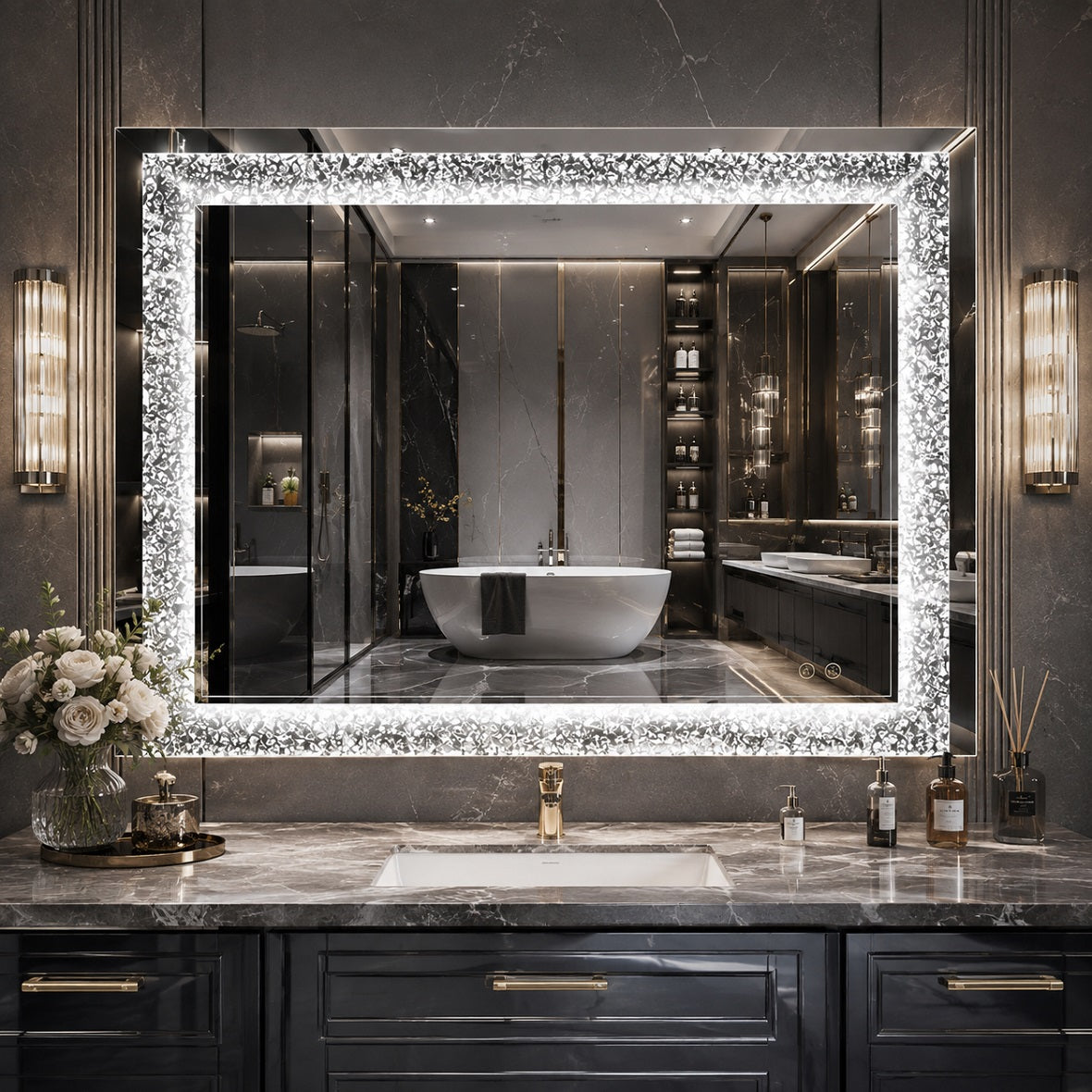
Most LED mirrors use relatively little electricity for lighting. The exact amount depends on the mirror’s rated wattage, how long it runs, and which powered features are active. A defogger, backlight, clock, speaker, or charging port can raise total consumption. To estimate your cost, multiply watts by operating hours, convert the result to kilowatt-hours (kWh), and apply the rate shown on your electric bill.
How Many Watts Does an LED Mirror Use?
There is no single wattage that applies to every LED mirror. A compact makeup mirror and a wide bathroom mirror do not necessarily have the same lighting system. Even two mirrors of similar size may use different LED strips, drivers, brightness levels, or defogger pads.
Watts describe the rate at which a device uses power while it is operating. They do not tell you how much energy the mirror has already consumed. That amount is measured in kilowatt-hours, or kWh—the unit that normally appears on a household electric bill.
For an accurate LED mirror wattage, check the product label, power adapter, installation manual, or technical specifications for the exact model. Look for terms such as “rated power,” “rated input,” or a number followed by W. If the documentation lists only the LED strip’s power, that figure may not include every electrical feature in the mirror.
Different components draw power at different times:
| Power component | When it may use electricity |
|---|---|
| Front LED lighting | While the main light is on |
| Backlighting | While the ambient light is active |
| Defogger pad | While the heated pad is running |
| Bluetooth speakers | During connection, playback, or standby |
| Clock or touch controls | They may require a small standby supply |
| Charging port | Mainly while a connected device is charging |
Mirror dimensions can offer a clue—a larger mirror may have a longer light strip—but size alone is not enough to calculate consumption. The rated input is the useful number.

How to Calculate LED Mirror Electricity Use
You need three pieces of information:
- The mirror’s wattage
- The number of hours it operates each day
- Your electricity price per kWh
Use these formulas:
kWh per day = (watts × hours used per day) ÷ 1,000
Daily cost = kWh per day × electricity rate
Monthly cost = daily cost × 30
Dividing watts by 1,000 converts watts to kilowatts. Multiplying kilowatts by operating time gives you kilowatt-hours.
Here is a sample calculation using a hypothetical 30-watt mirror, two hours of daily use, and an illustrative electricity rate of $0.17 per kWh:
30W × 2 hours ÷ 1,000 = 0.06 kWh per day
0.06 kWh × $0.17 = $0.0102 per day
$0.0102 × 30 = approximately $0.31 per month
That comes to about $3.72 per year if the usage stays the same. This is an illustration, not a universal LED mirror rating or a quote for a specific Hasipu model. Replace the wattage, hours, and electricity price with your own figures.
Estimated Cost at Different Daily Use Times
The table below keeps the same hypothetical 30W input and $0.17-per-kWh rate so you can see how operating time changes the result.
| Daily use | Monthly energy use | Estimated monthly cost | Estimated annual cost |
|---|---|---|---|
| 30 minutes | 0.45 kWh | $0.08 | $0.93 |
| 1 hour | 0.90 kWh | $0.15 | $1.86 |
| 2 hours | 1.80 kWh | $0.31 | $3.72 |
| 4 hours | 3.60 kWh | $0.61 | $7.45 |
| 8 hours | 7.20 kWh | $1.22 | $14.89 |
These are rounded estimates. Your LED mirror energy cost will change with the model’s total input, the features you use, and your utility rate. Time-of-use plans may also charge different prices depending on when the electricity is consumed.
What Affects an LED Mirror’s Power Consumption?
Mirror size and LED layout
A larger mirror may need a longer LED strip or more lighting sections. LED density, light output, and driver design matter too, so a larger surface does not automatically translate into a predictable wattage. Compare specification labels instead of judging by width or shape.
Brightness setting
Dimming can reduce the power drawn by the lighting on many designs. The relationship is not always one-to-one: setting a mirror to 50% brightness does not guarantee a 50% reduction in electricity use. The driver and dimming method affect the result.
Defogger use
A mirror defogger warms part of the glass to slow condensation after a shower. Because it produces heat, it adds an electrical load beyond the LEDs and can materially change LED bathroom mirror energy use while it is running. Turn the defogger off once the glass is clear or when the bathroom is no longer steamy. If a model includes timed shutoff, follow its manual rather than assuming every defogger switches itself off.

Front light and backlight
Some mirrors have a front task light, a rear ambient light, or both. Running both lighting zones may draw more power than using one zone alone, depending on how the circuits are designed. Separate controls make it easier to use only the lighting the room needs.
Bluetooth, clocks, and charging ports
Speakers, digital displays, touch sensors, memory controls, and charging ports can add operating or standby consumption. Their contribution may be modest, but it belongs in a precise whole-product calculation. A phone drawing power from the mirror’s USB port is also part of the load.
Hours of use
Operating time is often the easiest variable to control. A 30W device left on for eight hours uses four times the energy it would use in two hours. For a mirror shared by several people, estimate the combined daily time rather than one person’s routine.
Does an LED Mirror Use Electricity When Turned Off?
LED mirrors are generally energy-efficient because their built-in LEDs produce useful light with less power than traditional incandescent lighting. Actual bathroom mirror electricity usage still depends on the complete unit, including defoggers, clocks, Bluetooth speakers, touch controls, and other powered features.
When the light is off, a connected mirror may continue drawing a small amount of standby power for its controls, memory, clock, or wireless functions. A mirror that is unplugged or fully disconnected by an appropriate wall switch may use no measurable operating power.
Check the documentation for your exact model rather than relying on the word “LED” alone. A compatible electricity monitor can measure a plug-in mirror’s consumption, while testing a hardwired mirror should be left to a qualified electrician.
LED Mirror vs. Traditional Vanity Lighting
An LED mirror combines the reflective surface and lighting in one fixture. A traditional vanity setup uses a separate fixture above or beside the mirror. Either arrangement can be efficient; the result depends on the equipment installed.
| Feature | LED mirror | Traditional vanity fixture |
|---|---|---|
| Lighting position | Integrated around or behind the glass | Separate fixture above or beside the mirror |
| Energy use | Based on total mirror wattage and active features | Based on bulb count and wattage |
| Extra electrical loads | May include defogging, speakers, or charging | Usually limited to the light fixture |
| Replacement | Integrated components vary by model | Individual bulbs may be replaceable |
| Best comparison | Check rated input and daily operating time | Add the wattage of all installed bulbs |
To compare the two, add the wattage of every bulb in the traditional fixture. Then compare that total with the LED mirror’s whole-unit input under the functions you expect to use. Avoid comparing a mirror’s LED strip rating with a vanity fixture’s complete load; those figures do not describe the same thing.
How to Lower the Cost of Running an LED Mirror
Small habits are enough for most bathrooms:
- Turn the light on when you need task lighting instead of leaving it on as room decoration all day.
- Use a comfortable brightness setting that suits the available daylight and overhead lighting.
- Switch off the defogger when the glass is clear.
- Disconnect Bluetooth or charging devices when they are no longer in use.
- Compare the whole-unit rated input when shopping, especially if two mirrors have different feature packages.
- Follow the manual for touch controls, wall switches, and any automatic shutoff function.
There is usually no reason to operate a circuit breaker as an everyday energy-saving switch. Use the controls intended for normal operation, and ask an electrician about changes to a hardwired circuit.
How to Check the Electricity Use of Your Own Mirror
Start at the product label or manual. Record the rated watts and confirm whether the figure covers the complete mirror or only the lighting. Next, estimate the daily operating time for the light, defogger, and other powered functions. If separate wattages are provided, calculate each function on its own and add the kWh totals.
Use the actual per-kWh price from your latest utility bill. Be aware that a bill may include fixed service charges that do not rise or fall with one mirror’s use, so multiplying energy by the usage rate gives a better estimate of the mirror’s variable cost than dividing the entire bill by total kWh.
Owners of plug-in models can use a properly rated plug-in energy meter for a real-world reading. Measure several typical days rather than a single short session. Hardwired models should remain closed; have a qualified electrician perform any electrical testing.

Frequently Asked Questions
1. How many watts does an LED bathroom mirror use?
There is no universal wattage. Check the exact mirror’s label, adapter, manual, or technical page for its rated input. Make sure the number represents the complete unit rather than only the LED strip. Size, LED layout, brightness, defogging, and other features can change total power demand.
2. How much does it cost to run an LED mirror per month?
Multiply the mirror’s watts by daily hours, divide by 1,000, multiply by 30 days, and then multiply by your electricity price per kWh. For example, a hypothetical 30W mirror used two hours daily at $0.17 per kWh costs about $0.31 per month. Your result may differ.
3. Does an LED mirror use power when the light is off?
Some connected models may draw a small standby load for controls, memory, clocks, or wireless features even when the LEDs are off. A fully disconnected mirror may use no measurable operating power. Check the manual or use a compatible energy meter with a plug-in model.
4. Does a mirror defogger use more electricity than the LED lights?
It can. A defogger creates heat, so it adds a separate electrical load. Whether it draws more power than the lighting depends on the rated wattage of both systems and how long each one runs. Calculate them separately when the manufacturer provides separate figures.
5. Can I leave an LED mirror on all day?
Follow the operating instructions for your model. Leaving the light on increases electricity use and adds unnecessary operating hours when nobody needs it. The cost can still be calculated with the same wattage-times-hours formula, but switching the light off after use is the simpler habit.
6. Does dimming an LED mirror save electricity?
Dimming may lower the lighting’s instantaneous power draw, depending on the LED driver and control design. Do not assume that a 50% brightness setting always cuts consumption by exactly half. A power meter or model-specific technical data can show the actual change.