Table of Contents
The mirror above your bathroom sink makes a complicated task look effortless. You flip on the light, check your face, and move on. For much of human history, getting a useful reflection meant working with a carefully polished piece of stone or metal.
The history of mirrors reaches back roughly 8,000 years, with early manufactured examples found in what is now Turkey. The familiar silver-backed glass mirror came much later. Between those two points are objects small enough to hold in a hand, metal surfaces decorated with stories, and mirrored walls built to impress an entire royal court.
When Were Mirrors Invented?
Some of the earliest known manufactured mirrors date to around 6000 BCE. They were made from polished obsidian, a natural volcanic glass, in Anatolia, in present-day Turkey. No single person is known to have invented the mirror. In 1835, German chemist Justus von Liebig developed a chemical silvering method that became an important step toward modern glass mirrors.

A Brief Timeline of Mirror History
These are selected milestones, not a record of one invention passing neatly from country to country.
| Period | Region | Material or development | What it tells us |
|---|---|---|---|
| Around 6000 BCE | Anatolia | Polished obsidian | People deliberately made reflective objects. |
| Around 1550–1300 BCE | Egypt | Surviving bronze or copper-alloy mirror | Metal served as the reflecting surface. |
| Han dynasty, 206 BCE–220 CE | China | Cast bronze mirrors | Reflective fronts accompanied decorated backs. |
| Around the 3rd century CE | Roman world | Surviving glass mirror in a lead frame | Glass mirrors existed long before the Renaissance. |
| 16th–17th centuries | Venice and France | Improved glass mirrors; prestigious interiors | Mirror making became a competitive luxury trade. |
| 1835 and afterward | Germany and wider manufacturing | Chemical silvering and later refinements | A new coating process helped expand production. |
Sources: [1–7]. Ancient object dates establish surviving examples, not each culture’s first use.
Before Glass: The Earliest Known Mirrors
Still water can return a recognizable reflection without anyone making a thing. It is easy to imagine people noticing their faces in pools long before they made mirrors, but that is an inference, not a dated invention we can point to.
A manufactured mirror takes the idea further: someone chooses a material and deliberately prepares its surface.
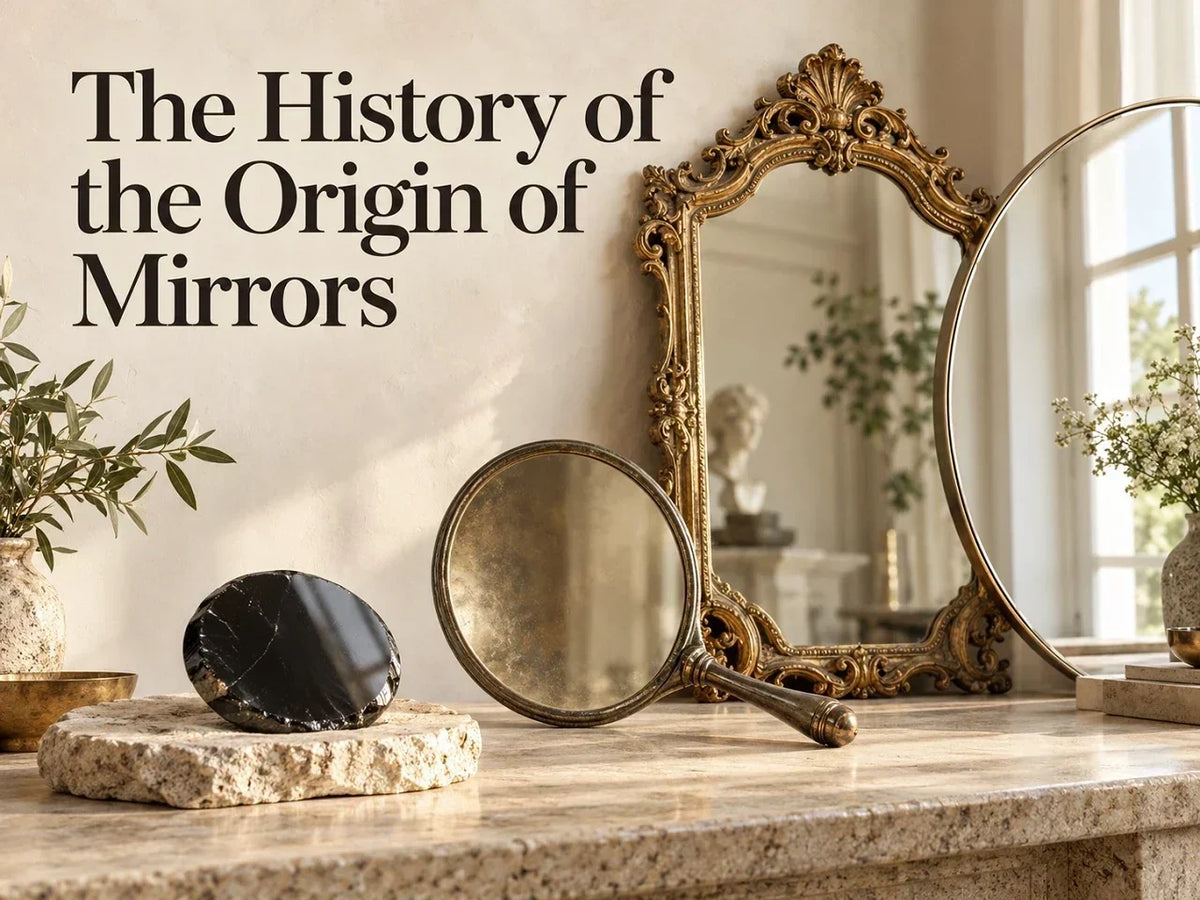
Among the earliest surviving examples are obsidian mirrors from Anatolia. The Çatalhöyük Research Project documents an excavated example, while a study of early mirrors describes specimens with slightly convex surfaces and surprisingly good optical quality. These were more capable objects than the phrase “polished rock” might suggest.
There is a small catch in the phrase “before glass.” Obsidian is itself natural glass, formed through volcanic activity. What these mirrors predate is the familiar construction of manufactured glass paired with a reflective metal backing.
For a reader looking at an ancient mirror today, that distinction matters. The dark material is the mirror itself. There is no transparent sheet over a hidden silver layer. A modern bathroom mirror and a polished obsidian mirror may both show a face, but their makers solved the problem with very different materials.
How Ancient Cultures Made Metal Mirrors
Metal offered another way to create a reflecting surface. Ancient craftspeople used materials including copper, bronze, and silver, polishing the face of the object so that it returned an image.
Egyptian mirrors combined practical use with symbolic design
An Egyptian mirror in the Metropolitan Museum of Art, dated around 1550–1300 BCE, is recorded as bronze or copper alloy. It is a specific surviving example of metal mirror making, not evidence that Egyptians first began making mirrors in that period.
Other Egyptian mirrors had handles shaped like papyrus stems or associated with Hathor, a goddess linked with beauty and rebirth. Their rounded metal faces could carry solar associations. The useful object and its symbolic design belonged together.
Chinese bronze mirrors had two distinct faces
Ancient bronze mirrors from China often paired a polished front with a patterned back and a central knob. Bowers Museum’s Han-dynasty examples help explain the process: craftspeople cast the metal, then polished the reflecting surface. Decoration could include geometric forms, animals, or figures.
Looking only at the decorated side can make the object seem more like a plaque than a mirror. Turn it over, and its purpose becomes easier to understand.
Mediterranean examples make the objects feel personal
An Etruscan bronze mirror from around 350 BCE depicts Thetis preparing for her bridal bath and adjusting her hair while looking into a mirror. The engraved scene connects the object with the act it helped someone perform.
A Roman silver mirror from the 1st century CE preserves something even more direct: its owner’s name, Iris, inscribed on the back. Its slightly curved front was polished to provide a reflection. A named possession is a useful reminder that these artifacts once belonged among someone’s everyday belongings.

How Glass Changed Mirror Making
Glass mirrors did not suddenly appear in Renaissance Venice. A surviving Roman example from around the 3rd century CE has glass and a lead frame. At about 3⅜ inches long, it is far closer in scale to a small personal accessory than a wall mirror.
That object answers one question while leaving another open. It establishes that glass mirrors existed in Roman times; it does not identify the first glass mirror ever made.
Later European production required improvements in both the glass and the reflecting layer. Venetian makers benefited from clear glass and, in the early 16th century, improvements to tin-mercury backing methods. An amalgam is a mixture of mercury with another metal; in these mirrors, that layer supplied the reflection.
Venetian mirrors became prestigious because of the skill involved in producing them. Clear glass, an even surface, and a successful backing had to work together. Knowing how to make one was valuable knowledge.
France’s ambitions are visible at Versailles. The Hall of Mirrors contains 357 mirrors arranged in 17 arches opposite the windows. The palace describes the display as evidence that French manufacture could compete with Venice. These were luxury objects used on an architectural scale.
The contrast with a handheld mirror is striking. Here, reflection did more than show a person’s face. It became part of the room’s design and a statement about the resources behind it.
The 1835 Breakthrough Behind Modern Mirrors
The name most often attached to the invention of modern mirrors is Justus von Liebig. His contribution was a method of depositing a thin layer of metallic silver onto glass through a chemical reaction in 1835. This process is called silvering.
The wording matters: Liebig developed a mirror-making process thousands of years after people had begun using mirrors. He did not invent reflection, polished metal mirrors, or the earliest glass examples.
In a typical silver-backed household mirror, light travels through the glass and reflects from the metal coating behind it. The glass gives the coating a smooth support while separating it from the surface you touch and clean.
A thin deposited coating also uses silver differently from a solid silver object such as Iris’s Roman mirror. The reflecting material no longer needs to form the body of the mirror.
The change was gradual. Tin-mercury mirrors and silvered mirrors continued to be made alongside each other; the older method did not disappear the year Liebig introduced his process.
How Mirrors Became Everyday Household Objects
There was no single year when ordinary households everywhere acquired glass mirrors. Availability depended on the place, the household’s resources, and the type and size of mirror.
The move toward wider access involved more than a new coating. Glassmaking, finishing, and manufacturing also developed. Larger cast plates and, later, machine grinding and polishing helped change what workshops could produce.
Mirrors already had several domestic jobs before they became broadly affordable. Historical interiors used them above fireplaces and as part of dressing furniture. They could reflect daylight or candlelight while also providing a place to check personal appearance.
Think about the different demands those jobs create. A dressing mirror needs a useful view from where someone sits or stands. A mirror over a mantel also needs to work with the room’s proportions. Once reflection becomes part of the architecture, the frame and placement matter alongside the image.
Museum histories connect silvering and manufacturing improvements with wider availability. That is a more useful explanation than imagining an abrupt switch from palace luxury to a mirror in every home.

Frequently Asked Questions
1. Who invented the mirror?
No single known inventor can be credited with all mirrors. Manufactured examples existed in prehistory, and different cultures made reflective objects from different materials. Justus von Liebig is associated with the 1835 chemical silvering process used in the development of modern glass mirrors.
2. What were mirrors made of before glass?
People used polished stone and metals such as copper, bronze, and silver. Obsidian needs a small qualification: although it is usually discussed with stone mirrors, it is natural volcanic glass. It differs from manufactured glass backed with metal.
3. Did ancient Egyptians use mirrors?
Yes. Surviving Egyptian mirrors include examples made from bronze or copper alloy. Some Egyptian mirror designs also incorporated religious imagery. The surviving objects document both the material used for reflection and the attention given to the handle and overall form.
4. Were mirrors always made of silver?
No. Early makers used several reflective materials. Even glass mirrors have used different metal coatings, including tin-mercury backing, silver, and aluminum. A mirror’s silvery appearance alone does not tell you which metal is present.
5. Why were mirrors once expensive?
Large, clear glass mirrors required skilled production and careful finishing. The size and quality of the glass, the reflective backing, and decorative work all affected the finished object. Versailles offers a vivid example of a period when extensive mirror displays expressed wealth and manufacturing power.
A mirror can be easy to overlook precisely because it works so well. Its history gives that ordinary object more texture: a polished surface, a cast metal disk, a carefully coated sheet of glass. The next time you pause at your dresser or bathroom sink, you are using the result of centuries of work on a very familiar need—seeing yourself clearly.
Sources and Further Reading
Historical dates, materials, and manufacturing details in this article were checked against the following research, museum collections, and institutional resources.
- Jay M. Enoch, Optometry and Vision Science: History of Mirrors Dating Back 8000 Years — Research on early manufactured mirrors and their optical characteristics.
- Çatalhöyük Research Project: Obsidian Mirror — Documentation of an obsidian mirror from the archaeological site.
- The Metropolitan Museum of Art: Egyptian Mirror, ca. 1550–1300 BCE — A surviving bronze or copper-alloy mirror.
- Bowers Museum: Reflections on Early Chinese Mirrors — Chinese bronze mirror production and decoration.
- The Metropolitan Museum of Art: Etruscan Bronze Mirror, ca. 350 BCE — A polished bronze mirror with an engraved mythological scene.
- The Metropolitan Museum of Art: Roman Silver Mirror, 1st Century CE — A silver mirror inscribed with the owner’s name, Iris.
- The Metropolitan Museum of Art: Roman Glass Mirror With Lead Frame — A glass mirror dated around the 3rd century CE.
- Williamstown Art Conservation Center: Historic Mercury Amalgam Mirrors: History, Safety and Preservation — Historical backing methods and changes in mirror production.
- Château de Versailles: The Hall of Mirrors — Official information about the gallery and its 357 mirrors.
- McGill University, Office for Science and Society: How Are Mirrors Made? — Liebig’s silvering process and reflective metal coatings.
- Pitt Rivers Museum, University of Oxford: Mirrors — Early mirror materials and Egyptian symbolic designs.
- Cooper Hewitt, Smithsonian Design Museum: Reflections on Light — Mirrors in historical interiors and their relationship with lighting.