Table of Contents
A bathroom mirror has a bigger visual job than its footprint suggests. It sits at eye level, catches the room’s light, and often becomes the first thing you see when you walk in. So the choice between a framed bathroom mirror and frameless bathroom mirror is not really a small finishing detail.
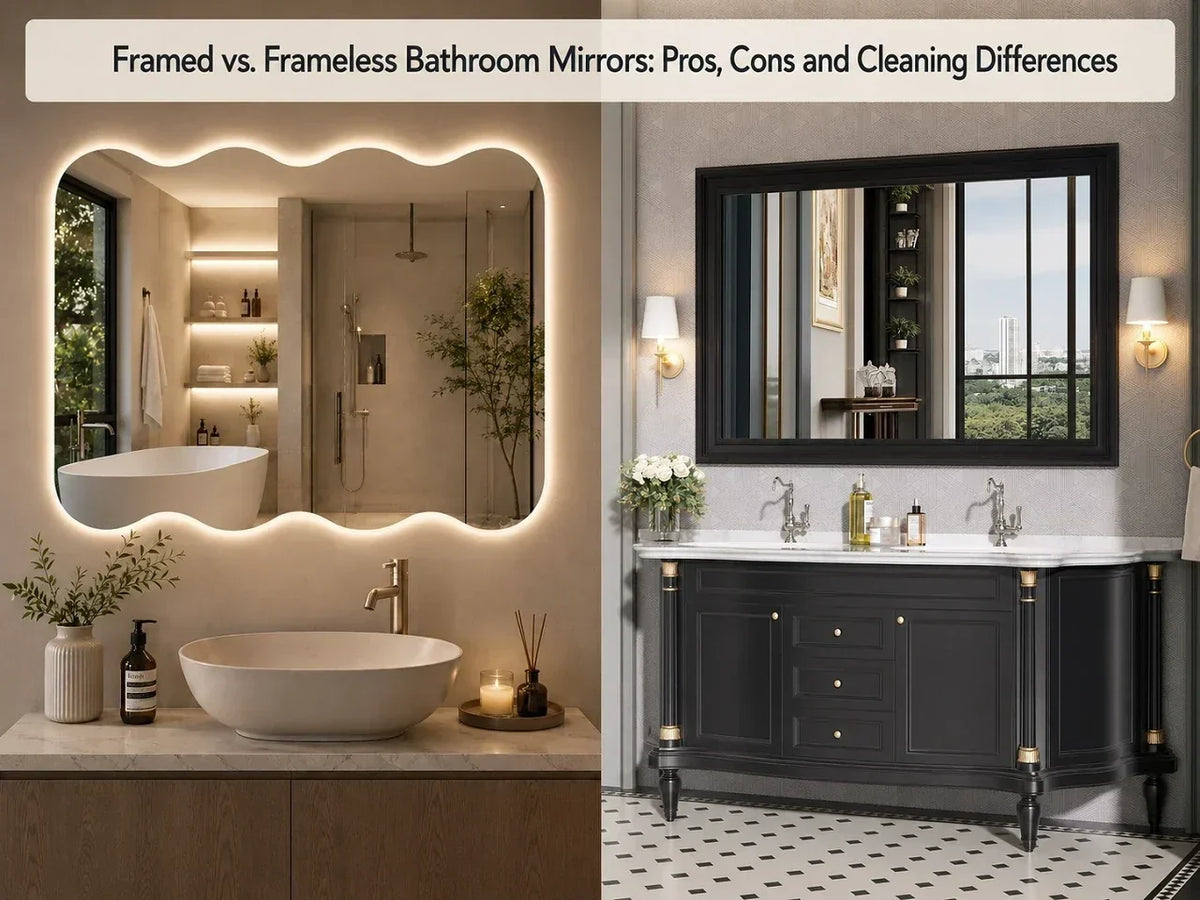
The short answer: choose a framed bathroom mirror when you want the mirror to add contrast, warmth, or a specific finish to the room. Choose a frameless bathroom mirror when the goal is a clean wall, more visual breathing room, or a mirror that quietly supports the rest of the design. Both can work beautifully in a bathroom; the better choice depends on the vanity, lighting, wall space, and how much detail you want to maintain.
At Hasipu, we suggest looking at the mirror after the vanity and lighting are decided. That makes the decision much easier, because the mirror then has a clear role to play.
Framed vs. Frameless Bathroom Mirrors at a Glance
| Feature | Framed Bathroom Mirror | Frameless Bathroom Mirror |
|---|---|---|
| Overall look | Decorative, defined, and more furniture-like | Clean, open, and understated |
| Works especially well with | Traditional, farmhouse, industrial, transitional, and layered spaces | Modern, minimalist, small, and spa-style bathrooms |
| Visual effect | Adds contrast and a focal point | Lets tile, sconces, and vanity take the lead |
| Cleaning | Glass plus frame edges and corners | Mostly one flat glass surface |
| Moisture concern | Depends on frame material and finish | Exposed mirror edges need good ventilation and careful cleaning |
| Sizing flexibility | Often sold in standard decorative sizes | Easy to make wide, tall, or wall-spanning |
| Lighting pairing | Great beside or between sconces | Great for integrated LED lighting or a broad reflection |
What Is a Framed Bathroom Mirror?
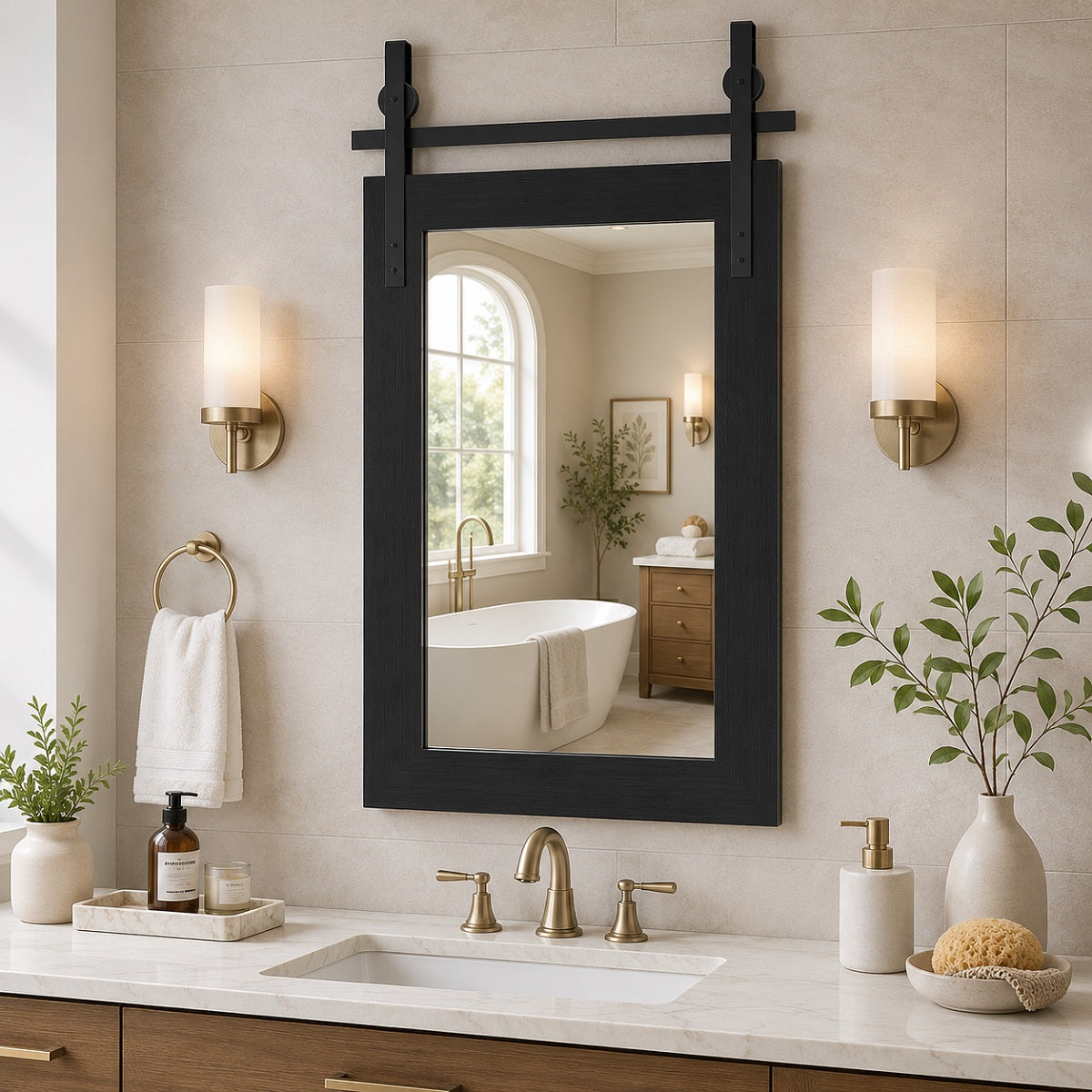
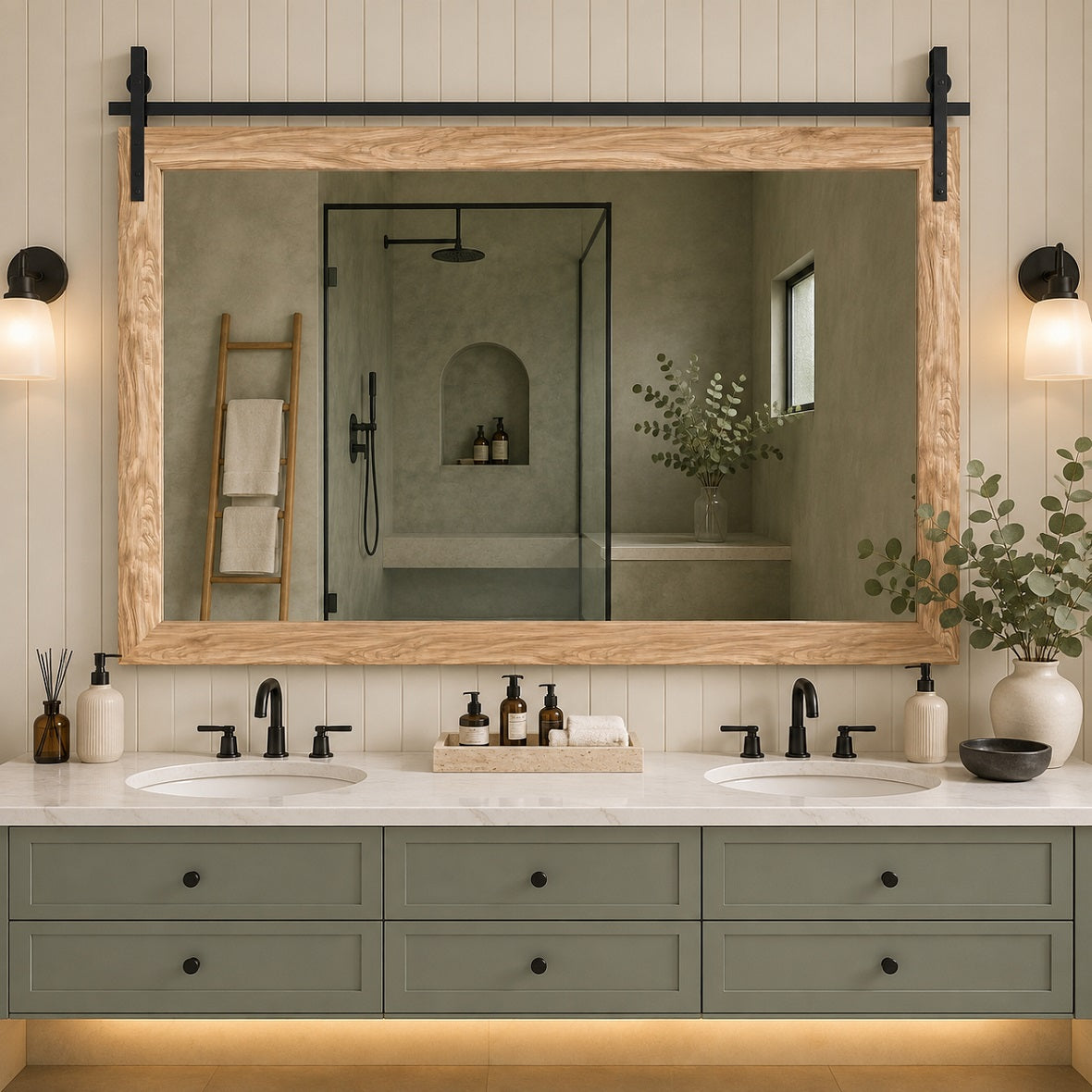
A framed bathroom mirror has a visible border around the glass. The frame may be metal, solid wood, engineered wood, resin, or another moisture-resistant material. It can be slim and quiet, like a narrow black edge, or it can be the most decorative item in the room.
That border gives the mirror a clear outline. In a bathroom with white walls, a walnut, brass, or matte-black frame can keep the vanity area from feeling flat. It is also an easy way to repeat a finish already used on cabinet pulls, faucets, or light fixtures.
Pros of framed bathroom mirrors
They bring personality to a plain bathroom. A frame adds color, texture, and a finished look without changing tile or cabinetry.
They create a strong visual anchor. This helps in a larger bathroom or above a substantial wood vanity, where a plain sheet mirror can feel a little lost.
They offer many style directions. Thin brass feels very different from rustic oak, and a clean black frame can suit a modern bath just as well as an industrial one.
They can hide the raw perimeter of the mirror. This is useful if the wall line is slightly imperfect or the existing mirror edge is not attractive.
They make double vanities easier to organize visually. Two matching framed mirrors can give each sink a defined zone.
Cons of framed bathroom mirrors
The frame takes up wall space. In a narrow bathroom, even a modest border can make the reflection feel a bit smaller.
Some materials do not love humidity. Unsealed wood, low-quality engineered wood, or a damaged finish can swell, peel, rust, or discolor over time.
They need more detailed cleaning. Dust settles on the top edge, while toothpaste mist and skin-care residue can collect where the frame meets the glass.
A bold frame can date a room faster. That does not make it a bad choice; it simply means the finish should be chosen with the rest of the bathroom in mind.

What Is a Frameless Bathroom Mirror?
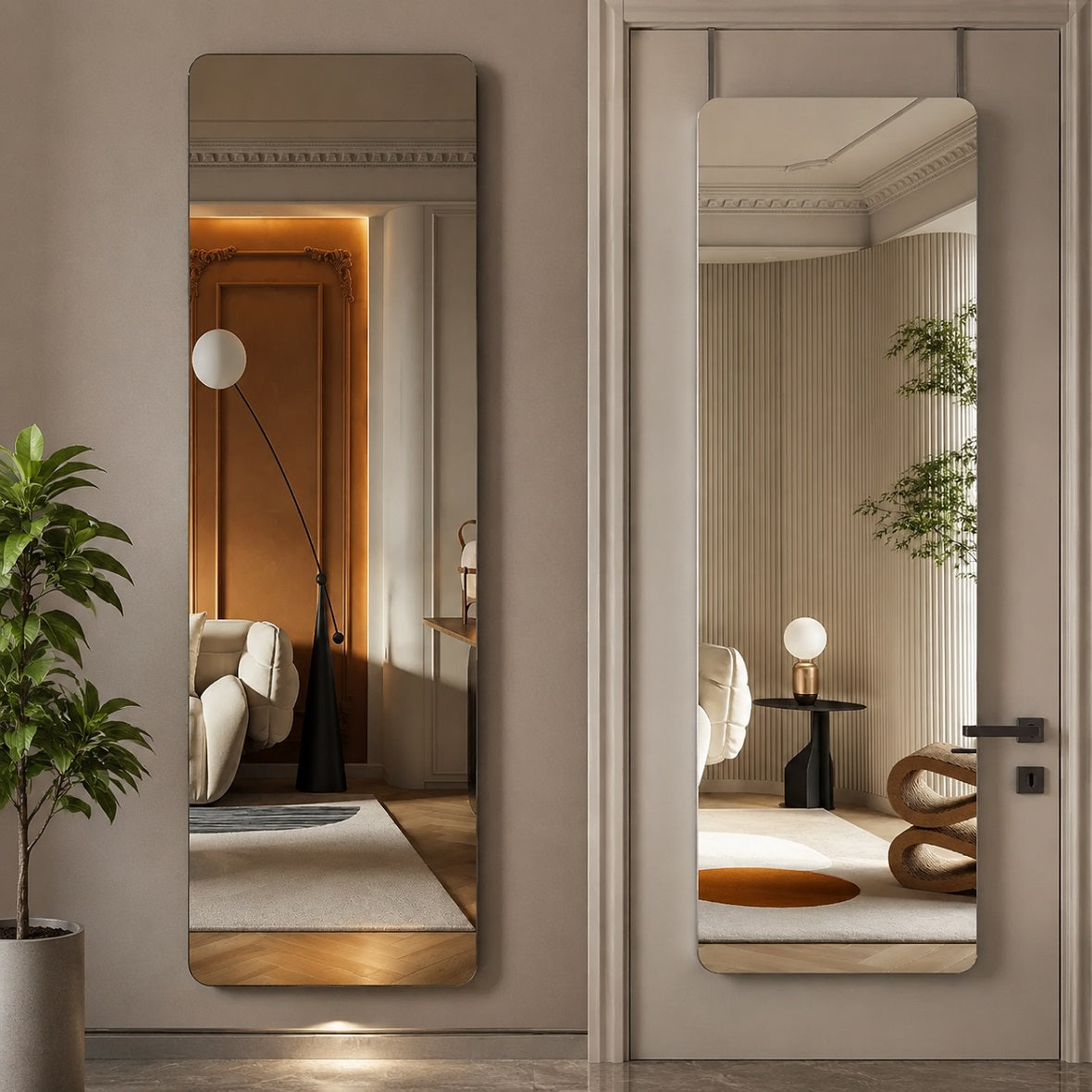
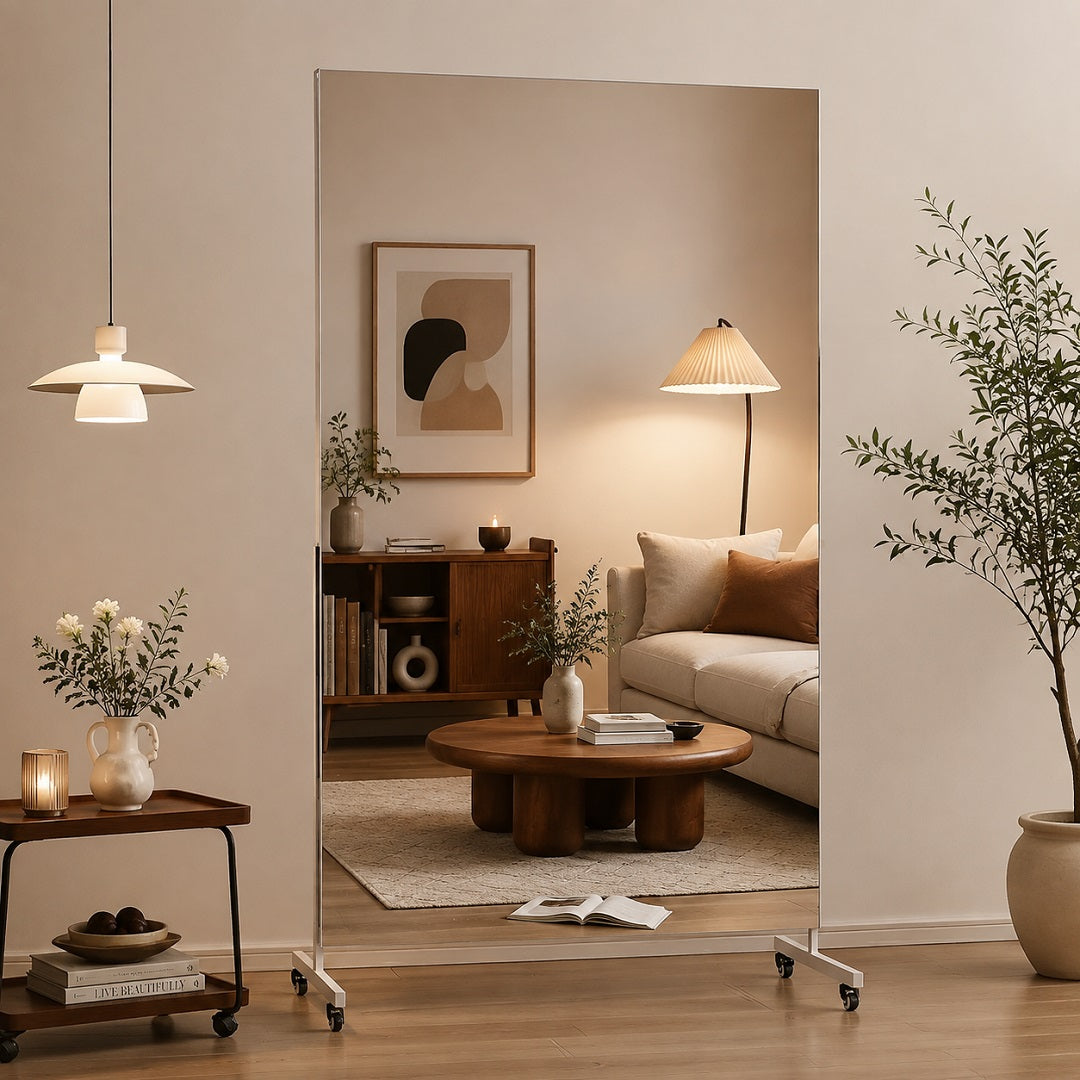
A frameless bathroom mirror has no attached decorative border. Its perimeter is usually polished for a smooth edge, or beveled so the glass tapers near the edge and catches light in a softer way. It can be a simple rectangle, an arch, an oval, or a large custom panel running across a double vanity.
Because there is no visual stop around the glass, a frameless vanity mirror tends to blend into the wall. That is why it is often used in clean-lined bathrooms, compact powder rooms, and spaces with beautiful tile that should remain visible.
Pros of frameless bathroom mirrors
They make a bathroom feel less busy. The reflection reads as one uninterrupted plane instead of another object layered on the wall.
They are especially helpful in small bathrooms. A larger reflective area can bounce available light around the room and make the wall feel less boxed in.
They are simple to wipe down. There are no carved details, seams, or frame corners to work around.
They work with many lighting plans. A broad frameless mirror suits side sconces, an over-mirror fixture, or an LED bathroom mirror with built-in front lighting or backlighting.
They are flexible for unusual walls. A custom piece can be cut around outlets, fit between tile returns, or span nearly the entire vanity width.
Cons of frameless bathroom mirrors
They may feel too plain in a character-rich room. If the vanity, tile, and fixtures are all minimal, the bathroom can end up looking a little unfinished.
The edges are visible. A frameless mirror needs careful installation and a quality mirror backing, especially in a steamy bathroom.
Fingerprints show quickly. This matters most on mirrors that are touched often, such as a medicine cabinet door or a mirror installed close to a door swing.
Installation needs precision. Large glass panels are heavy and should be mounted with hardware and adhesive made for mirrors, following the manufacturer’s guidance.

How to Choose Between a Framed and Frameless Bathroom Mirror
A framed mirror and a frameless mirror can both look right above the same vanity. The better choice depends less on what is “in style” and more on what the room needs. Look at the bathroom as a whole: its size, the amount of natural light, the vanity finish, wall tile, lighting plan, and how much cleaning you are willing to do.
1. Style and Visual Impact
A framed bathroom mirror reads more like décor. The border gives the mirror weight and makes it feel intentional, especially when the vanity wall needs a focal point. A black metal frame can echo matte-black faucets. A warm wood frame can soften white tile and cool stone. Brass or bronze works well when you want the mirror to connect with traditional or vintage-inspired hardware.
A frameless bathroom mirror puts less emphasis on itself. It blends into the wall and allows the vanity, tile, or lighting to stand out. This style is a natural fit for modern bathrooms, but it can also work in transitional spaces when the rest of the room already has enough texture and detail.
2. Bathroom Size and Sense of Space
In a compact bathroom, a frameless mirror often feels lighter. Without a border breaking up the reflection, it can make a narrow vanity wall feel wider and brighter. A wide frameless mirror is especially useful above a floating vanity or in a powder room where every inch of visual space matters.
A framed mirror can still work in a small bathroom, but the profile matters. Choose a slim frame and leave some wall space around it. A thick, dark, or ornate border may feel heavy when the vanity is already close to the walls.
For a large primary bathroom, either choice can work. Framed mirrors add definition and help separate two sink areas. One large frameless mirror can create a quieter, more continuous look across a double vanity.
3. Vanity, Tile, and Hardware Coordination
Framed mirrors are easier to use when you want the vanity area to feel coordinated. Match the frame loosely—not necessarily exactly—to the faucet, sconces, cabinet hardware, or vanity color. Repeating a finish once or twice is usually enough.
Frameless mirrors are more forgiving when finishes are mixed. If your bathroom has patterned tile, marble veining, a colorful backsplash, or statement sconces, a plain mirror gives those materials room to breathe. It avoids adding another competing finish to the wall.
4. Lighting and Daily Use
The mirror should support the way you use the bathroom every morning, not only how it looks in photos.
A framed mirror pairs well with sconces mounted on either side because the frame gives the lighting arrangement a structured look. It can also work with a light fixture above the mirror, provided the frame does not crowd the fixture.
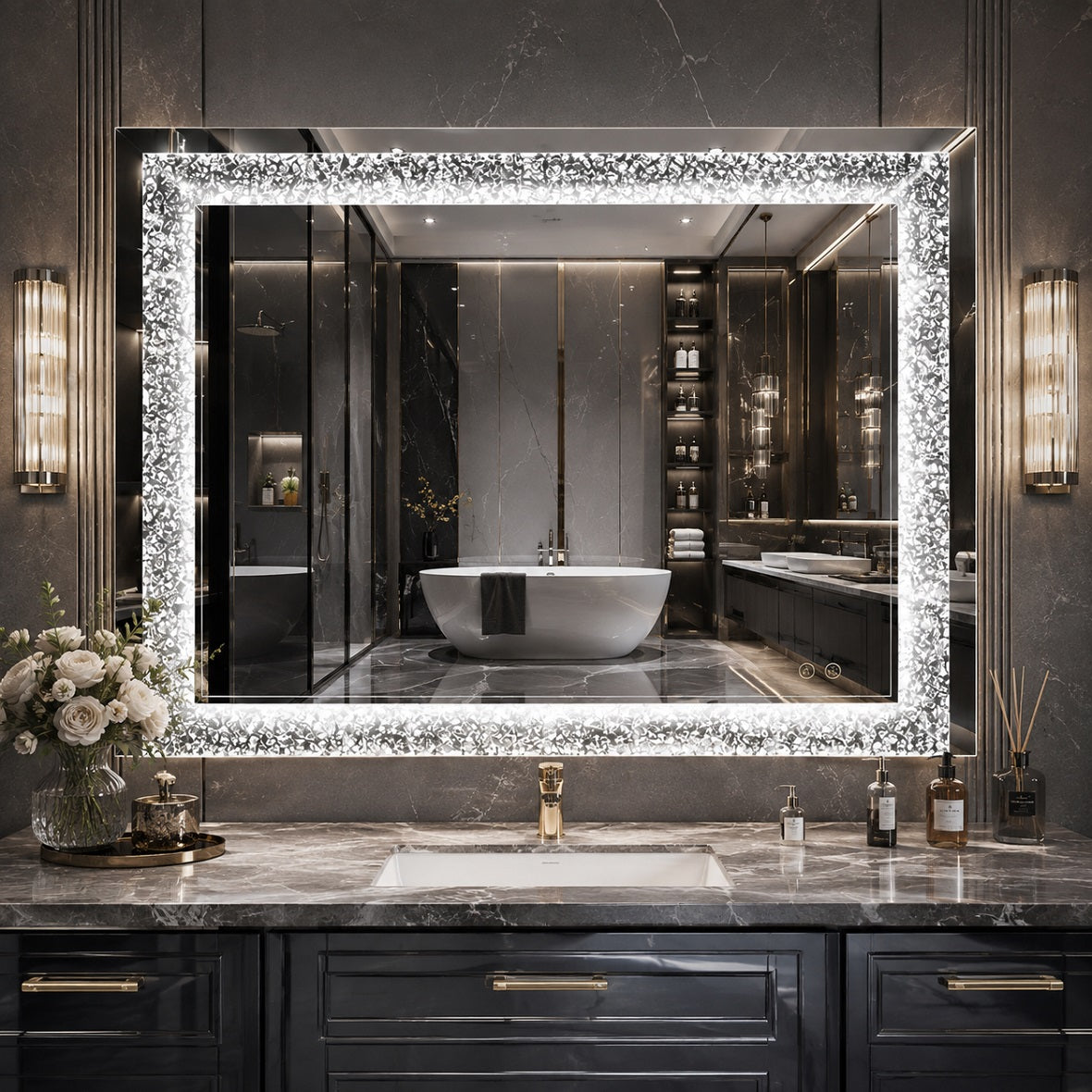
A frameless mirror works especially well with integrated lighting. A frameless LED bathroom mirror can provide a clean, seamless surface with front lighting, backlighting, or both. It is also a strong option when you want a broad, uninterrupted reflection for shaving, skincare, makeup, or getting ready.
5. Cleaning and Moisture Maintenance
A frameless mirror is usually quicker to clean. There is only one open glass surface, with no frame corners to dust or seams to wipe around. Spray cleaner onto a microfiber cloth rather than directly onto the mirror, then wipe from top to bottom. This helps prevent excess liquid from collecting at the lower edge.
A framed mirror needs a little more attention. Dust can settle on the top edge, and moisture may collect where the frame meets the glass. Metal frames should be dried after wiping. Wood frames should only be cleaned with a barely damp cloth, then dried immediately. Never let cleaner sit in the seam between the glass and frame.
Neither style is maintenance-free in a humid bathroom. Use the exhaust fan during showers, keep water from pooling along the mirror’s lower edge, and avoid abrasive pads or harsh cleaners.
6. Durability Over Time
The durability of a framed mirror depends heavily on its materials. Well-sealed wood, aluminum, stainless steel, and powder-coated metal are better choices for bathrooms than unfinished wood or frames with a weak painted finish. In a poorly ventilated bath, lower-quality frames may eventually peel, swell, rust, or discolor.
Frameless mirrors do not have a frame that can deteriorate, but their exposed edges need protection from repeated moisture. Quality mirror backing, proper installation, and good bathroom ventilation matter. If dark spots begin appearing near an edge, moisture may have reached the backing layer.
7. Installation and Sizing Flexibility
Framed mirrors are often sold in ready-made sizes, which makes selection straightforward. They are ideal when your wall and vanity fit a standard mirror size and you want a finished decorative piece.
Frameless mirrors offer more flexibility. They can be cut wide for a double vanity, tall for a low ceiling, or shaped around a specific wall condition. Custom sizes are helpful when working around sconces, outlets, tile edges, or an unusually placed backsplash.
Large mirrors of either type need a secure mounting method. Check the mirror’s weight, wall construction, and manufacturer instructions. For oversized mirrors, hardwired LED mirrors, or mirrors mounted close to a sink, professional installation is often the safest route.
8. Budget Considerations
A standard frameless mirror may cost less at the beginning because there is no decorative frame. Custom sizing, beveling, special shapes, and installation can change that quickly.
Framed mirror pricing varies widely. A simple manufactured frame can be affordable, while solid wood, premium metal, unusual finishes, and custom shapes add cost. Consider the complete setup: mirror, mounting hardware, lighting clearance, and installation.
Framed vs. Frameless Bathroom Mirrors: Cleaning Differences
Both styles need a clean microfiber cloth, a mirror-safe cleaner, and good bathroom ventilation. The difference is where moisture, dust, and residue tend to build up.
Cleaning a Framed Bathroom Mirror
A framed bathroom mirror needs attention around the glass as well as the frame. Dust often settles on the upper edge, while toothpaste splashes, skincare residue, and moisture can collect in the seam between the frame and mirror.
Spray cleaner onto a microfiber cloth rather than directly onto the glass. Wipe the mirror from top to bottom, then clean the frame according to its material. Metal or powder-coated frames can be wiped with a lightly damp cloth and dried right away. For wood frames, use only a barely damp cloth and follow with a dry one. Do not let water or cleaner sit in corners or joints, as repeated moisture can damage the finish over time.
Cleaning a Frameless Bathroom Mirror
A frameless bathroom mirror is usually quicker to clean because the glass is open from edge to edge. Use a clean microfiber cloth with a small amount of mirror-safe cleaner, then wipe in light, overlapping strokes from the top down.
Pay extra attention to the lower edge and corners near the backsplash. Since there is no frame protecting the perimeter, liquid should never pool along the edge or run behind the glass. Regular ventilation helps reduce condensation and protects the mirror backing from moisture-related dark spots.