

Table of Contents
A mirror frame may occupy only a narrow strip around the glass, but it can change how the entire room feels. Black creates a defined outline. Gold catches the light and brings warmth. Wood adds texture and makes a room feel more relaxed.
There is no single finish that works in every home. The right choice depends on the colors already in the room, the atmosphere you want to create, and where the mirror will hang.
This guide compares black vs. gold vs. wood-framed mirrors so you can choose a finish that looks intentional instead of simply matching the nearest faucet, cabinet pull, or piece of furniture.
Black vs. Gold vs. Wood-Framed Mirrors at a Glance
| Frame finish | Overall effect | Works especially well with | Possible drawback |
|---|---|---|---|
| Black | Graphic, grounded, streamlined | White walls, light wood, concrete, black fixtures | A wide frame can look heavy in a small or dark room |
| Gold | Warm, polished, decorative | Navy, green, cream, marble, warm white | Nearby gold finishes may clash when their tones are noticeably different |
| Wood | Natural, soft, textural | Neutral palettes, stone, linen, plants, wood furniture | Unsealed wood may react poorly to bathroom humidity |
These are starting points, not strict decorating rules. Shape, frame width, surface texture, and mirror size can make two mirrors in the same color look completely different.

What a Black Framed Mirror Brings to a Room
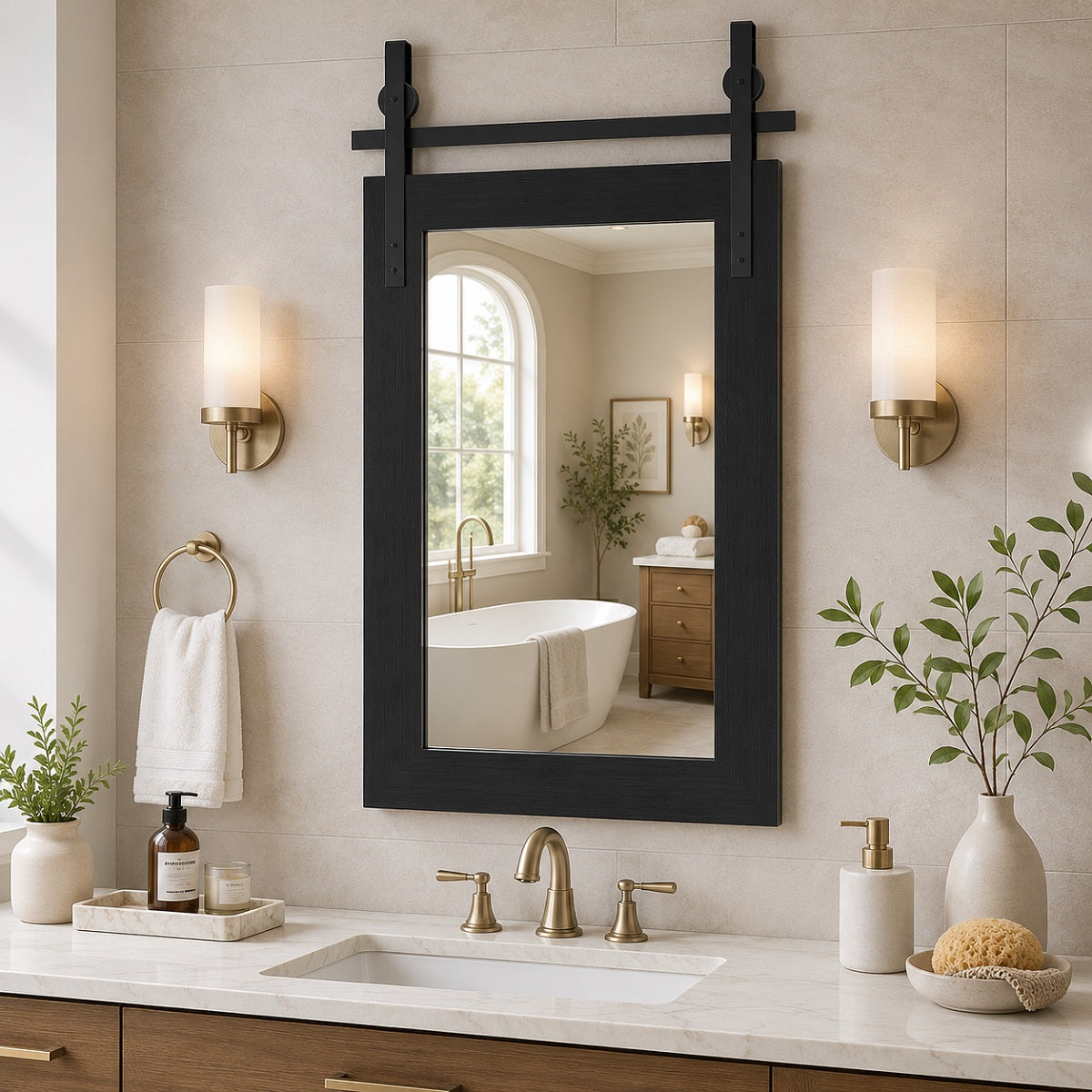
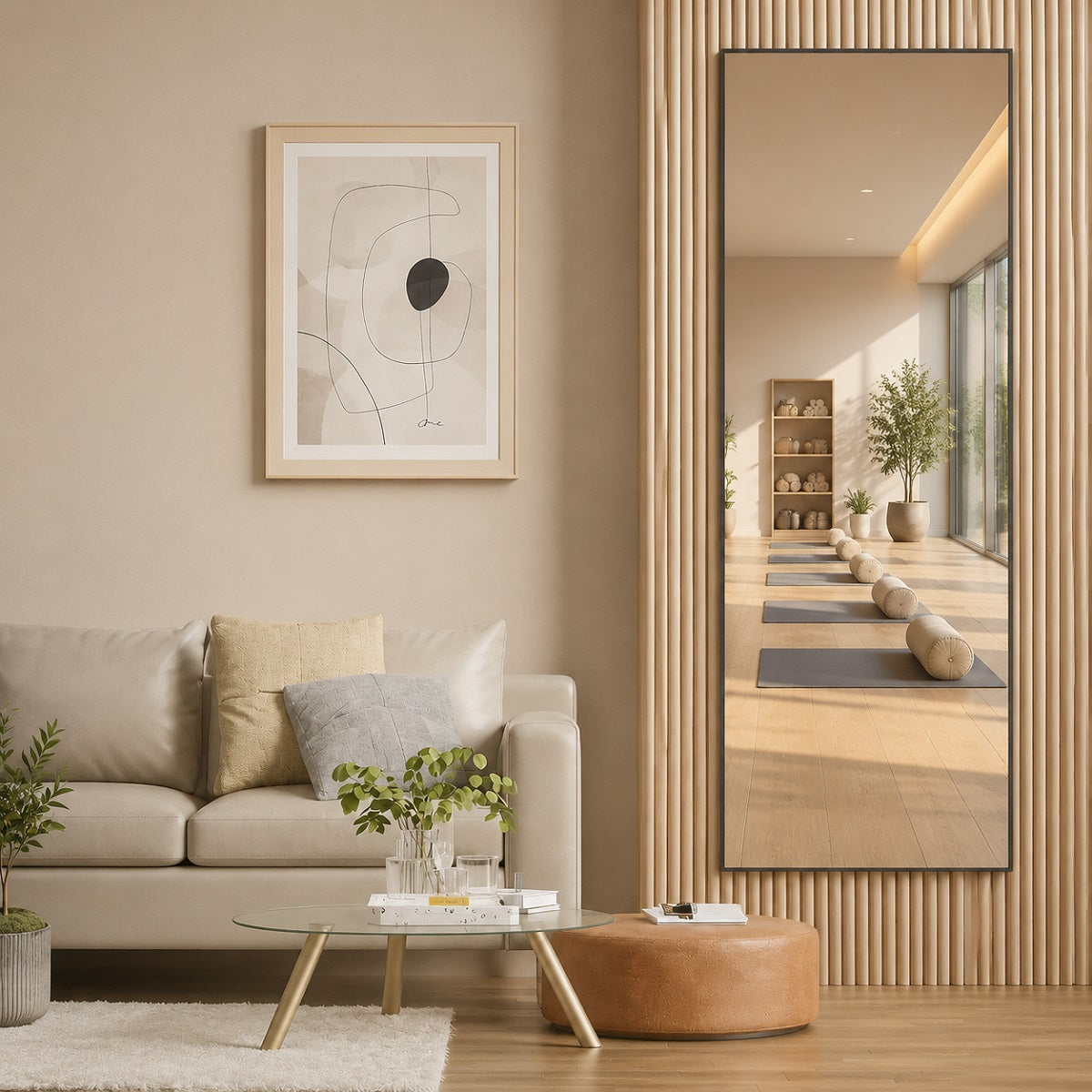
A black framed mirror creates the clearest visual boundary of the three finishes. Against a pale wall, it acts almost like a line drawing, making the mirror’s shape easy to see from across the room.
That definition suits contemporary bathrooms, industrial spaces, modern farmhouses, and minimalist bedrooms. A slim black metal frame keeps the look restrained, while a thick black wood frame feels bolder and more like a piece of furniture.
Black also helps connect dark details placed around the room. It can echo:
- Black faucets or shower trim
- Window frames
- Cabinet pulls
- Lamp bases
- Chair legs
- Dark grout or tile patterns
The finish does not have to match every black object exactly. Matte black, charcoal, and blackened bronze can sit comfortably together when their undertones and levels of sheen are reasonably close.
Where Black Works Best
Black is especially effective in white, beige, light gray, and pale wood rooms. The contrast prevents the mirror from disappearing into the wall.
It can also work in a dark room, but frame width becomes more noticeable. A narrow profile gives the mirror definition without adding too much visual weight. A thick frame on a charcoal or navy wall creates a moodier, more enclosed effect.
For an entryway, a black arched mirror can introduce architectural structure above a simple console. In a bathroom, a rectangular black mirror often looks clean above a floating vanity. A black full-length mirror is easy to place in a bedroom because it coordinates with many furniture colors and styles.
When Black May Not Be the Best Fit
Black can feel sharp in a room designed around pale pastels, delicate fabrics, and softly finished traditional furniture. It may also dominate a small powder room when the frame is wide and the space receives little natural light.
The answer is not always to avoid black. A thinner frame, rounded corners, or an oval shape can soften the contrast without losing the clean outline.
What a Gold Framed Mirror Adds
A gold framed mirror brings warmth to the wall and naturally draws attention. It can feel glamorous, vintage, traditional, or quietly modern depending on the shade, texture, and shape of the frame.
Polished gold has a brighter and more formal appearance. Brushed gold is softer and easier to place in everyday interiors. Antique brass and aged gold have darker variations that suit vintage, eclectic, and traditional rooms.
Gold looks particularly good with:
- Deep navy or forest green
- Warm white and cream
- Blush, terracotta, and burgundy
- Walnut and other dark woods
- White or gray marble
- Velvet and richly textured fabrics
Gold appears most balanced when it is repeated in a few deliberate places rather than used on every fixture and surface. Hasipu recommends pairing a gold mirror with one or two supporting details, such as cabinet pulls, lighting, or a decorative accessory. This gives the room a polished look without making the finish feel overdone.
Where Gold Works Best
Gold is a natural fit for powder rooms, formal entryways, dining rooms, and bedrooms. These areas allow the mirror to act as decoration as well as a reflective surface.
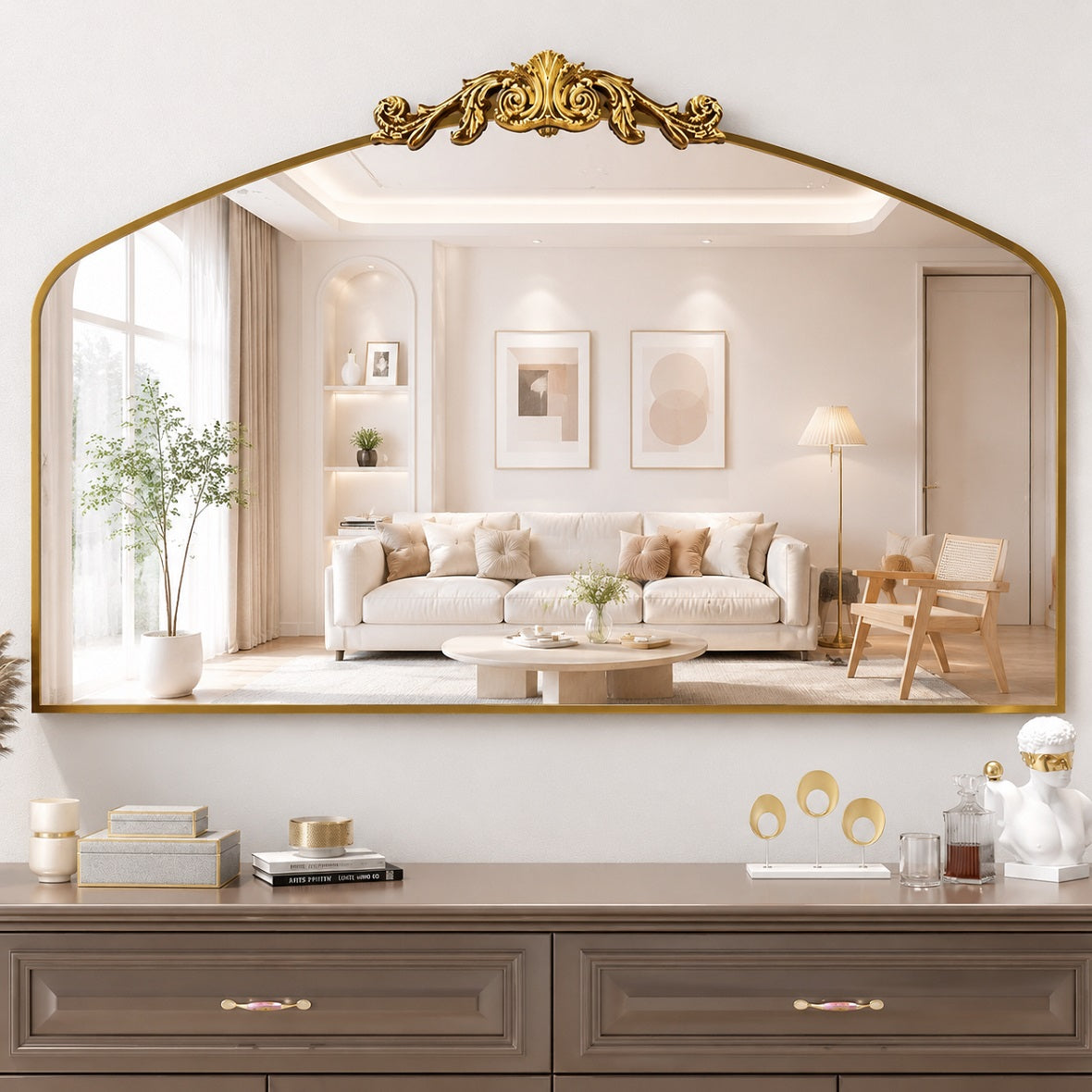
A slim brushed-gold rectangle can look restrained in a modern bathroom. An ornate gilded mirror makes a stronger statement above a fireplace or console. Round and oval gold mirrors soften vanities with square cabinet doors and straight countertops.
Gold can also warm up a cool color palette. A gray bathroom with white tile may feel flat when every fixture is chrome. A muted gold or brass-toned mirror introduces warmth without requiring new tile, paint, or cabinetry.
Does a Gold Mirror Have to Match the Faucet?
No. Exact matching is not required, and it is often difficult because manufacturers use different versions of brushed gold, champagne bronze, polished brass, and antique gold.
A gold mirror can sit comfortably near black, chrome, or nickel fixtures. The combination works best when each finish appears elsewhere in the room. A black faucet, for example, can connect with a black shower frame, while a gold mirror relates to the vanity light or cabinet pulls.
Black frames also work well with aged-brass lighting and hardware because black creates a clean visual break between nearby metallic finishes. Hasipu recommends repeating each finish at least once so the combination looks planned rather than accidental.
When several gold finishes will sit close together, compare samples in the room before ordering. A bright yellow gold beside a muted champagne finish may look mismatched, especially when the two surfaces are only a few inches apart.

What a Wood Framed Mirror Brings to a Space
A wood framed mirror adds something a smooth metal frame cannot fully reproduce: visible grain, tonal variation, and natural texture.
Wood works well in rooms with tile, painted walls, glass, and metal because it breaks up those hard, smooth surfaces. Even a slim oak frame can make a white bathroom feel warmer. Dark walnut gives a mirror more presence, while pale ash, oak, or maple supports Scandinavian and Japandi interiors.
Wood frames suit:
- Organic modern homes
- Farmhouse and rustic rooms
- Coastal interiors
- Mid-century spaces
- Japandi and Scandinavian designs
- Warm contemporary bathrooms
A natural wood mirror does not need to match the vanity or furniture perfectly. A slight contrast often looks more convincing. A pale oak mirror can lighten a dark walnut vanity, while a medium wood tone can keep white cabinetry from feeling sterile.
Light Wood vs. Dark Wood
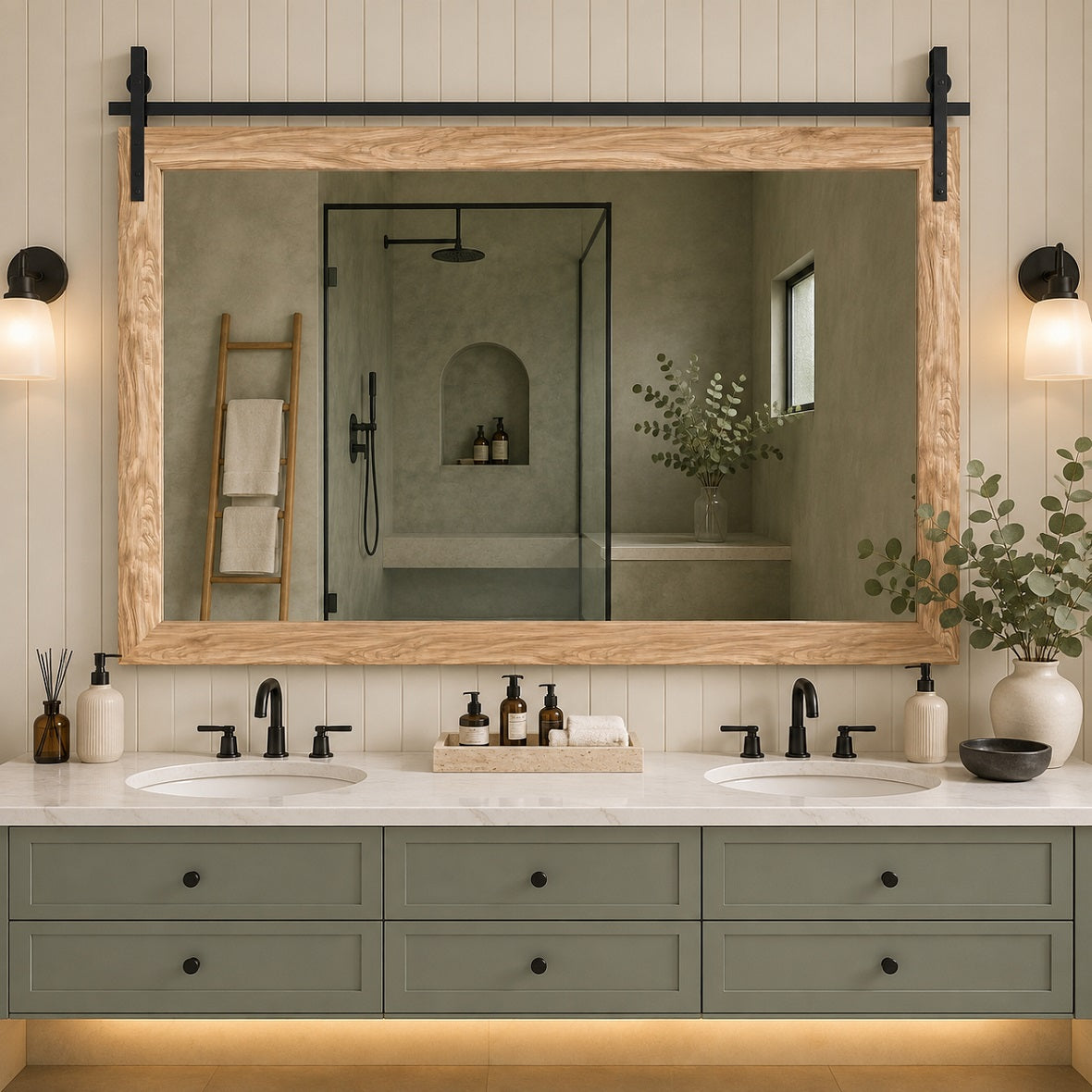
Light wood feels airy and casual. It pairs easily with off-white walls, limestone, woven baskets, greenery, and soft neutral textiles. A simple light-wood mirror is especially useful in a small bathroom where a thick dark frame might feel too prominent.
Dark wood feels richer and more grounded. Walnut and espresso finishes work well with cream, green, navy, brass, and natural stone. They can also give a large mirror enough visual presence for an open wall.
Reclaimed or distressed wood carries stronger rustic character. Its knots, markings, and uneven colors attract attention, so it usually looks best when the surrounding surfaces are quieter.
Can You Use a Wood-Framed Mirror in a Bathroom?
Yes, but the frame should be suitable for humid conditions. Solid wood can expand, contract, warp, or develop finish damage when moisture repeatedly reaches unsealed areas.
Before choosing a wood bathroom mirror, look for:
- Sealed edges and joints
- A moisture-resistant protective finish
- Hardware rated for the mirror’s weight
- A protected mirror backing
- Care instructions that allow bathroom installation
Ventilation also matters. Running the exhaust fan during and after a shower helps reduce moisture around the frame, mirror edges, and reflective backing. Hasipu also recommends wiping away standing water and avoiding direct spraying around the frame.
Do not assume that every wood-look frame is solid wood. Some frames use MDF, engineered wood, resin, plastic, or metal with a printed wood-grain finish. Read the material description instead of judging from product photos alone.
Which Mirror Frame Works with Your Interior Style?
Modern and Minimalist
Black is the most direct fit, particularly in a slim profile. It reinforces clean geometry without adding ornament.
Light wood is a softer alternative for warm minimalism. Gold can work too, though a brushed finish and simple frame shape will look more natural than a wide, ornate border.
Traditional
Gold and dark wood both suit traditional interiors. Gold adds formality, while wood connects with cabinetry, molding, and antique furniture.
Frame detail matters here. Beveled edges, carved profiles, and rounded shapes feel more traditional than a flat, narrow strip.
Modern Farmhouse
Black creates contrast against white walls, shiplap, and pale cabinetry. Wood brings a more relaxed and lived-in quality.
Avoid using distressed finishes on every surface. A clean-lined wood frame can preserve the warmth of farmhouse style without making the room feel overly rustic.
Organic Modern or Japandi
Natural wood is usually the strongest choice. Pale oak, ash, and walnut complement stone, linen, plaster, greenery, and muted colors.
For organic modern or Japandi interiors, Hasipu recommends a slim natural-wood frame that shows the grain without overpowering the wall. An oversized mirror with a restrained wood border adds warmth while preserving the quiet character of the room.
An irregular, arched, or softly rounded mirror can reinforce the organic look.
Art Deco and Glam
Gold has the clearest connection to these styles. Look for arches, scalloped corners, fluted details, geometric outlines, or aged metallic finishes.
Black and gold can also be used together. Black provides definition, while gold keeps the mirror from feeling severe.
Industrial
A black metal frame is the straightforward choice. It pairs naturally with concrete, exposed brick, black steel, leather, and weathered wood.
A dark wood frame can also work in an industrial room when the space needs less contrast and more warmth.
How to Choose Based on the Room
Bathroom
Start with humidity resistance and size, then consider color.
Black is practical for a clean modern look. Gold warms white or gray tile. Sealed wood softens hard bathroom surfaces and pairs naturally with a wood vanity.
For a balanced vanity arrangement, Hasipu recommends choosing a bathroom mirror that is the same width as the vanity or slightly narrower. Measure the available space between the faucet, countertop, lighting, backsplash, and nearby walls before selecting a size.
The mirror should provide a useful reflection area while leaving enough open space around the frame. It should not look squeezed between the lighting and faucet or extend awkwardly beyond the vanity.
Entryway
The entryway can support a more decorative frame because the mirror helps establish the character of the home.
Use black for structure, gold for a focal point, or wood for a welcoming natural feel. Scale the entryway mirror to the console instead of choosing a small piece that leaves the wall looking unfinished.
A wider console usually needs a larger mirror or a carefully arranged group of decorative pieces around it. A mirror that is too small may look disconnected from the furniture below.
Bedroom
Wood and gold tend to feel warmer and softer around upholstered furniture, curtains, rugs, and bedding. Black works well in modern bedrooms or as the frame for a full-length dressing mirror.
Check what the mirror will reflect before hanging it. A view of a window, artwork, or a tidy section of the room adds more visual value than a reflection of an open closet or cluttered surface.
For a leaning mirror, make sure it has appropriate anti-tip hardware. A floor mirror should be secured even when it appears stable against the wall.
Living Room
Treat the living room mirror like a piece of wall art. Gold can brighten a fireplace wall, black can sharpen a gallery arrangement, and wood can balance upholstered furniture and natural textiles.
A large mirror often has more impact than several undersized pieces, but its weight must be considered. Use mounting hardware suited to both the mirror and the wall construction.
Dining Room
Gold works well in a dining room because it reflects warm lighting and gives the wall a more decorative appearance. Dark wood can connect with the dining table or sideboard. Black creates a cleaner look in contemporary spaces.
Position the mirror where it can reflect a light fixture, artwork, or part of the table setting rather than an empty wall.
Should the Mirror Match the Furniture?
Matching is one route, but it is not the only route.
A wood mirror above a wood vanity can look cohesive when the tones are close. When the two finishes are almost identical but have different undertones, the mismatch may become more noticeable. Creating deliberate contrast is often easier.
Try these combinations:
- Black mirror with a light oak vanity
- Brushed-gold mirror with a navy cabinet
- Pale wood mirror with a white vanity
- Walnut mirror with a cream console
- Black mirror with brass lighting
- Gold mirror above a dark wood table
- Light wood mirror against a soft green wall
Instead of matching one object, look at the entire room palette. Repeating the frame color once or twice through lighting, hardware, furniture legs, picture frames, or small accessories usually provides enough connection.
Do Not Ignore Frame Width and Mirror Shape
Color receives most of the attention, but mirror frame width can have just as much influence on the finished look.
A thin black frame feels modern. A thick black frame feels bold and architectural. A delicate gold border looks polished, while a carved gold frame becomes the center of the room. A wide wood frame displays more grain and reads more like furniture.
Shape changes the result again:
- Rectangular mirrors provide a generous reflection area and work well above vanities.
- Round mirrors soften straight cabinetry, tile lines, and narrow walls.
- Arched mirrors add height and architectural interest.
- Oval mirrors feel visually lighter and slightly more traditional.
- Organic shapes create movement and work well as decorative accents.
- Square mirrors bring balance to compact vanities and symmetrical wall arrangements.
Choose the mirror size and shape before making the final decision on finish. A beautifully colored frame cannot correct a mirror that is too small for the wall or awkwardly proportioned above the furniture.
Which Frame Is Easiest to Maintain?
Maintenance depends on the actual frame material and surface coating, not color alone.
A painted or powder-coated metal frame can usually be cleaned with a soft dry or lightly damp cloth. Abrasive pads may scratch the surface or leave dull marks.
Gold-colored frames may show fingerprints more clearly when the finish is polished. Use gentle pressure and follow the product’s cleaning instructions. Some gold frames are made from metal, while others use painted wood, resin, or plastic.
Dust wood frames with a soft cloth. Do not leave water sitting along the lower edge, particularly in a bathroom. Strong cleaners can damage the protective coating or change the wood’s sheen.
Apply mirror cleaner to the cloth instead of spraying it directly onto the glass. This gives you better control and reduces the chance of liquid running behind the frame or collecting along the mirror edge.
Mirror Frame Mistakes to Avoid
Matching Every Finish in the Room
A bathroom does not need a black faucet, black mirror, black lighting, and black cabinet hardware to look coordinated. Too much matching can make the room feel flat.
Mixing two finishes often creates more depth. Black and gold are easy to combine, while natural wood can act as a neutral bridge between warm and cool materials.
Choosing the Frame Before Measuring
A finish may look perfect online but still be wrong for the wall. Measure the complete outside dimensions, not only the reflective glass.
Check the distance between the vanity and lighting, along with any nearby switches, outlets, shelves, or wall trim.
Ignoring the Frame’s Actual Material
“Gold,” “black,” and “wood” often describe appearance rather than construction. A gold frame may be aluminum, steel, resin, or painted wood. A black frame could be metal or wood. A wood-look frame may contain no natural wood.
The material affects weight, durability, moisture resistance, and cleaning requirements.
Using Too Small a Mirror
A small mirror above a wide vanity or console can look unfinished and provide limited reflection space. A larger mirror usually feels more intentional and can reflect more light into the room.
Leave enough breathing room around the frame, but do not shrink the mirror simply to create empty wall space.
Forgetting About the Reflection
A mirror doubles whatever appears in front of it. Before installation, stand in the intended location and check the view. Moving the mirror a few inches may allow it to reflect a window or artwork instead of a doorway, ceiling corner, or cluttered shelf.

Final Thoughts
Choose a black mirror when the room needs contrast or a stronger outline. It is versatile, easy to repeat, and comfortable in both warm and cool color palettes.
Choose a gold mirror when you want the mirror to catch the eye and add warmth. Its shape and sheen determine whether it feels contemporary, vintage, understated, or formal.
Choose a wood mirror when the room needs texture and a natural counterpoint to hard surfaces. Pay close attention to sealing and moisture resistance when the mirror will be used in a bathroom.
The best frame is not necessarily the one that matches the faucet or dresser most closely. It is the one that gives the room what it is missing. A pale space may need black definition. A cool room may benefit from gold. A bathroom filled with tile and metal may feel warmer with wood.
When comparing framed mirrors from Hasipu, check the frame material, overall dimensions, finish, hanging method, and recommended placement. These practical details matter just as much as the frame color and will affect how well the mirror works in your home.
Frequently Asked Questions
1. What color mirror frame is the most versatile?
Black is generally the easiest finish to place because it works with many wall colors, wood tones, and metal finishes. A slim black frame is especially adaptable. Natural wood is equally flexible in warm and neutral rooms.
2. Are gold-framed mirrors outdated?
No. The appearance depends on the gold tone and frame design. Slim brushed-gold frames feel clean and current, while ornate antique-gold mirrors carry a more traditional or vintage character.
3. Can I mix a black mirror with gold bathroom fixtures?
Yes. Black provides a neutral visual break and can keep a bathroom with gold fixtures from feeling overly coordinated. Repeat black elsewhere through a shower frame, cabinet hardware, lighting detail, or accessory so the mirror feels connected to the room.
4. Does a wood mirror have to match a wood vanity?
No. Related undertones matter more than an exact match. Warm woods tend to work well together, while a clear light-and-dark contrast can look intentional. Two nearly identical stains with noticeably different undertones may be harder to combine.
5. Which frame makes a small room look bigger?
The glass size, placement, lighting, and reflected view have more influence than the frame color. A large mirror with a narrow frame preserves more reflective area. Light wood and slim gold can feel visually lighter, while a narrow black frame provides definition without taking up much space.
6. Which mirror frame is best for a bathroom?
A moisture-resistant frame is the safest choice. Properly finished metal works well, and sealed wood can also be suitable. Check the product’s bathroom-use guidance rather than judging durability by frame color alone.